Israel’s war crimes

Calls for investigation into Gaza attacks

Israel blamed its earlier wars on the threat to its security, even that against Lebanon in 1982. However, its assault on Gaza was not justified and there are international calls for an investigation. But is there the political will to make Israel account for its war crimes?

by Richard Falk

For the first time since the establishment of Israel in 1948 the government is facing serious allegations of war crimes from respected public figures throughout the world. Even the secretary general of the United Nations, Ban Ki-moon, normally so cautious about offending sovereign states – especially those aligned with its most influential member, the United States – has joined the call for an investigation and potential accountability. To grasp the significance of these developments it is necessary to explain what made the 22 days of attacks in Gaza stand shockingly apart from the many prior recourses to force by Israel to uphold its security and strategic interests.
In my view, what made the Gaza attacks launched on 27 December different from the main wars fought by Israel over the years was that the weapons and tactics used devastated an essentially defenceless civilian population. The one-sidedness of the encounter was so stark, as signalled by the relative casualties on both sides (more than 100 to 1; 1300-plus Palestinians killed compared with 13 Israelis, and several of these by friendly fire), that most commentators refrained from attaching the label “war”.

The Israelis and their friends talk of “retaliation” and “the right of Israel to defend itself”. Critics described the attacks as a “massacre” or relied on the language of war crimes and crimes against humanity. In the past Israeli uses of force were often widely condemned, especially by Arab governments, including charges that the UN Charter was being violated, but there was an implicit acknowledgement that Israel was using force in a war mode. War crimes charges (to the extent they were made) came only from radical governments and the extreme left.

The early Israeli wars were fought against Arab neighbours which were quite literally challenging Israel’s right to exist as a sovereign state. The outbreaks of force were of an inter-governmental nature; and even when Israel exhibited its military superiority in the June 1967 six day war, it was treated within the framework of normal world politics, and though it may have been unlawful, it was not criminal.
But from the 1982 Lebanon war this started to change. The main target then was the presence of the Palestine Liberation Organisation (PLO) in southern Lebanon. But the war is now mainly remembered for its ending, with the slaughter of hundreds of unarmed Palestinian civilians in the refugee camps of Sabra and Shatila. Although this atrocity was the work of a Lebanese Christian militia, Israeli acquiescence, control and complicity were clearly part of the picture. Still, this was an incident which, though alarming, was not the whole of the military operation, which Israel justified as necessary due to the Lebanese government’s inability to prevent its territory from being used to threaten Israeli security.

The legacy of the 1982 war was Israeli occupation of southern Lebanon and the formation of Hizbullah in reaction, mounting an armed resistance that finally led to a shamefaced Israeli withdrawal in 1998. This set the stage for the 2006 Lebanon war in which the announced adversary was Hizbullah, and the combat zone inevitably merged portions of the Lebanese civilian population with the military campaign undertaken to destroy Hizbullah. Such a use of hi-tech Israeli force against Hizbullah raised the issue of fighting against a hostile society with no equivalent means of defending itself rather than against an enemy state. It also raised questions about whether reliance on a military option was even relevant to Israel’s political goals, as Hizbullah emerged from the war stronger, and the only real result was to damage the reputation of the IDF as a fighting force and to leave southern Lebanon devastated.
Read More

Killers of “lawyer for the poor” found guilty

Two men accused of the 2006 murder of “lawyer of the poor” Dionisio Díaz García were found guilty in a Tegucigalpa court on Feb. 27. Individual sentencing for César Damián Amador and Ramón Eusebio Solís will take place on March 18, but both are expected to receive the maximum penalty of 30 years in jail. Human Rights Prosecutor Sandra Ponce said, “The important thing is that justice has been carried out today, which is very important for defenders of human rights.” The verdict came days after the public testimony of “witness Z,” whose eyewitness account placed the two men incontrovertibly at the scene as the shooters. The witness was heavily protected and remained anonymous behind a grey robe and mask. [Revistazo, 2/20/09; La Prensa, 2/27/09; La Tribuna, 2/28/09; Revistazo, 2/28/09; past story: MISF, 1/22/07]

Read More

KOMBUCHA: ANTIOXIDANT MOONSHINE

Green tea has nothing on kombucha, a fizzy, fermented elixir with many devotees and supposedly transcendant powers. Molly Young cultures her own “zoogleal mat” and sips at her own risk …

Special to MORE INTELLIGENT LIFE

Type “kombucha tea” into Google and you’ll learn all sorts of things. How-to tutorials mix with glowing testimonials: the drink allegedly cures diabetes, asthma, arthritis, menstrual cramps, constipation and cancer. It also enables better skin, weight loss and thicker hair. Some say it’s mentioned in the Bible; others claim it’s what helps Tibetan monks live to 100 years old. Lindsay Lohan was spotted clutching a bottle on her way out of rehab.

With minor variations, all kombucha smells tangy and looks like effervescent tea, with strands of culture floating at the bottom of a bottle. The taste is bracing, sour, sweet and fizzy, like something served in goblets and called “elixir” in fairy tales. It is punchier and weirder than any other supermarket beverage, with a strong vinegar element.

Most people find kombucha first repugnant and then compelling, like whiskey. Though some remain repulsed: “If you want an honest account of the flavor,” writes one critic on a beverage-review website, “it had a really bitter prune like flavor that remind me [sic] of the scent of vomit.”

Well, de gustibus non est disputandum. If you expect kombucha to be all play and no work, you won’t like it. But it sure beats wheatgrass.

The history of kombucha is as murky as the liquid. The drink seems to have originated in East Asia and worked its way west, igniting a brief craze in late 19th-century Russia and later winning favour with American hippies. Until recently the tea was strictly a homemade product. The FDA released a statement in 1995 warning that kombucha isn’t officially approved as a medical treatment, adding that home-brewers should be careful to make the recipe under sanitary conditions. (Grandmothers and their therapeutic raspberry jam must abide by the same rules.)

What started as a holistic trend in California morphed into a DIY fad among college kids. “The hipsters were the early adopters,” observes Alice Gregory, a senior at Bard College. “Now everyone drinks it. My first kombucha was like the reawakening of a memory,” she tells me. “You feel like you’ve had it before and you don’t know why.”

It’s true: there’s something familiar buried inside the strangeness of the drink. As with beer, wine, cheese, yogurt, pickles, soy sauce and vinegar, kombucha is produced by a process of fermentation, which allows micro-organisms to act on foods. Kombucha’s rotten tang rings a similar bell. As the drink caught on, it “became a status thing at Bard to buy your kombucha versus make it,” Gregory says.

Consumers can choose from a handful of kombucha brands in a few dozen flavours. Yet it shouldn’t be long before the homemade version sees a resurgence, given its steep price (around $3.99 per bottle; recipients of federal food stamps get around $3 daily). The recipe is simple: a cup or two of sugar, a few quarts of black tea and bacteria from another kombucha sample (a bottle of store-bought stuff does the trick). As the mixture ferments, it forms a gelatinous disc called a “zoogleal mat” (pictured below), which resembles a pancake or a mushroom. This is why the drink is also known as “mushroom tea”, although it bears no relation to fungus.

Read More

German Brothel Offers 50-Percent Discount to Senior Citizens

“Life begins at 66,” reads an advertisement aimed at old people in Germany. But it’s not promoting orthopedic shoes — it’s for a brothel which is offering a 50-percent discount to senior citizens.

If you have to get old, Germany isn’t a bad place to do so. As well as generous state pensions, German senior citizens enjoy a host of benefits during their twilight years. Now, in addition to discounted rail travel, cut-price cinema tickets and cheap museum entry, Germany’s old folk have a new perk to take advantage of: a 50- percent discount at Germany’s largest brothel.

The brothel “Pascha” in Cologne is now offering senior citizens a 50 percent discount on sex services — but only between the hours of 12 and 5 p.m., and only upon proof of age. The offer, which many would argue beats free coffee at McDonalds, is valid for clients aged 66 and over.

“A normal session costs €50 with us — and we’re now paying 50 percent of that for these older guests,” a spokesman for the brothel told the news agency Reuters. “We don’t earn as much money, but we’re establishing ourselves across a broader range of age groups.” Prostitution is legal in Germany.

Read More

Never Indonesian enough

State discrimination against the Chinese is a form of cultural violence
By Wahyu Effendi

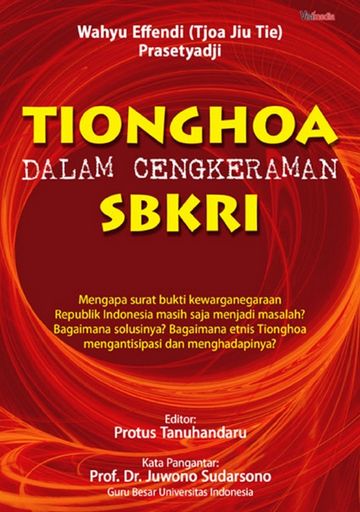
Cover image Tionghoa dalam Cengkeraman SBKRI (Chinese
Indonesians in the grip of the SBKRI)
Wahyu Effendi

Unlike Indonesians of Arab or Indian descent, Chinese Indonesians are required to have a document that proves they are Indonesian citizens. Whenever Chinese Indonesians deal with the bureaucracy, they are obliged to produce this document. It is an integral part of their administrative experiences of birth, marriage and death. They need it to get an identity card, to enrol in an educational institution, to obtain a business license and to get a passport.
Known by the acronym SBKRI, this document is compulsory for all Chinese Indonesians of 21 years of age or over, even if they were born in Indonesia to parents who were already Indonesian citizens. There is no equivalent document for other Indonesians, who simply have to show their identity card and their birth certificate. In practice, the SBKRI is a mark of ethnicity – for which Chinese must pay dearly – that passes down through the generations without end.
Cultural violence
It is not surprising, then, that Chinese Indonesians talk constantly about how they have to prove their ‘Indonesianness’ from the cradle to the grave. Take the experience of a friend of mine in Surakarta, who I’ll call Kwee Giok Nio. When he went to register the death of his mother, he had to produce her SBKRI before he could get permission to bury her. In another example, a Registry Office bureaucrat demanded that a Chinese Indonesian friend of mine called Roni produce his mother’s SBKRI before he could register his marriage. When Roni protested, saying that the SBKRI was no longer required, the bureaucrat asked him if he’d heard that from the President of the People’s Republic of China.
As these anecdotes suggest, an SBKRI is not just an administrative document or a harmless bureaucratic requirement. It is a sign of Indonesia’s mistrust of its Chinese citizens, which has its roots in the Emergency Regulation of 1958, under which an SBKRI could be requested if someone’s Indonesian citizenship was in doubt. The fact that the SBKRI persisted into, throughout and beyond the New Order is a clear sign that the ‘Indonesianness’ of Chinese Indonesians as a group is still in question, even for the state. As a consequence, even third generation Indonesians of Chinese descent are considered ‘foreign’ and not ‘Indonesian’.
The government’s failure to deal more decisively with the SBKRI issue is a sign of a much bigger problem.
State discrimination has had inevitable consequences for the status of Chinese Indonesians in the community, affecting everything from their level of political engagement to their social relations. Frans Hendra Winarta, a member of the Indonesian National Law Commmission, goes as far as to claim that anti-Chinese discrimination in Indonesia constitutes a form of cultural genocide. And although the SBKRI policy has never directly killed anyone, indirectly it played a role in Indonesia’s violent anti-Chinese race riots. In any case, crimes against humanity cannot always be measured in terms of lives lost or physical violence – they can also take the form of ‘cultural identity violence’.
Read More

The Proceeds of Crime

By George Monbiot

It’s a staggering case; more staggering still that it has scarcely been mentioned on this side of the ocean. Last week two judges in Pennsylvania were convicted of jailing some 2000 children in exchange for bribes from private prison companies.
Mark Ciavarella and Michael Conahan sent children to jail for offences so trivial that some of them weren’t even crimes. A 15 year-old called Hillary Transue got three months for creating a spoof web page ridiculing her school’s assistant principal. Mr Ciavarella sent Shane Bly, then 13, to boot camp for trespassing in a vacant building. He gave a 14 year-old, Jamie Quinn, 11 months in prison for slapping a friend during an argument, after the friend slapped her. The judges were paid $2.6 million by companies belonging to the Mid Atlantic Youth Services Corp for helping to fill its jails(1,2,3). This is what happens when public services are run for profit.
It’s an extreme example, but it hints at the wider consequences of the trade in human lives created by private prisons. In the US and the UK they have a powerful incentive to ensure that the number of prisoners keeps rising.
The United States is more corrupt than the UK, but it is also more transparent. There the lobbyists demanding and receiving changes to judicial policy might be exposed, and corrupt officials identified and prosecuted. The UK, with a strong tradition of official secrecy and a weak tradition of scrutiny and investigative journalism, has no such safeguards.
The corrupt judges were paid by the private prisons not only to increase the number of child convicts but also to shut down a competing prison run by the public sector. Taking bribes to bang up kids might be novel; shutting public facilities to help private companies happens – on both sides of the water – all the time.
The Wall Street Journal has shown how, as a result of lobbying by the operators, private jails in Mississippi and California are being paid for non-existent prisoners(4,5). The prison corporations have been guaranteed a certain number of inmates. If the courts fail to produce enough convicts, they get their money anyway. This outrages taxpayers in both states, which have cut essential public services to raise these funds. But there is a simple means of resolving this problem: you replace ghost inmates with real ones. As the Journal, seldom associated with raging anti-capitalism, observes, “prison expansion [has] spawned a new set of vested interests with stakes in keeping prisons full and in building more. … The result has been a financial and political bazaar, with convicts in stripes as the prize.”(6)
Even as crime declines, law-makers are pressed by their sponsors to increase the rate of imprisonment. The US has, by a very long way, the world’s highest proportion of people behind bars: 756 prisoners per 100,000 people(7), or just over 1% of the adult population(8). Similarly wealthy countries have around one-tenth of this rate of imprisonment.
Read More

POLITICS-PAKISTAN: Court Ruling May Deepen Political Crisis

By Beena Sarwar

KARACHI, Feb 26 (IPS) – The political chasm in crisis-riddled Pakistan has deepened after a Supreme Court ruling barred from political office opposition leader Nawaz Sharif and his younger brother Shahbaz Sharif, chief minister of Punjab – the country’s most populous and powerful province.

The Sharifs’ Pakistan Muslim League – Nawaz (PML-N) party had joined hands with President Asif Ali Zardari’s Pakistan People’s Party (PPP) to defeat political parties supporting former president Pervez Musharraf in elections last February, and force his resignation six months later.

But the alliance between Pakistan’s two main political parties fell apart, mainly over the restoration to office of chief justice Iftikhar Mohammed Choudhry – whose dismissal by Musharraf in 2007 sparked unrest led by the legal fraternity.

“The move [Wednesday’s apex court ruling] plunges Pakistan back into familiar territory,” said PML-N parliamentarian Ayaz Amir, talking to IPS on the phone from the capital Islamabad. “Another crisis, another round of turbulence… We seem to be cursed with the Chinese saying, ‘may you live in interesting times’.”

For most, the Supreme Court ruling – which upheld a lower court verdict, last June, that made Nawaz Sharif ineligible to stand for elections on airplane hijacking charges – has come “like a bolt from the blue,” as Asha’ar Rehman, resident editor of the daily ‘Dawn’ in Lahore put it.

“The political repercussions will be horrific. We were hoping they would show some maturity and let a reconciliation happen,” added Rehman, talking to IPS from Lahore, capital of the Punjab and the stronghold of the Sharifs.

Iqbal Haider, advocate and chairman of the independent Human Rights Commission of Pakistan, termed the decision as being “against democracy, not against the Sharif brothers’’.

In a no-holds barred press conference at his Lahore residence, shortly after the court ruling, a belligerent Nawaz Sharif said he had no problems with the PPP, but held the party head, Zardari, directly responsible for the contentious judgement.

Sharif, a former prime minister, also accused Zardari of offering a “business deal” to Shahbaz Sharif, asking him to support the government in extending the tenure of the current chief justice in return for which the court would provide the brothers with relief.

Presidential spokesman Farhatullah Babar dismissed these charges as a knee-jerk response. “The allegations that PML-N chief has levelled against President Zardari are far from reality and are based on ill intention,” he told a press conference in Islamabad later that evening.

Information Minister Sherry Rehman called for examining the court ruling dispassionately while admitting it had created a problem for the government in its efforts for reconciliation.

Many PPP parliamentarians, although unhappy about the decision, say there is unfortunately nothing the party can do in this regard.

The ruling is seen a “technical knockout” for the Sharif brothers who now also stand barred from contesting elections.

“More than anything, it undermines the democratic legitimacy of the government,” political analyst and economist Asad Sayeed told IPS. “Nawaz Sharif is a popular political leader. This decision will push him to the wall and perhaps further towards the religious parties.”

Within hours, President Asif Ali Zardari imposed direct central rule in the Punjab for two months. Defending the decision, a PPP spokesperson cited potential “anarchy” as angry activists took to the streets after Sharif in a press conference exhorted people to come out in protest.

The government wisely refrained from using police force to prevent the protests, as angry activists in various cities burned tyres, blocked traffic, and attacked property. In Rawalpindi, some even destroyed posters of former prime minister Benazir Bhutto and damaged the memorial at the public park where she was assassinated on Dec. 27, 2008.

‘Religious militants’ are widely believed to be behind her murder, barely two weeks before the scheduled polls which Bhutto had convinced her former rival Nawaz Sharif to contest, instead of boycotting them as he was planning to do.

Both twice-elected and twice-removed prime ministers had then returned from several years of exile abroad. During this time, army chief Pervez Musharraf headed Pakistan, after ousting Nawaz Sharif from the prime ministership in 1999.

Sharif had tried to replace the army chief and prevent the civilian flight bearing Musharraf back from an official visit to Sri Lanka, from landing in Pakistan. This was the ‘hijacking’ case for which Sharif was convicted, grounds now for his disqualification from public office or contesting elections.

Bhutto’s return to politics in Pakistan in October 2007 was widely seen as part of a ‘deal’ brokered by Washington to restore civilian rule in Pakistan in order to better handle the ‘war on terror’ – for which policy makers were by now prescribing a political rather than a military solution.

The widespread secular movement led by lawyers to restore chief justice Choudhry had also presented the possibility of progressive political change in Pakistan.

After the general elections of Feb. 18, 2008, the PPP and PML-N had agreed to form government as well as to restore the judges whom Musharraf had removed when he imposed emergency rule on Nov. 3, 2007.

“What people forget about the agreement was that it was also about government formation – the other two clauses were how the federal and the provincial governments were going to be formed,” said Asad Sayeed.

“Nawaz Sharif insisted on the judges’ restoration in order to undermine the PPP. They could not have moved towards forming government if Zardari had not agreed on this clause because Sharif was not willing to talk about it.”

Sharif continued to push for the restoration of chief justice Iftikhar Mohammed Choudhry. Most of the other judges ousted after Musharraf’s November 2007 emergency have since been reinstated after taking fresh oath of office.

The country was bracing for a lawyers’ ‘long march’ to restore Choudhry, scheduled to kick off on Mar. 12 and ending with a sit-in or ‘dharna’ in Islamabad. The PML-N has enthusiastically supported the move.

Ayaz Amir, who has warned against making the restoration of Choudhry the “be all and end all” of politics, told IPS he felt his PML-N party had “stuck its horns too much into this one issue”.

The planned long march, Amir predicted, ”will get more momentum now, but it won’t restore the judges. There will be more instability and tumult, with politicians being further discredited in the public eye”.

More ominously, widespread unrest could also leave the army with “no choice” but to step in – something it is, at this point, clearly reluctant to do.

Amir hopes it will not come to that. “We’re not at that point yet. We have to wait and see what happens when the situation plays itself out.”

Bitter political acrimony is not new in Pakistan. However, so far both the PPP and PML-N have kept their main shared goal before them -to keep the army out of politics and let the political process continue. Observers hope that this long view will prevail.

Read More
(Submitted by Hari Sharma)

CLIMATE CHANGE: New Thinking to Tackle Old Problems

By Kristin Palitza

Burkinabé farmer irrigating crops from a hand-dug well: changing rainfall patterns could devastate small farmers.

Credit: Tugela Ridley/IRIN

ROME, Feb 26 (IPS) – Organic and eco-friendly farming can feed the world, contrary to the common belief that biotechnology and chemical-intensive farming are indispensable, modern strategies to increase production, agricultural experts say.

“It is not necessarily about producing more food, but about producing more quality nutrition through less energy use and pollution,” declared Hans Herren president of the Washington DC-based Millennium Institute, a non-profit organisation promoting long-term, integrated, global thinking.

“We have to invest heavily into research on how to increase eco-agricultural production.”

The best way to mitigate climate change and gain food security is to support small-scale, ecological farming, scientists and economists said during the International Fund for Agricultural Development (IFAD) Governing Council in Rome, Italy, in late February. This would be a turnaround from international agricultural strategies of the past two decades that heavily promote monocropping and the use of biotechnologies.

“Nobody has really thought yet about how and if we can mitigate climate change in agriculture,” admitted Dr Josef Schmidhuber, head of the global perspectives study unit at the United Nations Food and Agriculture Organisation (FAO), indicating that although there is a lot of talk about averting the impact of climate change, no policies have been implemented yet to solve the problem.

“It starts and ends with governance, with convincing key decision makers to change strategy,” said Herren. “We know what the solutions to climate change are, but they are not put into practice because governments are in bed with the biotechnology industry. They are more interested in making a quick buck than in the long-term benefits of farmers.”

Herren believes industrial agriculture is “bankrupt by definition”, because it costs too much energy to produce: “For every calorie you produce you have to put in ten, if you look at fuel, fertiliser and labour needed.”

He lobbied policymakers to focus on prevention rather than fixing crises: “In agriculture, it takes a long time to rebuild what we destroy. It takes years to replenish soils and re-create diversity. We have to go back to the source and ensure that healthy soils grow healthy crops.”

Chemical-heavy agriculture has been systematically destroying soils, Herren complained, by causing mineral depletion, erosion and reducing soils’ ability to retain water.

“For small-scale farmers, water is far more important than having a pest-resistant, genetically modified plant, which is only resistant to one particular type of pest anyway,” he said.

Downward spiral Agriculture is the main income source for poor rural people in the developing world. At the same time, it is the human activity most directly affected by climate change.

Climate change will affect smallholder farmers (who own less than two hectares of land) through increased crop failure, a rise in diseases and mortality of livestock, increased livelihood insecurity resulting in assets being sold, indebtedness, migration and dependency on food aid. Other consequences will be desertification and land degradation, rising sea levels causing floods, diminishing natural resource productivity and, in some areas, irreversible loss of biodiversity.

Climate change is expected to put 49 million additional people at risk of hunger by 2020, and 132 million by 2050, according to IFAD. In sub-Saharan Africa, an additional 17 to 50 million people could be undernourished in the second half of the century due to climate change.

Generally speaking, climate change is expected to lead to a downward spiral in human development indicators, such as health and education, especially in sub-Saharan Africa.

“To feed the world, we will have to scale up productivity, but in an ecological way, by polluting less and making use of low-cost technologies,” said Michel Griffon, executive director of the National Research Agency of France. “We need a holistic approach to the entire ecosystem, including soil, water, plants, animal management, pests and diseases. It will be an immense challenge.”

Read More