AN INTERVIEW WITH KAMLA BHASIN

‘Movement is a larger thing’

Kamla Bhasin is a renowned feminist activist and gender trainer in South Asia. She has written extensively on gender issues. Most notable among her publications are: Borders and Boundaries: Women in India’s Partition, co-authored by Ritu Menon, Rutgers University Press, 1998, and What is Patriarchy? Kali for Women, 1993. Interviewed by Nazneen Shifa, a development worker and feminist activist in Dhaka.

NS: We know that you have a long experience in South Asia. Do you think that there is any difference between feminist movements and NGO-based gender rights activities?
KB: I think movement is a much larger thing. So, if there is NGO-based feminist thinking and activities I call it part of the feminist movement. I do not make a distinction whether you are working in an NGO or you are working in a government organisation or you are working in a newspaper. A movement is not an organisation, a movement is a much larger thing. So, if NGOs are doing something in a very strong feminist way, according to my understanding and definition, they would be part of the feminist movement. So, I do not thing there is a difference in that way. I mean weather you are eastern NGO or you are based anywhere…I think sometimes the misunderstanding is that movement is an organisation. Movement is not an organisation. For example, a writer like Taslima Nasrin according to me would be part of the larger feminist movement or somebody like Shameem Akhtar, a feminist filmmaker, is part of a movement; she does not have to be part of a group to belong to a movement. So, I think they are all part of the larger feminist movement.
In every context, we have specific kinds of movements, like women’s rights movement, but how do you relate these with the globalised gender rights movement?
A movement is spontaneous work of a large number of people all over the world. So, all the activities which take place in Bangladesh or India are automatically part of the global movement. So we don’t have to be connected to somebody outside. That’s my understanding of a movement. What is global feminist movement? Global feminist movement is made up of hundreds of group working in Bangladesh, India, Nepal, Sri Lanka or anywhere else; that is the global movement. Movement is not a membership thing. Movement is not something thing that you have to become a member of something global.
Since the 1980s, the feminist movement has been reshaped by the appropriation of global gender rights discourse. After the 80s, there took place a huge change by the intervention of NGOs in the context of women’s rights movement. Now we do not see a lot of spontaneous activities; more often than not things are NGO-funded. How do you evaluate this situation?
There are the advantages and disadvantages of the mainstreaming of gender. The concerns of gender have become mainstreamed and I am sure after sometime the cultural movement that you mentioned will also be mainstreamed. Now why did this happen? In the context of feminist movement because it has become mainstreamed, thousands of NGOs are doing it and today they are doing the same things which we were doing 20 years ago without payment. I do not know whether the work is less or the work is bad. The work is perhaps better organised. It is perhaps happening in all districts of Bangladesh and it is working on all issues which we are working. Just because it is funded by somebody, it does not reduce the value of the work necessarily. You have to see whether this is bad work or good work. For example, the work of most of the women’s rights organisation, is it bad work because they have just borrowed money? Or the work that the United Nations Development Programme is doing for the sensitisation of the police force. Earlier we had no access to the police but today because of our efforts, because of the women’s movements, the police also realise that they have to do gender sensitisation.
So this is what happens to any issue which becomes mainstreamed and really gender is one of the finest examples of mainstreaming. Very few other issues have got mainstreaming like that. I think it is a result of the women’s movement and I think what you have to judge is not the fact that whether these things have been taken over by NGOs. We have to judge whether they are as effective as before or more effective than before. Earlier, how many of the spontaneous michil and demonstration were taking place? Today, when we celebrate women’s day in Bangladesh, it is celebrated in 5000 villages. Earlier, were we able to do it? No. So I think I look at it that way. But, yes, some organisations have become established and may be if the women’s day merges in a holiday, may be they will not celebrate it. Because now you only do it 9 to 5 and some people are also working like that. But I would still consider them as part of the movement because for me the concept of movement is a much larger thing. They are still challenging patriarchy, they are still writing against it, working against it, even if they are working 9 to 5. Now, thousands of organizations are working 9 to 5 on these issues.
So, what we need to look at is not where the funds are coming from but the proper utilisation of the funds and the quality of work?
We have to see the quality of work. Funds are not a bad thing. Earlier also we needed funds but you were contributing small money here, small money there. People were required and at that time many of us were doing a full time job somewhere else, maybe selling Coca-Cola, and for two hours we were doing feminism. Now, because of the existence of funds, we are not selling ourselves to Coke or to a university or a college, we work full-time on these issues.

Read More

(via http://www.sacw.net/)

Common Chemicals May Delay Pregnancy

By Steven Reinberg

HealthDay Reporter
Chemicals known as perfluorinated chemicals, which are pervasive in food packaging, pesticides, clothing, upholstery, carpets and personal care products, may delay pregnancy, a new study suggests.

These chemicals are being phased out in the United States because of their toxic effects, and are expected to be completely gone by 2010. However, they remain in the environment and in the body for decades, and have been linked to developmental problems.

“These widespread chemicals apparently lower the fertility in couples trying to get pregnant,” said lead researcher Dr. Jorn Olsen, chairman of the Department of Epidemiology at UCLA’s School of Public Health.
Danish women in the study who had with high levels of perfluorooctanoate (PFOA) and perfluorooctane sulfonate (PFOS) took longer to get pregnant, Olsen said.

“If this finding can be replicated, one would have to look for other chemicals to replace these,” he said.

The report is published in the Jan. 29 online edition of Human Reproduction. And it follows on the heels of a report linking another common plastic chemical, bisphenol A (BPA), to developmental problems in fetuses and infants.

For the study, Olsen’s team collected data on 1,240 women who participated in the Danish National Birth Cohort. The researchers took blood samples from the women and interviewed them on how long it took them to become pregnant.

Read More

70,000 Bangladeshis set to work here


KUALA LUMPUR:
More than 70,000 Bangladeshi workers are expected to arrive here soon to work in the plantation, construction and services sectors, said the Bangladesh High Commission labour counsellor Talat Mahmud Khan.

Although there was a temporary freeze on the intake of foreign workers in the services sector, the visas of these Bangladeshi workers were approved before the restriction was imposed.

Despite the economic downturn and retrenchments, Bangla-deshi workers are still in demand as they are known to be hardworking, efficient and do not demand a high salary, said Talat.

The arrival of the latest batch would swell the number of Bangladeshi workers to almost 500,000.

Talat said the main grouse of the Bangladeshi workers here was that many of them were not given proper living quarters and medical benefits as promised by their employers.

They were also unhappy with the delay in the renewal of visas which sometimes took up to three months.

This caused anxiety because they were considered illegal immigrants and many were arrested by the Malaysian Immi-gration, said Talat.
The Bangladesh High Commis-sion has set up a halfway centre in Semenyih to house such workers.

On a separate matter, Talat hoped that the Malaysian Govern-ment would reduce the RM350 transfer fee for workers wanting to change their sector of work.

Read More

Announcement from Sansad

An announcement from Vancouver, Canada, based organization Sansad or South Asian Network for Secularism and Democracy.

Dear friends:

We are pleased to share with you this Declaration of an Year-long program to Celebrate the 100th Anniversary of the International Women’s Day, to culminate in a massive program a year from now on March 08, 2010.

This comes from a variety of grass root organizations concerned with the gender issues in the over all context of struggles for social and economic justice in many parts of India.

sansad

100 years of International Women’s Day
Achievements and Challenges

On the historic occasion of March 8, several organisations and individuals in Delhi, have come together to commemorate hundred years of International Women’s Day, to collectively celebrate the achievements of women’s struggles all over the world, to draw strength from the struggles and sacrifices of our earlier generations and to chart out the course of our future struggles.

Women’s struggles against exploitation, war and political alienation has a long and rich history of sacrifice, repression and ridicule. Whether it was working class women who were locked up in factories, and who got burnt when the factory caught fire, or suffragettes who were repeatedly jailed for asking for the right to vote, women were considered too frivolous to organise and were ignored by trade unions. Yet women throughout the world waged militant struggles to improve their working conditions and to end exploitation. The women’s movement, which began as a struggle against capital, acquired newer dimensions and began to address the myriad issues that affect women. This included the issue of the right over women’s own bodies, and breaking the silence against domestic and public violence.

March 8 was declared as the International Women’s Day in 1910 at the Second International Conference of Working Women in Copenhagen. Clara Zetkin, a leader of ‘Women’s Office’ for the Social Democratic Party in Germany proposed this day for women of the world to press for their demands. Women from 17 countries, representing unions, socialist parties, working women’s clubs, and women parliamentarians greeted Zetkin’s suggestion with unanimous approval. This day was of additional significance because on this day in 1908, women had gathered in New York City to rally around the issue of women’s suffrage.

Women in India have not only struggled for their own rights but have made significant contribution to all struggles for freedom, workers’ rights and land rights. In the twentieth century, one of the first examples of political action for women’s rights was the 1942 Nagpur struggle of thousands of Dalit women for compulsory free education for girls and political representation of Dalit women in public offices. In the 1940s women’s participation in Telangana movement for land rights was another landmark. Over the years, women contributed significantly to many other struggles related to livelihood and environmental issues, like the Chipko movement. Women came out in large numbers in the anti-liquor movement and against price rise.

While Dalit and Adivasi women in rural areas continued to claim their rights and dignity in small and big spaces, the 1980s were also characterised by widespread outrage and legal action by women’s groups and women of all classes in various cases of discrimination and violence against women, like the Shah Bano maintenance case, issues of dowry and dowry deaths, Sati, rape and child sexual abuse. Women in the north-eastern part of India, particularly Manipur, led and continue to lead the struggle against army atrocities and State repression.

With the 1990s, the Indian government embarked on World Bank dictated reforms and women protested against privatization, withdrawal of the State in social sectors and targeted Public Distribution System (PDS).

As a consequence of neo-economic policies, today our society is characterised by unprecedented disparities. Resources are being transferred to national and foreign capital in India with active participation of the State resulting in large-scale dispossession and displacement of people. Government policies have brought about agrarian crises where farmers are pushed to commit suicide. Withdrawal of the State from health, education and social security sectors has caused further impoverishment, exclusion and deprivation. In the name of micro credit, women are being exploited by the state, the microfinance institutions (MFIs) and some NGOs.

And in this process women suffer the most. If there is retrenchment, women are the first to be fired. If the family does not have food, women have even less. If there is dispossession, women lose traditional control and benefits even within the family, as cash compensation is given to male members. Women belonging to Dalit, Adivasi and religious minority communities, women with mental and physical disabilities, along with those marginalised due to their gender and sexual preferences, are even more vulnerable and exploited.

Arms of the state meant to protect citizens, have routinely used rape and sexual assault in order to intimidate, terrorise and control women and populations. Mass rapes and atrocities by security forces during anti-insurgency operations in North-East or Kashmir have further been strengthened by the existence of draconian laws like the Armed Forces (Special Powers) Act. The recent amendment in Unlawful Activities (Prevention) Act will also give a fillip to the State in its suppression of people’s movements. Furthermore, private armies sponsored by the State are also using sexual assault as a tool to suppress people’s struggles, like in Andhra Pradesh, Bihar, Chhattisgarh and Jharkhand.

Women are specifically targeted during communal and caste violence, as we have seen in Gujarat, Khairlanji and Orissa. Similarly women everywhere are under the threat of moral policing. Crimes against women, including against lesbians and bisexuals, and transgender persons, are on the rise, making their participation in public life increasingly difficult and their life within the home and the workplace more insecure.

In the face of dominant imperialist and repressive forces, we need to come together to build a united women’s movements, and resolve to struggle for a just and equitable society.

We hereby demand

People-centred and pro-women developmental policies; wherein microcredit-based self help groups (SHGs) cannot be the only and dominant intervention,

Food security, including PDS universalisation,

Livelihoods with fair wages and good working conditions, with regulation of working conditions for unorganized sector workers,

Land reform and women’s access to and control over productive resources,

Freedom from sexual assault and harassment, domestic and public violence,

Effective implementation of laws such as the Protection of Women from Domestic Violence Act and Scheduled Caste/Scheduled Tribe Atrocities Act.

Decriminalisation of homosexuality and reading down of Article 377 of IPC,

Elimination of caste-based professions like manual scavenging that exploits Dalit women

Strengthening of institutions and mechanisms that are set up to address special needs of women, SC, ST, OBC and religious minorities, and,

Repeal of Armed Forces (Special Powers) Act, UAPA, and Special Economic Zones (SEZ) Act.

On the occasion of this Centenary Year of International Women’s Day 2009, we call on women from all over the country to join together with other oppressed peoples to raise our voices against declining living standards, fascist attacks by the State and rightwing mobs, and other forms of patriarchal oppression. Let us use this opportunity to celebrate our achievements and build new solidarities to face the challenges ahead of us. Starting March 8th 2009, commemoration meetings will be held through the year and will culminate in a massive programme on March 8th 2010.

Centenary Committee to Celebrate International Women’s Day
AIPWA, AISA, CADAM, Centre for Struggling Women, Committee Against Violence on Women (CAVOW), Dalit Lekhak Manch, Democratic Students Union (DSU), Disha Chhatra Sangathan, Forum for Democratic Struggle, Gatividhi, Jagori, Krantikari Yuv Sanghatan, New Socialist Initiative, Nirantar, NTUI, Pragatisheel Mahila Manch, Progressive Students Union (PSU), Purogami Mahila Sanghatan, Saheli, Sangat, Stree Adhikar Sangathan, Stree Mukti League, and Arjumand Ara, Chanda Sagar, Dr. Ajita Rao, Indira Chakravarthy, Indira Pancholi, Karen Gabriel, Madhu Aggrawal, Nitoo Das, Shehla Faizee, Shubhra Sethi, Vibha Maurya and others.

Contact: iwdcentenary@gmail.com

Sansad website: http://sansad.org/Sansad/

A Federation of Balochistan, India, & Sindhu Desh

By B. R. Gowani

The violent actions of the Muslim militants and the willful inaction of the Pakistani government seem premeditated and designed to let the country get destroyed and disintegrate. The disintegration could also come through a civil war involving many ethnic, political, and religious groups. One may wonder if the leaders of the Pakistani government have reached an understanding with NASA (National Aeronautics and Space Agency) that the first livable planet discovered in our galaxy by their spacecraft will be allotted to Pakistan so that it can build a new Pakistan there. (See today’s final posting.)

Humor aside, every passing day is pushing Pakistan further towards abyss. Like the Indian movie character Devdas, Pakistan has set itself on the course of self-destruction for a long while now. The situation in Pakistan is really serious. Can the people of Pakistan fight these religious loonies?

Members of the political parties in Pakistan have always had weapons, but now they may be accumulating more as the country gets further engulfed in uncertainty. Most of its residents, however, do not have weapons and they lack the ruthlessness of the militants. They have to be protected by the government. There is no denying that Pakistan is dying and the only resuscitation that could probably work is the government’s firm and successful counter-action against these loonies. Even if the government decides to clash head on, there is no guarantee that it will be successful because sympathy for the militants has penetrated the military and civilian populations, therefore increasing the hopelessness of the situation.

Adding fuel to the inferno are other factors:
• the return of Zardari’s corrupt behavior,
• his removal of Shahbaz Sharif as Punjab’s governor, and
• the Supreme Court’s barring of his brother Nawaz Sharif from elected office
• the Sharif brothers are equally corrupt and dishonest
• Nawaz Sharif has always been cozy with the Islamists and will have no problem in exploiting the current crisis to his advantage
• Jamat-e-Islami party has expressed its support for the lawyers who are protesting against the Zardari government for not reinstating all the judges who were removed by Musharraf.

Pakistan was created in the name of Islam but religion didn’t prove a bond which could hold the country together. And now that the nation is on the path of shrinking further (East Pakistan seceded to become Bangladesh in 1971); how many more parts will the country break into is anyone’s guess.

CIA Fact Book

(In the Twentieth century, Israel is the only other country that was created in the cause of religion. Incidentally, it is also on the path to self destruction; although in a contrary manner. It is inviting its own destruction through expansion, that is, by grabbing more and more of the Palestinian land, which is in turn inciting an increasing number of Palestinians to be willing to give up their lives. This could become a major problem for the survival of Israel.)

Most Pakistanis do not want to see their country disappear from the world map, or that it gets reduced to the sole province of Punjab. However:
• the forced division of the Pashtun people living in Afghanistan and British India (now NWFP or North West Frontier Province of Pakistan) through the Durand Line in 1893 by the British <1>,
• the continuous unfair and inequitable treatment of Sindh, Baluchistan, and NWFP by the province of Punjab, and
• the creation of Taliban and their growing power

have all created a very ugly situation indeed.

Territorial partitions are frequently accompanied by atrocious violence — particularly when the division is performed as a result of a remnant colonial situation. The creation of Pakistan from India and the end of the British rule in 1947 saw a bloodbath of huge unimaginable proportion, where a million people lost their lives. (The date for independence was initially set for June 1948 but changed to the earlier date of August 1947 with the last Viceroy, Lord Louis Mountbatten (Queen Elizabeth’s uncle-in-law), presiding over the division.) Mountbatten could have resolved the Kashmir issue but did not do so, and it remains unresolved to this day. The Kashmir problem never permitted the two neighbors to develop any lasting amicable relationship. In 1965, Mountbatten summed up the mess he had created with the words: “I fucked it up.”

What Should Be Done?

These are critical times. The forces within and without are committed to changing Pakistan’s map. To avoid any more tragedies in South Asia, where too many people have suffered for too long, it behooves all to resolve the issue with learned wisdom from the past and to contemplate the solutions with a calm rational approach and not by waving Pakistani flags and screaming patriotic slogans. Since Pakistan’s creation, the latter tactics have only brought it harm. It is more crucial than ever to act prudently now, as this is a matter of survival for Pakistan.

Balochistan and Sindh both have access to the sea and are not landlocked; the former has the newly Chinese-built seaport of Gwadar and the latter has an international seaport. Also, both have an adequate amount of natural and human resources. This gives them the capability to survive as independent countries. But the geo-strategic importance of the area indicates that, from a security point of view, it will be difficult for them to gouge out the evil eye or rather the greedy eyes of the US and the emerging super powers of India and China. (A few years ago, the former US ambassador to Pakistan, Wendy Chamberlin remarked: “We are a player in the Pakistani political system.” And they are not going to give up this role in the near future.)

For bigger view click here

One practical solution, if implemented conscientiously, is to form some form of loose federation between India, Sindh and Balochistan. Why India? Because Sindh has a long physical border with India and also they have all been one country in the past. Additionally, they are culturally, linguistically, and politically closer to India. At the very least, Defense and Foreign Affairs should be handled jointly by all three partners.

Before making any such commitment, internally, Sindhi and Muhajir leaders will have to reach a truce first. (Muhajirs or “refugees” are the Urdu speaking people who migrated from India during the Partition. They have many relatives in India. Many Sindhi and Muhajir leaders have always felt friendly and emotional ties with India. The Sindhis within India and outside have felt the same affinity. The Indian opposition leader Lal Krishna Adwani was born in Karachi, Sindh.)

Next, the joint Sindh and Baluchi leaders will need to approach the leaders of Punjab to inform them about their intention to leave the Union. Punjab, in all probability, will not agree to this partition and try to discourage it by any means possible.

Further, it is of prime importance that Sindh and Balochistan not join the federation as one single unit but should instead join as two separate entities in order to minimize future problems. Also, Sindh and Baluchistan are both rich in land mass and should be able to accommodate the refugees from the Taliban on their land, and should provide for that in the Federation plan.

What Should India Do?

India will have to change its patronizing Big Brother attitude towards its neighbors. Nepal and Sri Lanka can attest to the bad experiences at being India’s neighbors. India should also reach an amicable solution to the Kashmir problem by including the participation of the Kashmiri people. India should also address the grievances of the people of Northeast India who have been marginalized and attempt to resolve their issues. India will need to learn to be fair and inclusive with all its partners. It will have to reign in its ego.

Currently, the Indian elite class is really flying high. And the speed with which the Indians in the US are operating and gaining influence in the US, the day is not far that it may overtake the powerful Israeli Lobby. Vijay Prashad points out that the Indian American Task Force (IATF) is imitating the Israeli Lobby and wants to become the “Indian Lobby”. But all that the Israeli Lobby has accomplished is to deny justice to the Palestinian people and turn Middle East into a cauldron. Does the IATF want India to do the same with other South Asian countries which are already hurting with other problems?

If the India-Sindh-Baluchistan federation gets formed and is successful, it will prompt other South Asian countries such as Bangladesh, Nepal, Sri Lanka, Burma, and Maldives to join the federation. Who knows, the new Pakistan may decide to join it ultimately.

Of course, India is a powerful country and can ignore these issues; but this it will do at its own peril. Let us reflect on the example of the greatest Super Power. Its arrogance has weakened it economically (out sourced labor) and ruined it financially (failed financial institutions).

B. R. Gowani can be reached at brgowani@hotmail.com

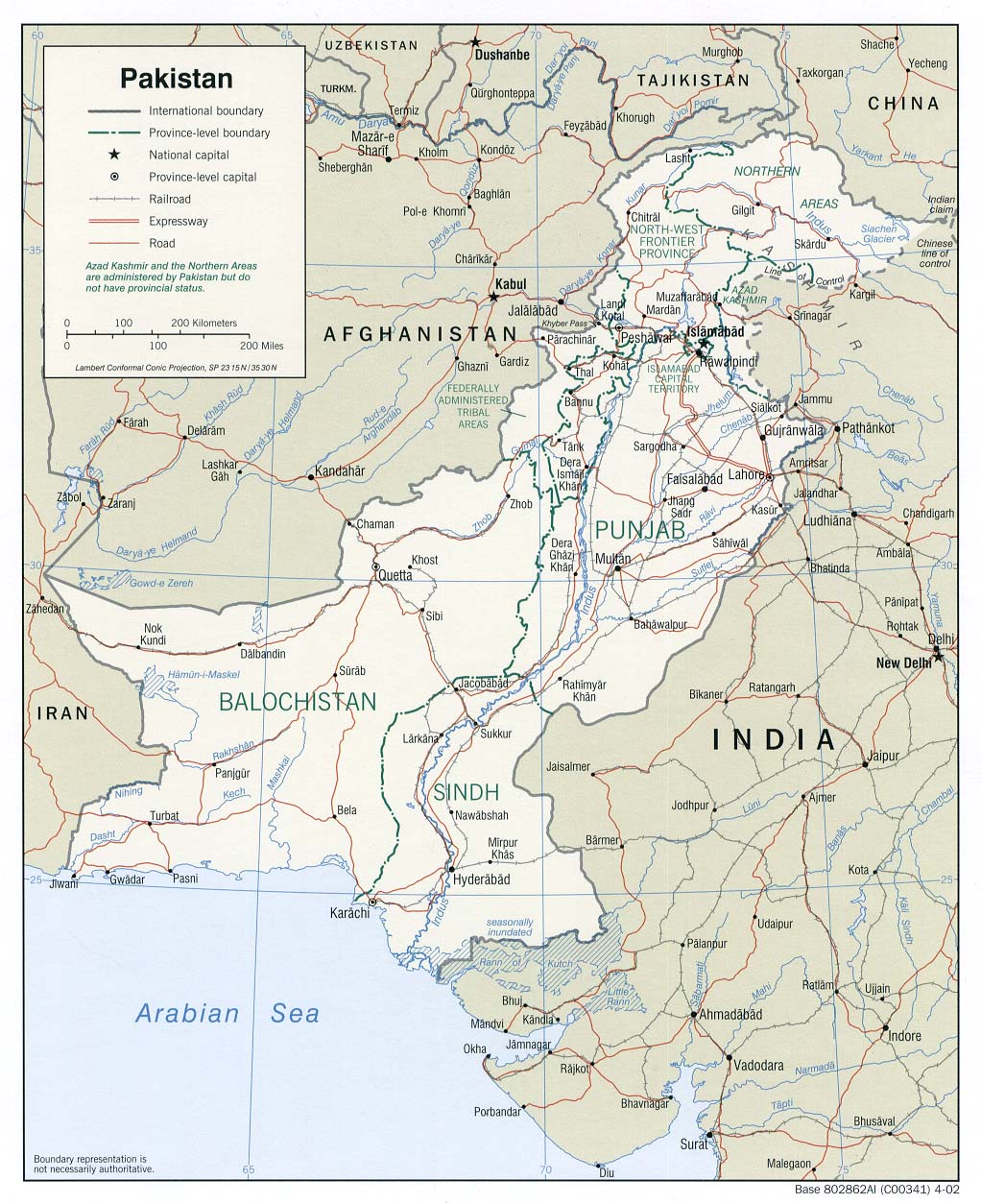
See the map for the FATA (Federally Administered Tribal Areas) and the NWFP (North Western Frontier Province).

Toba Tek Singh

By Saadat Hasan Manto (a great South Asian writer)

a short story about the lunacy of India’s Partition

Translated from the Urdu by Richard McGill Murphy

Two or three years after Partition, the governments of Pakistan and India decided to exchange lunatics in the same way that they had exchanged civilian prisoners. In other words, Muslim lunatics in Indian madhouses would be sent to Pakistan, while Hindu and Sikh lunatics in Pakistani madhouses would be handed over to India.
I can’t say whether this decision made sense or not. In any event, a date for the lunatic exchange was fixed after high level conferences on both sides of the border. All the details were carefully worked out. On the Indian side, Muslim lunatics with relatives in India would be allowed to stay. The remainder would be sent to the frontier. Here in Pakistan nearly all the Hindus and Sikhs were gone, so the question of retaining non-Muslim lunatics did not arise. All the Hindu and Sikh lunatics would be sent to the frontier in police custody.
I don’t know what happened over there. When news of the lunatic exchange reached the madhouse here in Lahore, however, it became an absorbing topic of discussion among the inmates. There was one Muslim lunatic who had read the newspaper Zamindar1 every day for twelve years. One of his friends asked him: “Maulvi Sahib! What is Pakistan?” After careful thought he replied: “It’s a place in India where they make razors.”
Hearing this, his friend was content.
One Sikh lunatic asked another Sikh: “Sardar ji, why are they sending us to India? We don’t even speak the language.”
“I understand the Indian language,” the other replied, smiling. “Indians are devilish people who strut around haughtily,” he added.
While bathing, a Muslim lunatic shouted “Long live Pakistan!” with such vigor that he slipped on the floor and knocked himself out.
There were also some lunatics who weren’t really crazy. Most of these inmates were murderers whose families had bribed the madhouse officials to have them committed in order to save them from the hangman’s noose. These inmates understood something of why India had been divided, and they had heard of Pakistan. But they weren’t all that well informed. The newspapers didn’t tell them a great deal, and the illiterate guards who looked after them weren’t much help either. All they knew was that there was a man named Mohammed Ali Jinnah, whom people called the Qaid-e-Azem. He had made a separate country for the Muslims, called Pakistan. They had no idea where it was, or what its boundaries might be. This is why all the lunatics who hadn’t entirely lost their senses were perplexed as to whether they were in Pakistan or India. If they were in India, then where was Pakistan? If they were in Pakistan, then how was it that the place where they lived had until recently been known as India?
One lunatic got so involved in this India/Pakistan question that he became even crazier. One day he climbed a tree and sat on one of its branches for two hours, lecturing without pause on the complex issues of Partition. When the guards told him to come down, he climbed higher. When they tried to frighten him with threats, he replied: “I will live neither in India nor in Pakistan. I’ll live in this tree right here!” With much difficulty, they eventually coaxed him down. When he reached the ground he wept and embraced his Hindu and Sikh friends, distraught at the idea that they would leave him and go to India.
One man held an M.S. degree and had been a radio engineer. He kept apart from the other inmates, and spent all his time walking silently up and down a particular footpath in the garden. After hearing about the exchange, however, he turned in his clothes and ran naked all over the grounds.
There was one fat Muslim lunatic from Chiniot who had been an enthusiastic Muslim League activist. He used to wash fifteen or sixteen times a day, but abandoned the habit overnight. His name was Mohammed Ali. One day he announced that he was the Qaid-e-Azem, Mohammed Ali Jinnah. Seeing this, a Sikh lunatic declared himself to be Master Tara Singh. Blood would have flowed, except that both were reclassified as dangerous lunatics and confined to separate quarters.
There was also a young Hindu lawyer from Lahore who had gone mad over an unhappy love affair. He was distressed to hear that Amritsar was now in India, because his beloved was a Hindu girl from that city. Although she had rejected him, he had not forgotten her after losing his mind. For this reason he cursed the Muslim leaders who had split India into two parts, so that his beloved remained Indian while he became Pakistani.
When news of the exchange reached the madhouse, several lunatics tried to comfort the lawyer by telling him that he would be sent to India, where his beloved lived. But he didn’t want to leave Lahore, fearing that his practice would not thrive in Amritsar.
In the European Ward there were two Anglo-Indian lunatics. They were very worried to hear that the English had left after granting independence to India. In hushed tones, they spent hours discussing how this would affect their situation in the madhouse. Would the European Ward remain, or would it disappear? Would they be served English breakfasts? What, would they be forced to eat poisonous bloody Indian chapattis instead of bread?
One Sikh had been an inmate for fifteen years. He spoke a strange language of his own, constantly repeating this nonsensical phrase: “Upri gur gur di annexe di be-dhiyan o mung di daal of di lalteen.”2 He never slept. According to the guards, he hadn’t slept a wink in fifteen years. Occasionally, however, he would rest by propping himself against a wall.
His feet and ankles had become swollen from standing all the time, but in spite of these physical problems he refused to lie down and rest. He would listen with great concentration whenever there was discussion of India, Pakistan and the forthcoming lunatic exchange. Asked for his opinion, he would reply with great seriousness: “Upri gur gur di annexe di be-dhiyana di mung di daal of di Pakistan gornament.”3
Later he replaced “of di Pakistan gornament” with “of di Toba Tek Singh gornament.” He also started asking the other inmates where Toba Tek Singh was, and to which country it belonged. But nobody knew whether it was in Pakistan or India. When they argued the question they only became more confused. After all, Sialkot had once been in India, but was apparently now in Pakistan. Who knew whether Lahore, which was now in Pakistan, might not go over to India tomorrow? Or whether all of India might become Pakistan? And was there any guarantee that both Pakistan and India would not one day vanish altogether?
This Sikh lunatic’s hair was unkempt and thin. Because he washed so rarely, his hair and beard had matted together, giving him a frightening appearance. But he was a harmless fellow. In fifteen years, he had never fought with anyone.
The attendants knew only that he owned land in Toba Tek Singh district. Having been a prosperous landlord, he suddenly lost his mind. So his relatives bound him with heavy chains and sent him off to the madhouse.
His family used to visit him once a month. After making sure that he was in good health, they would go away again. These family visits continued for many years, but they stopped when the India/Pakistan troubles began.
This lunatic’s name was Bashan Singh, but everyone called him Toba Tek Singh. Although he had very little sense of time, he seemed to know when his relatives were coming to visit. He would tell the officer in charge that his visit was impending. On the day itself he would wash his body thoroughly and comb and oil his hair. Then he would put on his best clothes and go to meet his relatives.
If they asked him any question he would either remain silent or say: “Upri gur gur di annexe di be-dhiyana di mung di daal of di laaltein.”
Bashan Singh had a fifteen-year-old daughter who grew by a finger’s height every month. He didn’t recognize her when she came to visit him. As a small child, she used to cry whenever she saw her father. She continued to cry now that she was older.
When the Partition problems began, Bashan Singh started asking the other lunatics about Toba Tek Singh. Since he never got a satisfactory answer, his concern deepened day by day.
Then his relatives stopped visiting him. Formerly he could predict their arrival, but now it was as though the voice inside him had been silenced. He very much wanted to see those people, who spoke to him sympathetically and brought gifts of flowers, sweets and clothing. Surely they could tell him whether Toba Tek Singh was in Pakistan or India. After all, he was under the impression that they came from Toba Tek Singh, where his land was.
There was another lunatic in that madhouse who thought he was God. One day, Bashan Singh asked him whether Toba Tek Singh was in Pakistan or India. Guffawing, he replied: “Neither, because I haven’t yet decided where to put it!”
Bashan Singh begged this “God” to resolve the status of Toba Tek Singh and thus end his perplexity. But “God” was far too busy to deal with this matter because of all the other orders that he had to give. One day Bashan Singh lost his temper and shouted: “Upri gur gur di annexe di be-dhiyana di mung di daal of wahay Guru ji wa Khalsa and wahay Guru ji ki fatah. Jo bolay so nahal sat akal!”
By this he might have meant: “You are the God of the Muslims. If you were a Sikh God then you would certainly help me.”
A few days before the day of the exchange, one of Bashan Singh’s Muslim friends came to visit from Toba Tek Singh. This man had never visited the madhouse before. Seeing him, Bashan Singh turned abruptly and started walking away. But the guard stopped him.
“He’s come to visit you. It’s your friend Fazluddin,” the guard said.
Glancing at Fazluddin, Bashan Singh muttered a bit. Fazluddin advanced and took him by the elbow. “I’ve been planning to visit you for ages, but I haven’t had the time until now,” he said. “All your relatives have gone safely to India. I helped them as much as I could. Your daughter Rup Kur . . .”
Bashan Singh seemed to remember something. “Daughter Rup Kur,” he said.
Fazluddin hesitated, and then replied: “Yes, she’s . . . she’s also fine. She left with them.”
Bashan Singh said nothing. Fazluddin continued: “They asked me to make sure you were all right. Now I hear that you’re going to India. Give my salaams to brother Balbir Singh and brother Wadhada Singh. And to sister Imrat Kur also . . . Tell brother Balbir Singh that I’m doing fine. One of the two brown cows that he left has calved. The other one calved also, but it died after six days. And . . . and say that if there’s anything else I can do for them, I’m always ready. And I’ve brought you some sweets.”
Bashan Singh handed the package over to the guard. “Where is Toba Tek Singh?” he asked.
Fazluddin was taken aback. “Toba Tek Singh? Where is it? It’s where it’s always been,” he replied.
“In Pakistan or in India?” Bashan Singh persisted.
Fazluddin became flustered. “It’s in India. No no, Pakistan.”
Bashan Singh walked away, muttering: “Upar di gur gur di annexe di dhiyana di mung di daal of di Pakistan and Hindustan of di dar fatay mun!”
Finally all the preparations for the exchange were complete. The lists of all the lunatics to be transferred were finalized, and the date for the exchange itself was fixed.
The weather was very cold. The Hindu and Sikh lunatics from the Lahore madhouse were loaded into trucks under police supervision. At the Wahga border post, the Pakistani and Indian officials met each other and completed the necessary formalities. Then the exchange began. It continued all through the night.
It was not easy to unload the lunatics and send them across the border. Some of them didn’t even want to leave the trucks. Those who did get out were hard to control because they started wandering all over the place. When the guards tried to clothe those lunatics who were naked, they immediately ripped the garments off their bodies. Some cursed, some sang, and others fought. They were crying and talking, but nothing could be understood. The madwomen were creating an uproar of their own. And it was cold enough to make your teeth chatter.
Most of the lunatics were opposed to the exchange. They didn’t understand why they should be uprooted and sent to some unknown place. Some, only half-mad, started shouting “Long live Pakistan!” Two or three brawls erupted between Sikh and Muslim lunatics who became enraged when they heard the slogans.
When Bashan Singh’s turn came to be entered in the register, he spoke to the official in charge. “Where is Toba Tek Singh?” he asked. “Is it in Pakistan or India?”
The official laughed. “It’s in Pakistan,” he replied.
Hearing this, Bashan Singh leapt back and ran to where his remaining companions stood waiting. The Pakistani guards caught him and tried to bring him back to the crossing point, but he refused to go.
“Toba Tek Singh is here!” he cried. Then he started raving at top volume: “Upar di gur gur di annexe di be-dhiyana mang di daal of di Toba Tek Singh and Pakistan!”
The officials tried to convince him that Toba Tek Singh was now in India. If by some chance it wasn’t they would send it there directly, they said. But he wouldn’t listen.
Because he was harmless, the guards let him stand right where he was while they got on with their work. He was quiet all night, but just before sunrise he screamed. Officials came running from all sides. After fifteen years on his feet, he was lying face down on the ground. India was on one side, behind a barbed wire fence. Pakistan was on the other side, behind another fence. Toba Tek Singh lay in the middle, on a piece of land that had no name.
1 “The Landowner”
2 Literally: “The lack of contemplation and lentils of the annexe of the above raw sugar of the lantern.”
3 “Gornament”: Punjabi pronunciation of the English “government.”
Read here

Lines of Control

by Farida Batool

(Farida Batool is a PhD student at the School of Oriental and African Studies at the University of London. She is studying film making.)

Hammad Nasar’s comments:

In Pakistan, a new generation of artists who did not witness their nation’s birth pangs has been able to pursue more critical lines of enquiry. Farida Batool’s larger than life “holographic” lenticular print mounted on board, Line of Control (2004), exemplifies this openness. It shows two bodies—one male, one female—from torso to mid-thigh, side-by-side. The image’s focal point is the line where the bodies meet. Shift in any direction and the illusory bodies move with you, but the line stays almost static.
The Lahore-based Batool uses the sexual act as a metaphor for the carnal intimacy of South Asia’s ruptured neighbors. The term “Line of Control,” or its three-letter acronym LOC, is embedded in the vernacular language and imagination of the subcontinent, referring to unfinished cartographic business in the disputed border region of Kashmir. More generally it refers to the messy legacy of decolonization. The line has been transgressed often—four wars since 1947, including a near-nuclear skirmish in 1999 at Kargill—and has consumed thousands of lives. Sex, with its varying associations of birth, death, union, play, submission, domination and consent, brings this synergy into visceral focus.

Read More

The Destabilization of Pakistan

(The following three articles are dated but relevant to today’s crisis in Pakistan.

Although Pervez Musharraf has stepped down and a civilian government is in power, things have worsened and the uncertainty there has increased.

The first two articles: “The Destabilization of Pakistan” by Michel Chossudovsky and “Pakistan’s Baluch Insurgency” by Selig S. Harrison were first published in December 2007 and October 2006 in Global Research and Le Monde Diplomatique, respectively.

The final article is written by Ralph Peters from a US hegemonic perspective and raises some legitimate issues. Ed.)

by Prof. Michel Chossudovsky

The assassination of Benazir Bhutto has created conditions which contribute to the ongoing destabilization and fragmentation of Pakistan as a Nation.

The process of US sponsored “regime change”, which normally consists in the re-formation of a fresh proxy government under new leaders has been broken. Discredited in the eyes of Pakistani public opinion, General Pervez Musharaf cannot remain in the seat of political power. But at the same time, the fake elections supported by the “international community” scheduled for January 2008, even if they were to be carried out, would not be accepted as legitimate, thereby creating a political impasse.

There are indications that the assassination of Benazir Bhutto was anticipated by US officials:
“It has been known for months that the Bush-Cheney administration and its allies have been maneuvering to strengthen their political control of Pakistan, paving the way for the expansion and deepening of the “war on terrorism” across the region.
Various American destabilization plans, known for months by officials and analysts, proposed the toppling of Pakistan’s military…
The assassination of Bhutto appears to have been anticipated. There were even reports of “chatter” among US officials about the possible assassinations of either Pervez Musharraf or Benazir Bhutto, well before the actual attempts took place. (Larry Chin, Global Research, 29 December 2007)


Political Impasse

“Regime change” with a view to ensuring continuity under military rule is no longer the main thrust of US foreign policy. The regime of Pervez Musharraf cannot prevail. Washington’s foreign policy course is to actively promote the political fragmentation and balkanization of Pakistan as a nation.

A new political leadership is anticipated but in all likelihood it will take on a very different shape, in relation to previous US sponsored regimes. One can expect that Washington will push for a compliant political leadership, with no commitment to the national interest, a leadership which will serve US imperial interests, while concurrently contributing under the disguise of “decentralization”, to the weakening of the central government and the fracture of Pakistan’s fragile federal structure.

The political impasse is deliberate. It is part of an evolving US foreign policy agenda, which favors disruption and disarray in the structures of the Pakistani State. Indirect rule by the Pakistani military and intelligence apparatus is to be replaced by more direct forms of US interference, including an expanded US military presence inside Pakistan.

This expanded military presence is also dictated by the Middle East-Central Asia geopolitical situation and Washington’s ongoing plans to extend the Middle East war to a much broader area.

The US has several military bases in Pakistan. It controls the country’s air space. According to a recent report: “U.S. Special Forces are expected to vastly expand their presence in Pakistan, as part of an effort to train and support indigenous counter-insurgency forces and clandestine counterterrorism units” (William Arkin, Washington Post, December 2007).

The official justification and pretext for an increased military presence in Pakistan is to extend the “war on terrorism”. Concurrently, to justify its counterrorism program, Washington is also beefing up its covert support to the “terrorists.”

The Balkanization of Pakistan

Already in 2005, a report by the US National Intelligence Council and the CIA forecast a “Yugoslav-like fate” for Pakistan “in a decade with the country riven by civil war, bloodshed and inter-provincial rivalries, as seen recently in Balochistan.” (Energy Compass, 2 March 2005). According to the NIC-CIA, Pakistan is slated to become a “failed state” by 2015, “as it would be affected by civil war, complete Talibanisation and struggle for control of its nuclear weapons”. (Quoted by former Pakistan High Commissioner to UK, Wajid Shamsul Hasan, Times of India, 13 February 2005):

“Nascent democratic reforms will produce little change in the face of opposition from an entrenched political elite and radical Islamic parties. In a climate of continuing domestic turmoil, the Central government’s control probably will be reduced to the Punjabi heartland and the economic hub of Karachi,” the former diplomat quoted the NIC-CIA report as saying.

Expressing apprehension, Hasan asked, “are our military rulers working on a similar agenda or something that has been laid out for them in the various assessment reports over the years by the National Intelligence Council in joint collaboration with CIA?” (Ibid)

Continuity, characterized by the dominant role of the Pakistani military and intelligence has been scrapped in favor of political breakup and balkanization.

According to the NIC-CIA scenario, which Washington intends to carry out: “Pakistan will not recover easily from decades of political and economic mismanagement, divisive policies, lawlessness, corruption and ethnic friction,” (Ibid) .

The US course consists in fomenting social, ethnic and factional divisions and political fragmentation, including the territorial breakup of Pakistan. This course of action is also dictated by US war plans in relation to both Afghanistan and Iran.

This US agenda for Pakistan is similar to that applied throughout the broader Middle East Central Asian region. US strategy, supported by covert intelligence operations, consists in triggering ethnic and religious strife, abetting and financing secessionist movements while also weakening the institutions of the central government.

The broader objective is to fracture the Nation State and redraw the borders of Iraq, Iran, Syria, Afghanistan and Pakistan.

Pakistan’s Oil and Gas reserves

Pakistan’s extensive oil and gas reserves, largely located in Balochistan province, as well as its pipeline corridors are considered strategic by the Anglo-American alliance, requiring the concurrent militarization of Pakistani territory.

Balochistan comprises more than 40 percent of Pakistan’s land mass, possesses important reserves of oil and natural gas as well as extensive mineral resources.

The Iran-India pipeline corridor is slated to transit through Balochistan. Balochistan also possesses a deap sea port largely financed by China located at Gwadar, on the Arabian Sea, not far from the Straits of Hormuz where 30 % of the world’s daily oil supply moves by ship or pipeline. (Asia News.it, 29 December 2007)

Pakistan has an estimated 25.1 trillion cubic feet (Tcf) of proven gas reserves of which 19 trillion are located in Balochistan. Among foreign oil and gas contractors in Balochistan are BP, Italy’s ENI, Austria’s OMV, and Australia’s BHP. It is worth noting that Pakistan’s State oil and gas companies, including PPL which has the largest stake in the Sui oil fields of Balochistan are up for privatization under IMF-World Bank supervision.

According to the Oil and Gas Journal (OGJ), Pakistan had proven oil reserves of 300 million barrels, most of which are located in Balochistan. Other estimates place Balochistan oil reserves at an estimated six trillion barrels of oil reserves both on-shore and off-shore (Environment News Service, 27 October 2006) .

Covert Support to Balochistan Separatists

Balochistan’s strategic energy reserves have a bearing on the separatist agenda. Following a familiar pattern, there are indications that the Baloch insurgency is being supported and abetted by Britain and the US.

The Baloch national resistance movement dates back to the late 1940s, when Balochistan was invaded by Pakistan. In the current geopolitical context, the separatist movement is in the process of being hijacked by foreign powers.

British intelligence is allegedly providing covert support to Balochistan separatists (which from the outset have been repressed by Pakistan’s military). In June 2006, Pakistan’s Senate Committee on Defence accused British intelligence of “abetting the insurgency in the province bordering Iran” [Balochistan]..(Press Trust of India, 9 August 2006). Ten British MPs were involved in a closed door session of the Senate Committee on Defence regarding the alleged support of Britain’s Secret Service to Baloch separatists (Ibid). Also of relevance are reports of CIA and Mossad support to Baloch rebels in Iran and Southern Afghanistan.

It would appear that Britain and the US are supporting both sides. The US is providing American F-16 jets to the Pakistani military, which are being used to bomb Baloch villages in Balochistan. Meanwhile, British alleged covert support to the separatist movement (according to the Pakistani Senate Committee) contributes to weakening the central government.

The stated purpose of US counter-terrorism is to provide covert support as well as as training to “Liberation Armies” ultimately with a view to destabilizing sovereign governments. In Kosovo, the training of the Kosovo Liberation Army (KLA) in the 1990s had been entrusted to a private mercenary company, Military Professional Resources Inc (MPRI), on contract to the Pentagon.

The BLA bears a canny resemblance to Kosovo’s KLA, which was financed by the drug trade and supported by the CIA and Germany’s Bundes Nachrichten Dienst (BND).

The BLA emerged shortly after the 1999 military coup. It has no tangible links to the Baloch resistance movement, which developed since the late 1940s. An aura of mystery surrounds the leadership of the BLA.

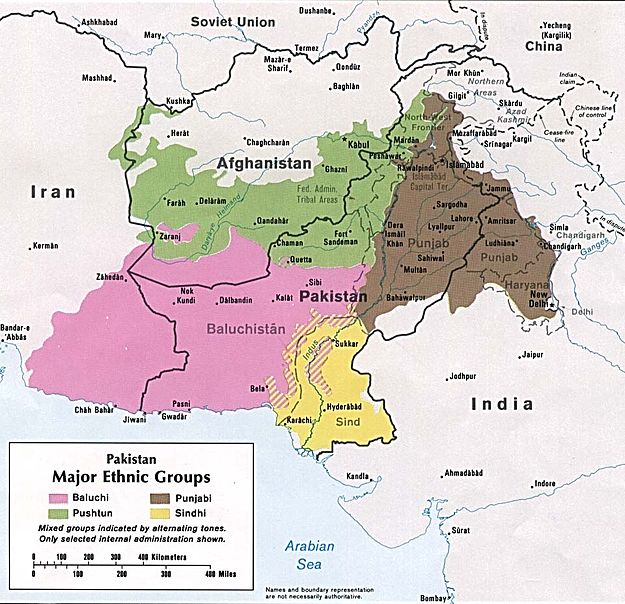
Baloch population in Pink: In Iran, Pakistan and Southern Afghanistan

Read More