
State discrimination against the Chinese is a form of cultural violence
By Wahyu Effendi
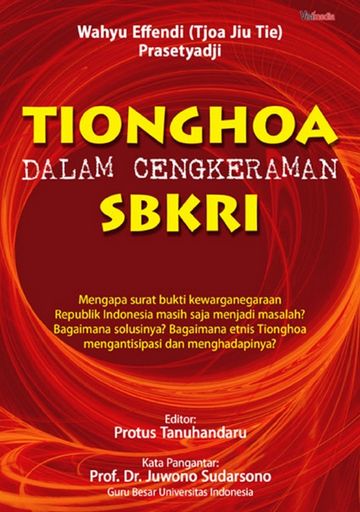
Cover image Tionghoa dalam Cengkeraman SBKRI (Chinese
Indonesians in the grip of the SBKRI)
Wahyu Effendi
Unlike Indonesians of Arab or Indian descent, Chinese Indonesians are required to have a document that proves they are Indonesian citizens. Whenever Chinese Indonesians deal with the bureaucracy, they are obliged to produce this document. It is an integral part of their administrative experiences of birth, marriage and death. They need it to get an identity card, to enrol in an educational institution, to obtain a business license and to get a passport.
Known by the acronym SBKRI, this document is compulsory for all Chinese Indonesians of 21 years of age or over, even if they were born in Indonesia to parents who were already Indonesian citizens. There is no equivalent document for other Indonesians, who simply have to show their identity card and their birth certificate. In practice, the SBKRI is a mark of ethnicity – for which Chinese must pay dearly – that passes down through the generations without end.
Cultural violence
It is not surprising, then, that Chinese Indonesians talk constantly about how they have to prove their ‘Indonesianness’ from the cradle to the grave. Take the experience of a friend of mine in Surakarta, who I’ll call Kwee Giok Nio. When he went to register the death of his mother, he had to produce her SBKRI before he could get permission to bury her. In another example, a Registry Office bureaucrat demanded that a Chinese Indonesian friend of mine called Roni produce his mother’s SBKRI before he could register his marriage. When Roni protested, saying that the SBKRI was no longer required, the bureaucrat asked him if he’d heard that from the President of the People’s Republic of China.
As these anecdotes suggest, an SBKRI is not just an administrative document or a harmless bureaucratic requirement. It is a sign of Indonesia’s mistrust of its Chinese citizens, which has its roots in the Emergency Regulation of 1958, under which an SBKRI could be requested if someone’s Indonesian citizenship was in doubt. The fact that the SBKRI persisted into, throughout and beyond the New Order is a clear sign that the ‘Indonesianness’ of Chinese Indonesians as a group is still in question, even for the state. As a consequence, even third generation Indonesians of Chinese descent are considered ‘foreign’ and not ‘Indonesian’.
The government’s failure to deal more decisively with the SBKRI issue is a sign of a much bigger problem.
State discrimination has had inevitable consequences for the status of Chinese Indonesians in the community, affecting everything from their level of political engagement to their social relations. Frans Hendra Winarta, a member of the Indonesian National Law Commmission, goes as far as to claim that anti-Chinese discrimination in Indonesia constitutes a form of cultural genocide. And although the SBKRI policy has never directly killed anyone, indirectly it played a role in Indonesia’s violent anti-Chinese race riots. In any case, crimes against humanity cannot always be measured in terms of lives lost or physical violence – they can also take the form of ‘cultural identity violence’.
Read More