
Category: Uncategorized
Rajendra Krishan, Rafi, and Madan Mohan haunting song
by B. R. GOWANI
The following song is from 1964 film Sharabi (Drunkard) starring Madhubala and Dev Anand. This song is picturized on Dev Ananad, remembering frequent scenes of the good times he had spent with Madhubala.
The song belongs to the period considered as the Golden Era of India’s Hindi/Urdu film music. The singers used to do a few hours riyaaz everyday to further improve vocals. Music was not very commercialized. Music directors were dedicated to their art and produced great work. Poets created some meaningful and heart wrenching lyrics.
Post British India’s first prime minister Jawaharlal Nehru was an atheist and an enthusiatic supporter of arts. The film industry than was secular and was free of the hateful movies being churned out in Modi’s India today. (See here, here, here, here, and here.)
The music for the song is by Madan Mohan, the poet is Rajendra Krishan, and the singer is the evergreen and most versatile Mohammed Rafi.
Rafi was a devout non-drinking Muslim but the song gives an impression as if he is drunk.
The Urdu language was prominent in movie dialogues and songs. The religious imagery was used by poets in a secular manner.
Mujhe le chalo aaj phir us gali mein

mujhe le chalo Aj phir us gali meiN
jahAN pehle pehle ye dil laDkhaDAyA
vo duniyA vo meri muhabbat ki duniyA
jahAN se meiN betAbiyAN le ke AyA
 mujhe le chalo

jahAN so rahi hai meri zindgAni
jahAN chhoD AyA mein apni javAni
vahAN Aj bhi ek chaukhaT pe tAzA
muhabbat ke sajdohN ki hogi nishAni
mujhe le chalo

vo duniyA jahAN uske naqsh-e-qadam hai
vahiN meri khushiyAN vahiN mere gham hai
meiN le AuNgA khAk us rahguzar ki
ke us rahguzar ki to zare sanam hai
mujhe le chalo

vahAN ek rangeen chilman ke pichhe
chamaktA huwA uskA rukhsAr hogA
basA luNgA AnkhoN mein vo roshni meiN
yuNhi kuchh ilAj-e-dil-e-zAr hogA

mujhe le chalo Aj us gali meiN
jahAN pehle pehle ye dil laDkhaDAyA
vo duniyA vo meri muhabbat ki duniyA
jahAN se meiN betAbiyAN le ke AyA
 mujhe le chalo

Today, please take me again to that lane

today, please take me again to that lane
where my heart had first staggered
that world, that world of my love
from where I brought restlessness
please take me

where my life (love) is sleeping
where I left my youthful years
on her door, even today you will see
fresh marks of love-prostations <1>
please take me

that world where her foot prints are
that's where my joys and sorrows are
I'll bring the earth of that pathway
that path's particles are beloved to me
today, please take me

there behind a colorful curtain
would be her glowing face
in my eyes I would settle her luminosity
that's how my tortured heart will get some relief

today, please take me to that lane
where my heart had first staggered
that world, that world of my love
from where I brought restlessness
please take me
Note
<1> SajdohN is a plural of sajdah, a Muslim prostration performed during the Islamic prayer. Poet Rajendra Krishan was a Hindu but is using Muslim imagery.
Vice versa Muslim poets used Hindu imagery where situation in films demanded it. Example: Man tarpat hai hari darshan ko, the most famous bhajan was written by Shakeel Badayuni, set to music by Naushad Ali, and sung by Mohammed Rafi — all three were Muslims.
B. R. Gowani can be reached at brgowani@hotmail.com
Inquiring minds want to know: What foods should I put up my rectum?
by KATHLEEN WALLACE

Administrator of the Centers for Medicare and Medicaid Services Dr Mehmet Oz (in red tie) IMAGE/UNILAD
RFK Jr and AI Give the US Some Needed Health Advice
“Your scientists were so preoccupied with whether or not they could that they didn’t stop to think if they should.”
Yes, the United States Department of Health and Human Services has some unique health advice coming from their website-based AI chatbot. A brave individual asked the AI what are the foods that are recommended by the agency to insert in the rectum? Kind of like asking about the food pyramid and such but related to.………your butt. Without hesitation or even a blush of the cheek, the response came back clear and decisive: bananas and cucumbers.
The question was asked on the official site, and the solid information was delivered. It’s clearly an indication that all of the brain-drain and loss of scholars during the Trump regime have not toppled our position at the forefront of public health. No, all those canceled research dollars have not affected the caliber of information coming out of our nation in the slightest. Lesser nations may tell you to put absurd things in your rectum like arugula or even kimchi, but the United States health platform with RFK Jr at the helm will make sure that only the most correct and up-to-date information is available (in terms of what to put up your ass).
We have had what looks like the elevation of the most idiotic and damaged individuals to the top positions in the Trump administration. RFK Jr. is a standout even in this crowd of misfits.
Senator Bill Cassidy of Louisiana noticed an incongruity in the headspace of this man. In September of 2025 RFK Jr said that Trump deserved a Nobel Prize for initiating Operation Warp Speed and the subsequent roll-out of Covid vaccinations. Cassidy asked RFK Jr if he stood by that statement. He said “absolutely”. Then Cassidy offered: “But you just told Senator Bennet that Covid vaccine killed more people than Covid.” RFK Jr didn’t have a coherent response to this gotcha moment. The brainworm subsequently died of Cringe, just from living in that man’s noggin.
Before you give too much credit to Cassidy for pointing out such obvious disparities of rational thought, you do need to know that Cassidy has been called Louisiana’s Susan Collins due to his oft repeated levels of concern. He shows his furrowed brow and then subsequently votes for anything Daddy Trump wants, including placing RFK Jr in charge of HHS. Of course, this isn’t enough to guarantee Trump won’t still go after you as evidenced by Trump endorsing an even nuttier individual running against Cassidy. The MAGA don’t seem to know how thin the tightrope is that they walk and how Trump thrives on withdrawing support at even the slightest notion of disloyalty. He seems to genuinely enjoy it. One minute you are a Vice President, then next some guys are looking to hang you. You would think out of some form of self-preservation that these fools would band together against Trump before the time comes when they lose favor. I guess you can’t accuse any of them of being very clever or able to see what’s coming up on their own horizon.
Kathleen Wallace for more
Who are you?
by JINOY JOSE P.

Dear Reader,
In Kafka’s The Trial, Josef K. wakes one morning to find two strangers in his room. They tell him he is under arrest. He asks why. They don’t know. He asks to see their papers. They don’t have any. He pulls out his bicycle permit, then his birth certificate, hoping one of these will settle the matter. It settles nothing. The agents have no interest in what Josef K. can prove about himself. They are interested only in what the court has decided about him.
More than a century later, this scene has lost none of its force. Across the world, governments are tightening the terms on which a person is allowed to be who she claims to be. In India, where three new laws were passed in rapid succession in March 2026, the state has moved further into the private territory of identity—regulating religious conversion, gender recognition, and marriage in ways that put the burden of proof on the individual. But this is not only an Indian story. The question it raises is as old as political philosophy: who does the state think a person is?
Every legal system carries an implicit theory of personhood. Liberal laws that came out of the Enlightenment and were adopted unevenly across the colonised world, start from a particular assumption: that the basic unit of society is the individual. She has rights. She makes choices. She enters contracts, including marriage, on her own terms. The state exists to protect her autonomy, not to define it.
But there is an older model that never really went away. In this model, the person is not the basic unit. The family is. The caste is. The community is. A person’s identity is not self-generated but ratified—by parents, by priests, by village elders, by magistrates. You are your father’s son, your community’s member. Before you can say who you are, somebody else must confirm it.
B.R. Ambedkar understood this better than most. In Annihilation of Caste, his undelivered speech of 1936, he argued that Hindu society did not recognise the individual at all. What it recognised was the caste, the sub-caste, the family—nested circles of belonging that left no room for a person to define herself on her own terms. “In every Hindu the consciousness that exists is the consciousness of his caste,” he wrote. The individual was not merely constrained. She was, in a philosophical sense, absent. Ambedkar spent his life trying to make her present—in law, in politics, in the Constitution he drafted.
The relationship between the state and the individual has never been a settled matter. For most of human history, the question did not arise: people belonged to lords, clans, castes, congregations. The idea that a person might stand before the state as an autonomous unit, bearing rights that preceded the state, was a late and radical invention. And even then, it was partial. The French Declaration of the Rights of Man and of the Citizen in 1789 spoke grandly of liberty and equality, but it took another century and a half for French women to get the vote. The Indian Constitution enshrined fundamental rights for all citizens, but personal law—governing marriage, inheritance, and family—remained divided along religious lines, each community’s patriarchs left to adjudicate the lives of their people.
The modern state was supposed to resolve this. Modernity was the promise that the individual would finally emerge from the shadow of the group. You could leave the village. You could marry whom you chose. You could change your name, faith, gender. The state’s job was to record these choices, not approve them.
What is happening in India and elsewhere is the reversal of that promise.
Frontline for more
Iran’s cunning communication tactics erode US credibility across Muslim world

Diplomatic cables indicate that several governments with historical ties to Washington are increasingly concerned about their populations’ growing disdain for the US government
Washington’s reputation has taken a major hit in Muslim-majority nations since the start of the US-Israeli war on Iran, mainly due to ingenious communication tactics deployed by the Islamic Republic, according to diplomatic cables reviewed by POLITICO.
The cables specifically detail the war’s aftermath in three Muslim countries located in different parts of the world: Bahrain, Azerbaijan, and Indonesia.
“Taken together, the cables paint a picture of countries where the US is losing the population’s trust, and potentially that of their governments,” the DC-based outlet reports.
Since the beginning of the war, Iranian embassies and digital creators have extensively used memes and various tools across multiple online platforms to undermine Washington’s often confusing and aggressive messaging.
In particular, AI-generated satirical videos produced by Iranian digital media company Explosive Media, styled like Lego movies, have consistently gone viral on social media, racking up millions of views.
? Iran-linked accounts are circulating a new LEGO-style propaganda video portraying U.S. and Israeli leaders as corrupt elites tied to the “Epstein files,” part of a broader online campaign aimed at undermining support for the war.
The animation depicts President Donald Trump… pic.twitter.com/PdjcJGrjuy— Drop Site (@DropSiteNews) April 9, 2026
The popularity of the videos led YouTube to suspend Explosive Media’s channel for alleged “violent content.”
“Seriously! Are our LEGO-style animations actually violent?” Explosive Media asked via social media following YouTube’s ban.
???? The Iranians are following everything we’re saying on social media
Insane music video ?? pic.twitter.com/vjgNPRlpnj— Middle East Observer (@ME_Observer_) April 15, 2026
Iranian embassies have also been instrumental in undermining Washington’s justifications for its war of aggression, often poking fun at US government officials and challenging their statements.
The Strait of Hormuz will be controlled by me and the Ayatollah?? pic.twitter.com/IxIgo1Pn6S— Iran Embassy SA (@IraninSA) March 23, 2026
On the other hand, US embassies across the world have “been instructed not to create original content about the Iran war to share publicly and instead are largely limited to reposting approved messaging from the White House or the State Department,” POLITICO reports.
The situation is compounded by US diplomats becoming “afraid to speak up under the Trump administration after it largely sidelined them from key foreign policy decisions, fired numerous members of the Foreign Service and emphasized ‘fidelity’ for those left.”
The Cradle for more
Gen Z’s biggest fear is laughable at first. But it’s quietly wreaking havoc on their lives.
by KELSEY WEEKMAN

More than 50% of Gen Z-ers say anxiety about being cringe has prevented them from opening up emotionally. How did a reign of self-censorship come to define young Americans?
Here’s a nonexhaustive list of things Gen Z finds cringe: drinking, getting a driver’s license, having a boyfriend, going out, not going out, using the wrong emojis, using the wrong slang, parting your hair the wrong way, wearing the wrong jeans. It’s cringe to try and it’s cringe not to try hard enough.
It’s easy to dismiss Gen Z’s particular aversion to cringe as kind of silly — finding things embarrassing is a rite of passage for young people and always has been — but cringe is so much more than a fleeting reaction or a punch line for generational mockery. It’s become the trait that most defines and unites Gen Z-ers, who are now between the ages of 14 and 29.
Their fear of cringe is an internal censor that shapes what they say, post, pursue and even feel comfortable wanting. It’s a prison of young people’s own making as they try to take flight as adults. A new Yahoo/YouGov poll demonstrates how this anxiety has shaped their lives in very real ways: More than half of adult Gen Z respondents said that they have avoided expressing themselves freely online for fear of coming across as cringe. It has also seeped into their lives beyond the internet: 55% say fear of cringe has prevented them from opening up to someone emotionally; large shares say that it has held them back romantically and prevented them from pursuing hobbies and seizing professional opportunities.

“I have avoided sharing stuff with friends and family out of fear of coming off as being cringe,” Charlie, a 19-year-old Connecticut resident, tells Yahoo. “What often happened was my own personal passion for the thing died out and I felt like I was weird for ever even liking it.”
This phenomenon is perhaps a natural consequence of how Gen Z came of age: They were the first to grow up entirely online, with technology in their hands from an early age. They’ve adapted to being constantly surveilled and picked apart by ever more punishing versions of the internet than other generations experienced. Who could blame them for their nerves?
Yahoo for more
Israel just passed a law sanctioning the lynching of Palestinians…so why is the Congressional Black Caucus so silent about it?
by ANTHONY ROGERS-WRIGHT

The same caucus that celebrated the Emmett Till Antilynching Act refuses to condemn Israel’s new death penalty for Palestinians.
“The Black Caucus has never – and should never – recover any vestige of dignity after putting the Democratic Party ahead of hundreds of thousands of poor and exiled Black people.” – Glen Ford
Last month, the zionist ethnostate of Israel, once again, made its wanton disregard for the humanity and people(s)-centered human rights (PCHRs) of Palestinian people known to the entire world with passage of a new law mandating the death penalty of Palestinians of the Occupied West Bank convicted of carrying out “deadly terror attacks.” By a vote of 62-47, the Israeli Knesset approved the new measure and further stipulated that the executions of Palestinians would be carried out by hanging as the default method of punishment. Passage of the new edict was celebrated by Israel’s right wing National Security Minister and zionist zealot, Itamar Ben Gvir, who not only celebrated by drinking champagne on the Knesset floor, but also by wearing a pin in the shape of a noose.

Israel National Security Minister, Itama Ben Gvir. Credit: AP Press
Concerns with the racist nature of Israel’s new law, which would only apply to Palestinians, were raised in a joint statement released by the governments of Germany, Italy, France, and the United Kingdom, which, in part, stated, “We are particularly worried about the de facto discriminatory character of the bill. The adoption of this bill would risk undermining Israel’s commitments with regards to democratic principles.” Additionally, deputy Middle East Director at Human Rights Watch, Adam Coggle, stated, “Israeli officials argue that imposing the death penalty is about security, but in reality, it entrenches discrimination and a two-tiered system of justice, both hallmarks of apartheid.” Coggle added, “The death penalty is irreversible and cruel. Combined with its severe restrictions on appeals and its 90-day execution timeline, this bill aims to kill Palestinian detainees faster and with less scrutiny.” And the Israel-based human rights group, B’Tselem, highlighted the fact that Palestinians are tried in military courts, unlike Israeli citizens, including radical Israeli settlers who have been increasingly carrying out terrorist attacks in the Occupied West Bank, who are tried in civilian courts, Palestinians are tried in military courts. This is a salient distinction as military trials of Palestinians have a, 96% conviction rate, based largely on “confessions” extracted under duress and torture during interrogations.”
BAR for more
Iran ceasefire: Not an off-ramp for the US but a life-saving ejection seat
by RAMI G. KHOURI

It’s the first time that a Middle Eastern country has single-handedly checked the massive war-making capabilities of the US and Israel.
Whatever the fate is of the putative two-week ceasefire agreement between the US and Iran, it remains historically significant due to novel dynamics that the war just revealed and that portend important new power relations regionally and globally.
These include both positive and negative developments that are epic in their magnitude and historic in their implications for the future.
Most analysis in the West has spoken of Trump searching for an “off ramp” to escape the danger he had painted himself into – using the analogy of how drivers on highways seek an exit ramp to enter a rest stop or a lower-intensity side road. But what Iran has actually done is to instead offer Trump and Israel a chance to press the ejection seat button to escape their damaged fighter-jet – and survive without achieving their war aims.
The war’s critical new dynamics have included the massive destruction of essential civilian infrastructure and military facilities across the region, by the US, Israel, Iran and Tehran’s allies.
This includes the American threat of Iran’s annihilation alongside Israel’s actual genocidal destruction of all life-supporting mechanisms in Gaza and much of south Lebanon. This disrupted vital global supply chains that impact every life and economic dimension – food, energy, water, technology, travel — and was tacitly supported by all actors’ foreign allies.
It also confirmed the death of any international law or global treaty protections for non-combatants that once differentiated between military and civilian needs. All humans on Earth now live in danger.
Positive aspects of the Pakistan-mediated two-week ceasefire agreement are that it has been accepted — if not fully implemented — by all, and includes substantive concessions by all.
Negotiations can succeed if the US and Israel send serious adults to discuss permanent peace, instead of frivolous media performers, professional killers, and nasty colonial officers. The US negotiators in particular should reflect the interests, values, and views of the American people, and stop taking instructions from Israelis.
Compliance with Israeli demands, however, is not only a Trumpian phenomenon; Washington has consistently reflected Israeli priorities and wishes in the Middle East since the 1950s, while not seeing the Palestinians, Lebanese, Iranians and others in the region as people with equal rights to Israelis.
This war was instigated by decades of repeated Israeli pressure, exaggerations and lies about Iran’s unproven threats to the US and the region that successive White House leaderships swallowed. It was finally triggered by Trump and a few fellow circus-vintage dramatists — who also never consulted Congress as constitutionally required, and did not reflect the wishes of the American people, two-thirds of whom oppose the war.
Al Jazeera for more
The Mexican security company with a $1.27 billion surveillance empire
REST OF WORLD

Founded as a home alarm business in 1995, Grupo Seguritech now operates 188 command centers across Mexico and has at least 31 subsidiaries. Now it’s coming to the U.S.
This article was adapted from our latest investigation, produced in partnership with Type Investigations: A Mexican surveillance giant you’ve never heard of is now watching the U.S. border.
Grupo Seguritech was founded in Mexico City in 1995 by father-son duo Shimon and Ariel Picker as a small company selling alarm systems for homes.
The company’s first foray into government work was installing a network of municipal security cameras, according to Seguritech’s website. By 2004, the company had installed its first video surveillance center. And in 2013, it designed Mexico’s first C5 command center, a type of facility that connects local, regional, and federal law enforcement agencies and integrates intelligence gathering with public emergency services.
What does Grupo Seguritech do?
Today, Grupo Seguritech does work in a variety of fields. It has established prison surveillance systems and provided drones and tactical vehicles to government partners. It has received a government contract for meteorological radars, and built an aerospace division called SeguriSpace that launched 18 satellites into orbit for meteorology work.
Seguritech’s bread and butter, though, is its top-to-bottom surveillance packages, which it helped pioneer in Mexico. Government contracts obtained via public records requests show that alongside constructing command centers, the company and its subsidiaries design intelligence gathering and sharing systems, procuring the necessary equipment — cameras, drones, license plate readers, and computer software — or supplying their own equipment.
“We look for the best practices and technologies and we integrate them,” Picker had said in a TV interview from about a decade ago. “So we look for the best video camera system with the best software, the best turnstiles, the best software for access control, the best fiber, the best installation practices.”
Seguritech’s subsidiaries
Grupo Seguritech does not list all of its subsidiaries publicly. However, internal company documents obtained by Rest of World and Type Investigations list 27 subsidiaries under the Grupo Seguritech umbrella, most of which operate in the security field and are based in Mexico. Public records revealed at least three more branches of Seguritech outside of Mexico.
Rest of world for more
History: When Persia freed the Jews
by MASOOD LOHAR
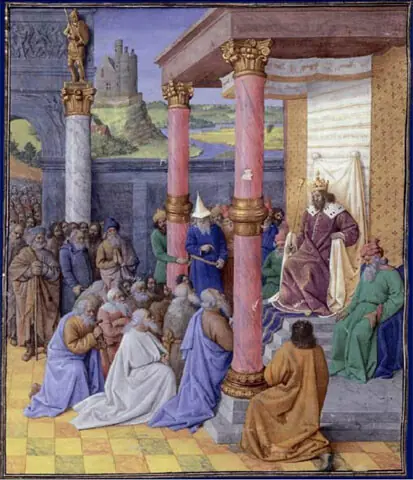
When Babylon fell to the armies of Cyrus the Great in 539 BCE, the world witnessed not just the collapse of an empire but the birth of a new vision of rule.
For the Jews exiled in Babylon, this Persian conqueror was no ordinary king. He was a liberator, remembered in scripture as “the Lord’s anointed” — the only non-Jew ever to be given the title of Messiah in the Hebrew Bible.
This remarkable episode — where a Persian monarch enabled the rebuilding of the Jewish Temple in Jerusalem — remains one of history’s most fascinating encounters between two ancient civilisations. It is a story of exile and return, of empire and faith, and of how tolerance can shape legacies that endure for millennia.
The Exile and the Promise of Return
The Jews had been living under the shadow of Babylonian captivity since 586 BCE, when King Nebuchadnezzar destroyed the First Temple [Solomon’s Temple] in Jerusalem and deported thousands to Babylon. For decades, their identity was tested in foreign lands, their rituals suppressed, their hopes dimmed.
When Cyrus the Great defeated Babylon, he handed the exiled Jews something they had not had in decades…
Then came Cyrus. In a sweeping campaign, he conquered Babylon and issued a decree that allowed displaced peoples — including the Jews — to return to their homelands. For the Jewish community, this was nothing short of miraculous. The Book of Ezra records his edict: “The Lord, the God of heaven, has given me all the kingdoms of the earth… and he has appointed me to build a temple for him at Jerusalem in Judah.”
A King Unlike Others
What made Cyrus different from other conquerors? Unlike rulers who sought to erase local traditions, Cyrus embraced diversity. His empire stretched across vast lands, yet he allowed subject peoples to worship freely and govern themselves in matters of faith.
The famous Cyrus Cylinder, an ancient clay cylinder inscribed in Akkadian cuneiform and discovered in Babylon, describes his policy of restoring temples and returning exiled communities — a vision of rule that resonates with modern ideas of human rights.
For the Jews, Cyrus was not just a political figure but a spiritual saviour. The prophet Isaiah even described him as chosen by God to deliver Israel. This intertwining of Persian statecraft and Jewish theology created a bond that shaped both traditions.
Dawn for more