
By Kristin Palitza
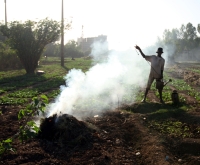
Burkinabé farmer irrigating crops from a hand-dug well: changing rainfall patterns could devastate small farmers.
Credit: Tugela Ridley/IRIN
ROME, Feb 26 (IPS) – Organic and eco-friendly farming can feed the world, contrary to the common belief that biotechnology and chemical-intensive farming are indispensable, modern strategies to increase production, agricultural experts say.
“It is not necessarily about producing more food, but about producing more quality nutrition through less energy use and pollution,” declared Hans Herren president of the Washington DC-based Millennium Institute, a non-profit organisation promoting long-term, integrated, global thinking.
“We have to invest heavily into research on how to increase eco-agricultural production.”
The best way to mitigate climate change and gain food security is to support small-scale, ecological farming, scientists and economists said during the International Fund for Agricultural Development (IFAD) Governing Council in Rome, Italy, in late February. This would be a turnaround from international agricultural strategies of the past two decades that heavily promote monocropping and the use of biotechnologies.
“Nobody has really thought yet about how and if we can mitigate climate change in agriculture,” admitted Dr Josef Schmidhuber, head of the global perspectives study unit at the United Nations Food and Agriculture Organisation (FAO), indicating that although there is a lot of talk about averting the impact of climate change, no policies have been implemented yet to solve the problem.
“It starts and ends with governance, with convincing key decision makers to change strategy,” said Herren. “We know what the solutions to climate change are, but they are not put into practice because governments are in bed with the biotechnology industry. They are more interested in making a quick buck than in the long-term benefits of farmers.”
Herren believes industrial agriculture is “bankrupt by definition”, because it costs too much energy to produce: “For every calorie you produce you have to put in ten, if you look at fuel, fertiliser and labour needed.”
He lobbied policymakers to focus on prevention rather than fixing crises: “In agriculture, it takes a long time to rebuild what we destroy. It takes years to replenish soils and re-create diversity. We have to go back to the source and ensure that healthy soils grow healthy crops.”
Chemical-heavy agriculture has been systematically destroying soils, Herren complained, by causing mineral depletion, erosion and reducing soils’ ability to retain water.
“For small-scale farmers, water is far more important than having a pest-resistant, genetically modified plant, which is only resistant to one particular type of pest anyway,” he said.
Downward spiral Agriculture is the main income source for poor rural people in the developing world. At the same time, it is the human activity most directly affected by climate change.
Climate change will affect smallholder farmers (who own less than two hectares of land) through increased crop failure, a rise in diseases and mortality of livestock, increased livelihood insecurity resulting in assets being sold, indebtedness, migration and dependency on food aid. Other consequences will be desertification and land degradation, rising sea levels causing floods, diminishing natural resource productivity and, in some areas, irreversible loss of biodiversity.
Climate change is expected to put 49 million additional people at risk of hunger by 2020, and 132 million by 2050, according to IFAD. In sub-Saharan Africa, an additional 17 to 50 million people could be undernourished in the second half of the century due to climate change.
Generally speaking, climate change is expected to lead to a downward spiral in human development indicators, such as health and education, especially in sub-Saharan Africa.
“To feed the world, we will have to scale up productivity, but in an ecological way, by polluting less and making use of low-cost technologies,” said Michel Griffon, executive director of the National Research Agency of France. “We need a holistic approach to the entire ecosystem, including soil, water, plants, animal management, pests and diseases. It will be an immense challenge.”