
by L. ALI KHAN
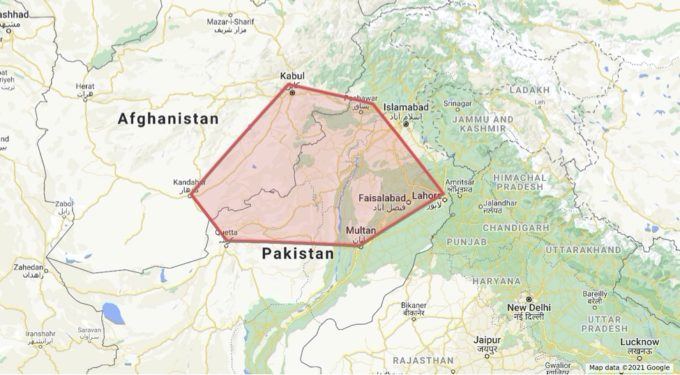
The Afghanization of Pakistan is a relentless historical phenomenon that started several centuries ago and shaped the regional dynamics. This article focuses on the Gandhara region that cuts across Afghanistan and Pakistan and cements them together. The ancient Silk Route passed through Gandhara, as does the modern Karakoram Highway. The study demonstrates that the Gandhara history nurtures the enduring religious and military traditions critical to the persistence of militancy in the region.
The Afghan warriors, some of the Turkic ancestry, transformed the Gandhara region and the contiguous areas through invasions, Islamization, and de-Hinduization — a set of forces that created modern Afghanistan, separated Pakistan from India, and may influence the future of Kashmir. The Taliban of Afghanistan and the Taliban of Pakistan are the current versions of the old warriors. The ancient warriors, Afghan Turks, and the Mughals ventured into and beyond Gandhara to reach Delhi and further East into India. The modern warriors, carrying the Gandhara sensibilities, refuse to accept invasions and occupations. They also resent the Indian sovereignty over Muslim Kashmir since it runs antithetical to the historical narrative of de-Hinduization of Muslim territories.
Below, a brief historical overview will explain how the Afghan weltanschauung (spirit of fighting and piety) shaped the six historical cities of Kabul, Kandahar, Quetta, Multan, Lahore, and Peshawar, framing the Gandhara Hexagon. Even though its borders have contracted and expanded under various rulers, the Gandhara Hexagon contains Pashtuns, Balochis, Punjabis, and numerous other ethnic groups. Afghanistan and Pakistan, as presently constituted, are modern nation-states built around the Gandhara region.
Note that Mumbai, Kolkata, Chennai, the sacred Hindu city Varanasi, and the holy rivers of Ganga and Jumna, regardless of Muslim rule for centuries, seem light years away from the Gandhara region. Even Muslim Bangladesh that eventually broke away from India and Pakistan shared inconsequential Gandhara awareness. However, Srinagar of Kashmir is ethnically and geopolitically much closer to the Hexagon. Prime Minister Imran Khan and the military establishment call Kashmir Pakistan’s “jugular vein.”
Historically, even before the arrival of Islam, what unites Afghanistan and Pakistan geography is the Gandhara region, farmed with deep memories of thousands of years. What presently divides the Gandhara region is the 1893 Durand Line that the British drew in the sand after the second Anglo-Afghan war to separate Afghanistan from what the imperialists called British India.
For centuries, the Greeks, Persians, Arabs, Hindus, and the Chinese all assembled in Gandhara to exchange goods, ideas, and cultural artifacts. Various invaders, ancient and contemporary, such as Alexander the Great, the British, the Soviets, and the Americans, dreamed of bringing the Gandhara region under their control. The Arabs brought Islam to western Afghanistan, but the Afghan warriors carried Islam forward to transform Gandhara into an Islamic territory, imbuing its inhabitants with the pietistic urge to expand Islam into the South and East lands.
A young Winston Churchill (1874-1965) spent some time as a military officer and war correspondent in Nowshera, a Pakistani town in the Gandhara region.
Counterpunch for more