
by GIORGIO TRUCCHI
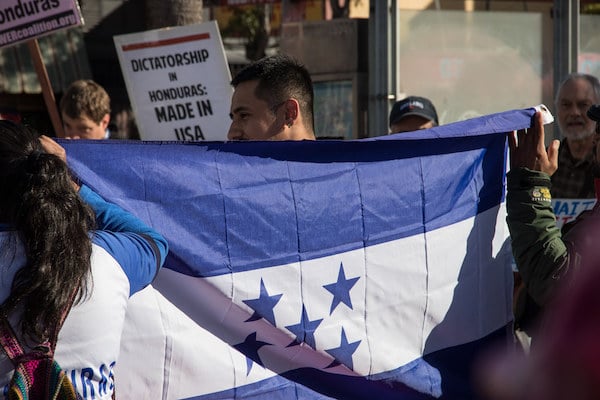
On November 28, more than 5 million Hondurans will be asked to elect the President of the Republic, 128 deputies to the National Congress, 20 to the Central American Parliament, 298 mayors and more than 2 thousand municipal councillors.
As the election date approaches, the political atmosphere has become polarized, conflict has intensified and social tension grown.
No one has forgetten the violent repression of 2017 against those who protested against the gross electoral fraud that prolonged the agony of the current government regime. At that time, more than thirty people lost their lives violently and these crimes have remained in total impunity.
The bloody events of the last few days reawaken the ghosts of that violence and repression
On November 11, a Liberal Party candidate for councillor, Óscar Moya, was shot several times in Santiago de Puringla (La Paz). Two days later the mayor of Cantarranas (Francisco Morazán) and candidate for reelection for the Liberal Party, Francisco Gaitán, was assassinated.
The following day the leader of the opposition Libertad y Refundación (Libre) Party, Elvir Casaña, and a Liberal Party activist, Luis Gustavo Castellanos, were killed in San Luis (Santa Bárbara) and San Jerónimo (Copán), respectively. Two other activists were wounded in the deadly attack on Castellanos.
On November 15, another attack killed Dario Juarez, a Liberal Party vice-mayor candidate in the municipality of Concordia (Olancho). Two days later, unknown persons made an attempt on the lives of Héctor Estrada, independent candidate for mayor of Campamento (Olancho) and Juan Carlos Carbajal, candidate for mayor of El Progreso for the Salvador Party of Honduras.
According to the Office of the United Nations High Commissioner for Human Rights (OHCHR) in Honduras and the National Violence Observatory (ONV) of the National Autonomous University of Honduras (UNAH), more than 30 violent deaths have been registered in the context of the current electoral process, which is shaping up to be even more violent than that of 2017.
The Observatory reported at least 64 cases of electoral violence up until October 25, including 27 homicides and 11 attacks. To these must be added the most recent attacks that took the lives of five people in five days (as detailed above) and other non-fatal attacks.
The OHCHR condemned these acts of electoral violence “that affect the right to political participation” and urged the authorities to carry out “prompt, thorough and impartial investigations”.
A legacy of impunity
“These murders of local leaders are a prelude to what could happen during and after the elections. Let us remember that all this is happening after the approval in Congress of reforms and laws that deepen the criminalization of social protest and citizen mobilization,” warned Bertha Oliva, coordinator of the Committee of Relatives of the Detained and Disappeared in Honduras (Cofadeh).
“They have been practically legalizing repression against those who demonstrate their discontent and defend human rights. These are the results,” she added.
In 2017, repression against those protesting the electoral fraud orchestrated by the ruling National Party claimed the lives of 37 innocent victims (Cofadeh 2018). Of all these cases only one was successfully prosecuted and the charges against the police officer accused of shooting and killing were dismissed.
“The chain of command was never investigated, nor the context in which these deaths were caused. The dictatorship gave the military police guarantees of impunity to capture, torture and execute opponents in the streets. This only generates the conditions for similar and even more violent events to be repeated”, predicted the human rights defender.
In this sense, Cofadeh will be monitoring and denouncing any electoral crimes committed before and during Election Day, as well as violations against people exercising their right to vote.
Three for the presidency
Of the 16 presidential aspirants, only three have a real chance of winning: Xiomara Castro of the opposition Libre Party, who leads most polls; Nasry “Tito” Asfura Zablah of the National Party, main opponent of the former first lady and Yani Rosenthal of the Liberal Party, representing the other traditional party in Honduras but with little chance of victory.
Monthly Review Online for more