
by DANNY SHAW
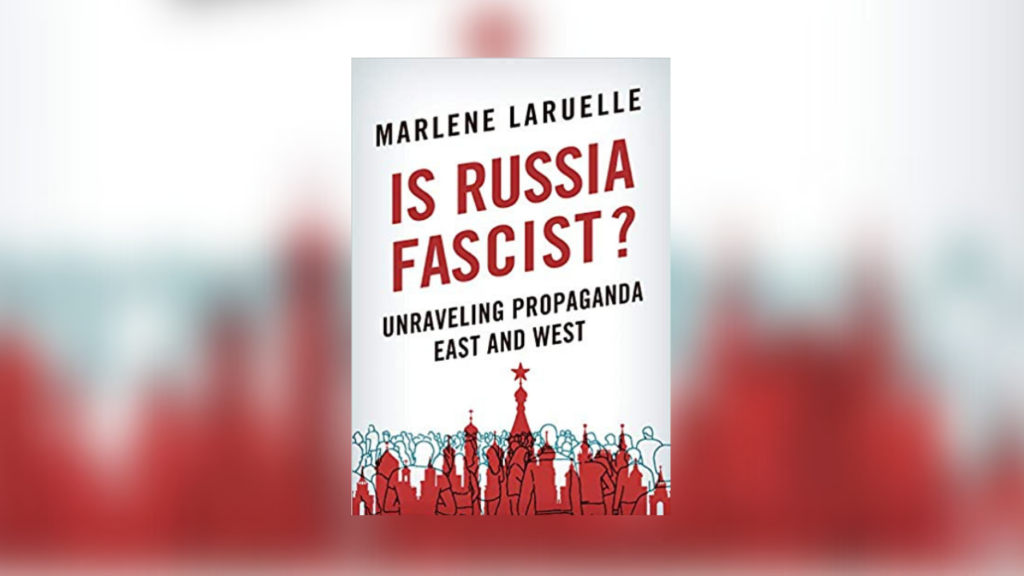
Is Russia Fascist?: Unraveling Propaganda East and West by Marlene Laruelle (Ithaca, New York: Cornell University Press, 2021)
Mainstream liberal U.S. media such as MSNBC and the New York Times have dedicated countless hours and pages to presenting Russian President Vladimir Putin as the devil incarnate. In 2014, former U.S. Secretary of State Hillary Clinton went as far as to compare his actions in Ukraine to those of Hitler in Europe (p. 3). Then U.S. President Joe Biden called Putin a “killer” on March 17 in what appeared to be his way of proving how “presidential” he is compared to Donald Trump. When RT journalists were introduced on a 2019 panel at the Assembly of Journalists and Social Communicators in Caracas, the crowd of Venezuelans burst into applause chanting, “Putin, Putin, Putin!”
Vilified by certain global class forces and loved by others, what is the true ideological character of Putin and the Russian political leadership? Moving beyond certain propaganda, while remaining bogged down in a clear anti-Soviet evangelism, French historian Marlene Laruelle makes a convincing academic argument that Russian state ideology is not fascist.
The George Washington University professor and U.S. State Department researcher has dedicated her professional life to becoming an expert on Russian history and what she terms the dominant ideology of the Russian state today, “illiberalism.” Her book, Is Russia Fascist?: Unraveling Propaganda East and West, accomplishes two tasks: One that is intellectually honest and another that further contributes to the Memory Wars and Battle of Ideas by perpetuating biased Western views of key issues that have arisen in Soviet history and in contemporary Russia. An example of Memory Wars is when right-wing states raise questions about who actually collaborated with the Nazis in an attempt to create an alternative memory of events.
Dismantling the Claim That Russia Is Fascist
The greatest strength and central thread of the book is Laruelle’s consistency in proving the Russian state is not fascist.
Chapter 6 analyzes the country’s “vivid far-right landscape.” The author looks at skinheads, militia subculture, combat sports, extreme expressions of the Russian Orthodox Church, conspiracy theories, the Night Wolves motorcycle club, among other examples of this landscape. She concludes these ideological trends—similar to what is found in the West—are marginally present in Russia, but have little to no influence on Russian leadership and receive no institutional support from the state. This milieu, or ecosystem, as she calls it, is in fact “largely repressed by Russian state organs” (157).
Laruelle dedicates sections of chapters 6 and 7 to evaluating the reach of political analyst Alexander Dugin—known as “Putin’s brain”—and his international far-right contacts. She concludes the West exaggerates Dugin’s influence and his “networks and international visibility should not be the tree obscuring the forest” (126). Despite Western rumors, Laruelle writes, “Putin has never mentioned him [Dugin]” nor met him and she adds, “Dugin has little direct access to the highest echelons of the Presidential Administration” (118).
Laruelle explains slapping the fascist label on Putin and Russia is not scholarly, but is an attempt by certain forces to discredit Russia to prevent the country of 144 million from being taken seriously in the international arena. Her scholarship finds the Russian state draws from myriad ideological sources, such as social conservatism, Soviet nostalgia, illiberalism, Russian orthodoxy and Russian nationalism. The professor concludes: “If there is an overarching ideological trend to identify, it is illiberalism… a denunciation that holds that liberalism is now ‘obsolete’ and has ‘outlived its purpose,’ as Putin declared in 2019, and a return to an ideology of sovereignty—national, economic and cultural-moral sovereignty” (158). The way Laruelle uses “liberalism” sounds innocent enough, but it’s a euphemism for capitalism, imperialism and Western hegemony, words the author never uses in her book.
‘Unraveling Propaganda’ with More Disinformation?
Toward Freedom for more