
Humans far behind as robot breaks record at Beijing half marathon
A humanoid robot competing against flesh-and-blood runners broke the world record at a Beijing half marathon on Sunday, showcasing the rapid technological advancement achieved by Chinese makers. Humanoid robots have become a common sight in China in recent years, in the media as well as in public spaces.
Youtube for more
Humanoid robot breaks human half-marathon record; Drastic improvement reflects systemic advances in China’s robot technologies: expert
by TAO MINGYANG, CHEN QINGRUI, & NIU YINGBO
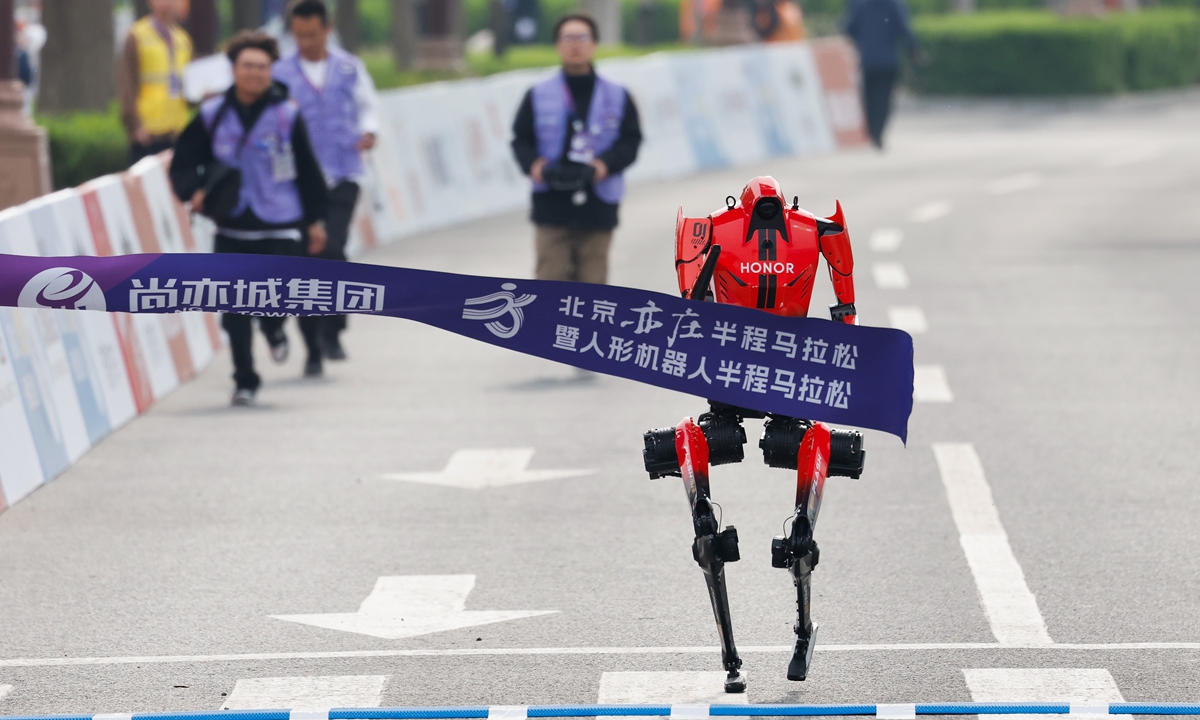
Just a year ago, humanoid robots stumbled awkwardly across the pavement, tripping mid-stride as human handlers rushed in to steady them. But on Sunday at the second Humanoid Robot Half Marathon in Beijing, robots didn’t just keep their balance – they rewrote expectations. The winning robot outpaced the human half marathon world record, while the top three finishers completed the course entirely autonomously, signaling a stunning leap in capability.
Charging through the 21-kilometer route in southern Beijing’s E-Town, the Robotics D1 humanoid robot – developed by Chinese smartphone maker HONOR and nicknamed “Lightning” – crossed the finish line in 48 minutes and 19 seconds in the remote-control category.
However, under the competition rules, the time posted by remote control robots is multiplied by 1.2, so the ultimate winner was another robot of the same type in the autonomous navigation group, which posted a winning time of 50 minutes 26 seconds, an enormous improvement from last year’s winning time of 2 hours and 40 minutes. It also outpaced the man’s half marathon world record of 57 minutes 20 seconds recorded by Ugandan runner Jacob Kiplimo in 2026 at the Lisbon Half Marathon.
Participation in the event expanded nearly fivefold, with 102 robot teams, including five international teams, taking part in the second edition. A total of 26 brands and more than 300 humanoid robots competed, according to official data. Of these, 47 teams completed the race – 18 via autonomous navigation and 29 via remote control—resulting in an overall completion rate of over 45 percent.
The marked improvement in the finishing time highlights systemic breakthroughs in China’s humanoid robot technologies, including power systems, control, perception and decision-making, Wang Peng, an associate research fellow at the Beijing Academy of Social Sciences who focuses on the tech sector, told the Global Times on Sunday. “The technology has moved beyond barely functional to rapidly approaching practical usability,” he said.
Faster and smarter
Global Times reporters watching along the route saw that when the robots set off alongside human runners, spectators burst into cheers, many recording the moment on their phones.
Compared with the inaugural event in 2025, the speed and the running postures of the robots have seen significant improvement. While many robots last year struggled to maintain balance at the starting point, nearly all entrants this year launched steadily and were able to adjust their speed smoothly on the bends, the Global Times noted.
The top three teams all deployed HONOR’s “Lightning” model, featuring autonomous perception and navigation as well as high-speed locomotion. Its speed and explosive power proved decisive, according to the company.
Du Xiaodi, a test and development engineer from the championship team “Qitian Dasheng,” told the Global Times on site that the robot’s design drew on elite human athletes, with leg length approaching one meter.
In addition, the robot’s joints are equipped with a liquid-cooling system adapted from consumer electronics such as smartphones. “The system can provide continuous cooling for the entire race,” Du said.
Global Times for more