
by CHRISTOPHE JAFFRELOT
It has more to gain than to lose.
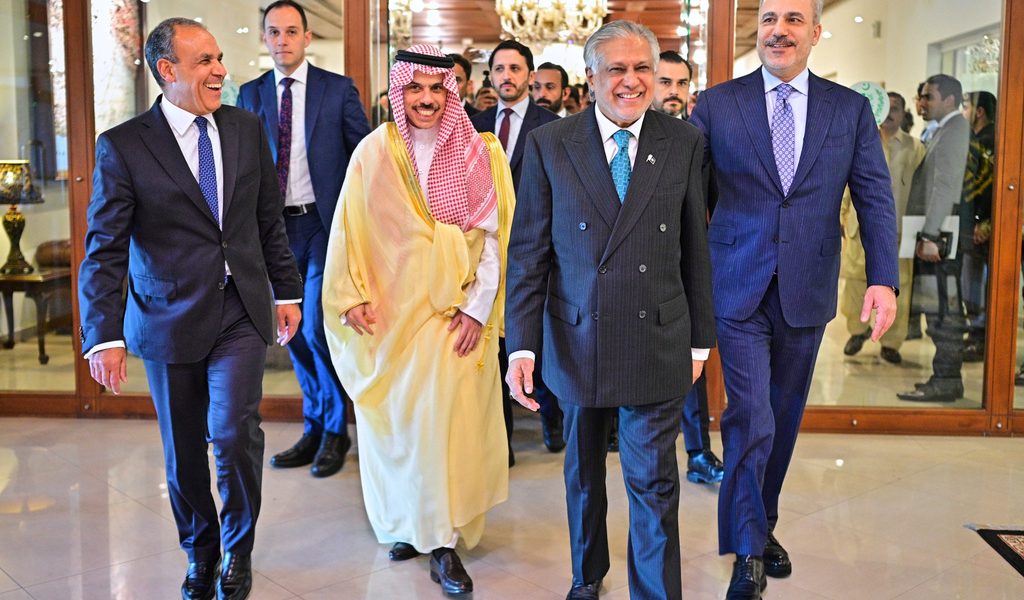
Last week, Pakistan delivered the Trump administration’s 15-point peace plan to Iran.
This is not the first time an American president has got Islamabad to play a mediating role: in the early 1970s, Richard Nixon had persuaded General Yahya Khan to serve as an intermediary between Washington and Beijing with a view to the official recognition of the People’s Republic of China, which took place shortly after a visit to the Chinese capital by Henry Kissinger – who was supposedly ill in Islamabad while Khan was introducing him to Mao Zedong.
Why is Pakistan going along with this? Because it has more to gain than to lose.
First, helping Trump – as it intended to do last year regarding the deployment of Pakistani troops to Gaza, which was ultimately rejected by Israel – is a way to cultivate the White House’s trust, which has already manifested itself in the resumption of military cooperation in exchange for rare earth minerals from Balochistan and an agreement on cryptocurrencies. Strengthening ties with the United States thus allows Pakistan to somewhat emancipate itself from its immense dependence on China and to reconnect with a country that was, throughout the Cold War – and again after 9/11, for nearly 15 years – a very generous partner, particularly in waging the war in Afghanistan, first against the Soviets and then against the Taliban: Islamabad may even hope for a return to the “good old days” when Pakistani officers were trained in the United States.
Second, it is a way to prevent Trump from criticising the war Pakistan has been waging in Afghanistan since last month – which amounts to repeating the scenario of 1970–71: Nixon needed the Pakistanis too much in his dealings with the Chinese to speak out against the repression of the Bengalis who were demanding independence – and who eventually achieved it.
Third, by taking on the role of mediator, Pakistan enhances its international prestige, particularly in relation to India, a country whose reputation has long been built on this type of action under Nehru (following the Korean War and the Indochina War) and which, today, remains silent.
Fourth, Pakistan is as badly affected by the Iran war as India – if not more: for a country suffering from a chronic trade deficit and heavy debts, the shock caused by the rise of the price of oil and gas is bound to result in an economic crisis with disastrous social consequences.
Fifth, acting as an intermediary allows Pakistan to avoid taking sides in a war that directly or indirectly pits countries against one another with which Islamabad seeks to maintain good relations, particularly Iran and Saudi Arabia. In 2015, this was the reason Pakistan had already refused to join the coalition Riyadh had formed to wage war against the Houthis in Yemen.
Getting involved would have risked alienating the country’s roughly 20% Shia population and, above all, Iran.
The Wire for more