
Abduction in Caracas
by TARIQ ALI
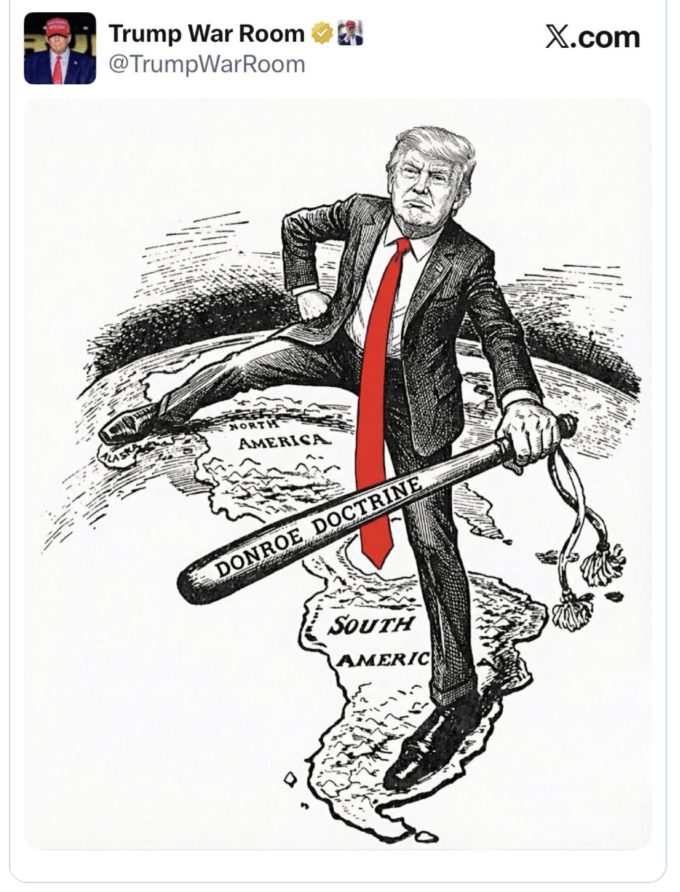
Two decades before US forces kidnapped Venezuelan president Nicolás Maduro this weekend, Hugo Chávez had already predicted the approach:
Years ago, someone told me: ‘They’re going to end up accusing you of being a drug trafficker – you personally – you, Chávez. Not just that the government supports it, or permits it – no, no, no. They’re going to try to apply the Noriega formula to you.’ They’re looking for a way to associate Chávez directly with drug trafficking. And then, anything goes against a ‘drug trafficker president’, right?
On the morning of 3 January, Trump tweeted a Happy New Year message. The US had carried out ‘a large scale strike on Venezuela and its leader’. President Maduro and his wife Cilia had been ‘captured and flown out of the Country’. Trump said more details would follow in a few hours’ time. The details, however, were confused.
Later that day, an old friend from Caracas rang to say that secret negotiations had been taking place for some time between the regime and the Americans. The Americans wanted Maduro’s head, which he refused to supply – according to the New York Times, he was offered transport to a well-cushioned retirement in Turkey, which he scorned, to his great credit. And though repeatedly offering to negotiate with Washington on questions of oil and US drug imports, he was also rallying Venezuelans against Trump’s military build-up in the Caribbean.
The Trump administration evidently preferred negotiating with Delcy Rodríguez, the vice-president, and others in Venezuela, where the two key ministers are Diosdado Cabello at the Interior Ministry and Vladimir Padrino at Defence. Both have support in the Army, some 100,000 strong, and Cabello also commands the popular militia forces, which are said to be larger still. As Trump reinforced his threatening armada over the past few months, the Maduro government responded by arming sections of the population.
The question of who now governs Venezuela has therefore become crucial. The first answer came from Trump: ‘We are going to run the country until such time as we can do a safe, proper and judicious transition.’ But the Trump Administration is caught in a cleft stick. Trump’s MAGA base is not in favour of sending American troops to be killed in foreign countries – this was a central part of the campaign they waged against the Democrats and the old GOP establishment over Afghanistan and Iraq. They do not want US troops on the ground in Venezuela. At the same time, the hard-right Latino émigré ultras represented by Rubio are unhappy that Bolivarians are still in office in Caracas.
There was talk at one point that Marco Rubio might be appointed de facto governor or consul, to give orders to the Venezuelan government. Meanwhile, messages from Caracas have been mixed. The day after the capture of Maduro, Cabello declared:
This is an attack against Venezuela. We are in position. We call on our people to remain calm and to trust the leadership. Do not allow anyone to become discouraged or make the situation easier for the aggressive enemy.
Sidecar NLR for more
A New Year of Empire
by TAMARA PEARSON
US Starts 2026 by Bombing Venezuela and Kidnapping Its President
With its violent military intervention into Venezuela—a country I used to live in—the US has begun this year with entitled and undisguised imperialism. The unapologetic kidnapping of Nicolas Maduro and of Celia Flores (not just a wife as the media refers to her, but also former head of the National Assembly) and killing of at least 40 Venezuelans aims to cement and normalize the US’s standard operating procedure for international relations as violence and control. It will take Venezuela’s oil and the DRC’s tech minerals, and to hell with Global South self-determination, agency, and ownership.
I remember when I lived in Venezuela and we talked about what we would do if the US attacked. We were already facing other kinds of attacks, including basic food shortages orchestrated by private companies, destabilization attempts, right-wing violence, and English-language mainstream media lies. The conversation particularly came up around elections, when the shortages and destabilization typically increased, and US attacks felt less hypothetical.
Even then, though, we would balance the very real and long history of violent US interventions in Latin America with skepticism. How could they kill innocent people and bomb what felt like to me the closest thing to paradise? Venezuela was never a utopia—there were mistakes and much work to do, but the Andean mountains were intensely green, the coastal waters a peaceful turquoise, the nights full of fairy fog that you could see drifting down the streets. The days were full of the laughter of the tiny children I taught as part of our participatory education project. We solved our own local problems as an organized community, turned empty lots into community gardens, and there was always, always, political debate and high political literacy. People knew their constitution, often by heart, knew the laws, and the news. Venezuelans had and have this infinite urge to dance, even on moving buses or after two-day long meetings. How could anyone consider destroying that world? It felt inconceivable. It didn’t make sense, and it still doesn’t.
Yet we all know that beautiful Gaza, with its beaches, shops, delicious zaatar bread, hospitals, books, and resilient people, has been turned into rubble and whole families wiped out. The US-led destruction of Afghanistan and Iraq ruined people, communities and saw key cultural and archaeological sites irreparably damaged, and artifacts looted. I live in Mexico now, and here alone, the US has used NAFTA and the so-called “War on Drugs” to militarize this beautiful country and systematically turn it into a vast grave (with 131,000 forced disappearances) and into an obedient neoliberal production line for nearshoring US companies. So, in Venezuela, I guess we should have been less skeptical. Friends there messaged me on Saturday in shock, their ears ringing from the sounds of bombs. New year weekend wasn’t meant to be this.
However, throughout 2025, the US had asserted itself more openly as global police chief at the service of big business. It “negotiated” (pressured) a “ceasefire” in the DRC which would give it access to the country’s highly sought-after tech minerals and metals and to security control, and it has supported Israel, bombed Nigeria, and killed Venezuelans with complete impunity. It closed its borders to refugees in violation of international law, and breached migrant and human rights within its own borders. It also bombed Syria, Iraq, Iran, Yemen, and Somalia. It carried out or was partner to 622 overseas bombings in total, and also intervened in manipulative ways, such as Trump’s comments days before the Honduran election in November that led to the victory of the right-wing candidate he backed, or the US’s role in the international “Gang Suppression Force” in Haiti.
While global institutions like the International Criminal Court and the UN have demonstrated their ineffectiveness at doing anything at all about the US’s illegal sanctions against Cuba, the genocide in Gaza, or climate destruction, Trump has been able to fortify the US as a force that actually decides international affairs.
In his press conference Saturday, Trump said the US would be selling Venezuelan oil. Though he laid the groundwork for the military intervention into Venezuela with evidence-free talk of drug cartels, bombing what were likely fishing boats in the second half of 2025, most people knew this was always about regaining control over the country with the largest known oil reserves. However, Venezuela also represents defiance. The US has sanctioned the country for such behavior for over a decade, killing or contributing to the deaths of over 40,000 people in 2017–18 alone.
The US doesn’t just treat the Global South as a resource buffet. In order to secure its access to the goods, it wants the countries’ governments at its beck and call. Venezuela, especially during the 2010s and through initiatives like CELAC (Community of Latin American and Caribbean States), was playing a role of uniting Latin America against such dominance and towards independence and social and economic alternatives.
Savage Minds for more
‘We did this incredible thing’: Trump’s capture of Maduro and the ‘complexities’ of international law
by AYESHA MALIK
America’s actions are a violation of Article 2(4) of the United Nations Charter and a clear act of aggression.
It shouldn’t be shocking and yet it still is. Images of the leader of a sovereign, oil-rich nation humiliated and handcuffed by the world’s superpower using tactics as crude as the resource it seeks to control. We have seen this before, after all.
Libya’s Muammar Qaddafi, Iraq’s Saddam Hussein, Congo’s Patrick Lumumba, Iran’s Mohammad Mosaddegh, Chile’s Salvador Allende and Panama’s Manuel Noriega all met the same fate (a full list would take up the entire article). Regime change, rinse, repeat.
‘He effed around and he found out’
By most accounts, Maduro seems to have gotten off lightly. In 2019, US Senator Marco Rubio threatened that the Venezuelan leader would meet the same fate as Qaddafi, tweeting a photo of the bloodied Libyan general before he was reportedly sodomised and killed by US supported rebels. The CIA has long preferred assassination as the policy option for stubborn leaders using underhanded tactics like poisoned cigars, turning lovers into honeypots, planting a Brutus within a Caesar’s inner circle. That is until Trump decided the US no longer needed to operate from the shadows.
In 2017, Trump considered the assassination of Syrian President Bashar al-Assad, reportedly saying “let’s f***ing kill him! Let’s go in. Let’s kill the f***ing lot of them.” And it seems with Maduro, someone did try. A few months after Rubio’s threat, there was an attack against Maduro’s life, which was “the world’s first known attempt to kill a head of state with a retail drone, purchased online and armed by hand with military grade explosives”.
After spending many years trying to illegitimise the Venezuelan leader in order to pave the way for the invasion, US Secretary of War Pete Hegseth, who has the verbal range of a legacy-admitted frat bro at an American university, said that Maduro had his chance but had “effed around and he found out”. He also said, in an effort to appease the Republican MAGA base, that this regime change operation was “America First” and he was right in a way; the biggest winners of the night were Texan oil barons.
‘We’re going to take back the oil’
Dawn for more
It’s Colonialism, Stupid!
by BOAVENTURA DE SOUSA SANTOS
What happened in the early hours of January 3 in Caracas left the world stunned. But the strongest reason for astonishment is the fact that the world was stunned. What happened had been widely predicted. Since when? The less informed would say since Donald Trump came to power. But it is mainly since the publication of the National Security Strategy in November 2025, which states that the US reserves the right to intervene in any country whenever its interests are at stake.
Let’s go back in history and analyze the three main components of what happened: the surprise, the illegal capture of a political leader, and the reasons given for the act.
As for the surprise and the reasons, we need only go back to September 1939. In 1939, the world (the world that mattered then was Europe and the US) was stunned by Hitler’s surprise attack on Poland. The justification of the Nazi leader: “The Polish state has refused the peaceful settlement of relations which I desired, and appealed to arms… In order to put an end to this lunacy I have no other choice than to meet force with force from now on… Destroying Poland is our priority… The winner is never asked if what he said was the truth or a lie. As far as starting and fighting a war is concerned, there is no law – victory is the decisive factor. Be brutal and be without mercy.”
Anyone who closely followed Hitler’s behavior could predict what was going to happen. Hitler publicly invented Polish aggression while secretly ordering surprise attacks, telling his generals to act ruthlessly to achieve victory, illustrating the deceptive nature of the invasion. Polish aggression was invented, the invention was turned into reality through propaganda, and the invasion was invoked as an act of self-defense. Germany’s security was at stake. It so happened that European diplomats looked but did not see, listened but did not hear, read but did not understand. Denial was a cover for the impotence and poor political quality of the political leaders of the time.
As for the illegal capture of leaders, it is easy to recall the case of Panamanian President Daniel Noriega on January 3, 1990. However, we need to go back much further to see how a similar tactic was used in the past during the period of historical colonialism. King Ngungunyane was the king of the Gaza Empire between 1884 and 1895, a territory that today corresponds largely to Mozambique. Because of his resistance to Portuguese colonialism, he was known as the “Lion of Gaza.” He was defeated by colonialist troops in 1895 in Chaimite. Not satisfied with their victory and fearing that the king would continue to fuel anti-colonial resistance, the colonialists captured him and brought him to Portugal as a trophy of war. They paraded him along the main avenue of Lisbon. He was then deported to one of the Azores Islands, where he died in 1906.
In August 1897, French colonialists imposed colonial control over the Menabé kingdom of the Sakalava people in western Madagascar, massacring the local army. King Toera was killed and beheaded; his head was sent to Paris, where it was placed in the archives of the Natural History Museum. Almost 130 years later, pressure from the king’s descendants, as well as from the government of the Indian Ocean nation, paved the way for the return of the skull.
In other words, displaying symbols of resistance (sometimes the leaders themselves, their skulls, or their art objects) as trophies in the metropolis is a consistent practice of colonial rule. Whether the “deposit” is on an island, in a museum, or in a center in New York is a minor issue, a matter of convenience for the victor.
Has colonialism returned?
This is perhaps the most naive question that can be asked at this point. It is based on the idea that colonialism is a thing of the past, having ended with the independence of the European colonies. Nothing could be further from the truth. Colonialism is the treatment of a people or social group considered subhuman and, as such, unworthy of being defended by international or national law, human rights, or international treaties. The justification is perfectly rational: since they are subhuman, it would be absurd to treat them as human. That would jeopardize the defense of beings considered fully human. Colonialism is racism, slavery, plundering of natural and human resources, occupation by a foreign power, expulsion of peasants or indigenous peoples from their ancestral territories to make way for “development projects,” illegal deforestation, ethnic profiling, and racial discrimination.
Colonialism is a permanent and essential component of capitalism. Writing in England and bearing in mind above all the English case, Karl Marx was mistaken when he wrote that colonial violence was an initial phase of capitalism (primitive or original accumulation) that would later give way to the “monotony of economic relations based on the exploitation of free wage labor.” Colonial violence is permanent, and without it, capitalism would not exist. It is not present in the same way everywhere in the world precisely because colonialism-capitalism is an unequal and combined global project. From Rosa Luxemburg to Walter Rodney and David Harvey, this fact is now almost universally accepted.
More recently, what was the creation of the State of Israel if not an act of colonial occupation, a loathsome way for Europeans to unload onto the Palestinian people the atonement for the heinous crimes that they, Europeans, had committed against the Jews? Is the transformation of Gaza into the Riviera of the eastern Mediterranean anything more than an act of recolonization?
Z Network for more
Venezuela: American regime change with a Trumpian twist
by BELEN FERNANDEZ

Trump has added a particular layer of dementedness to the latest unprovoked US aggression.
United States President Donald Trump has kicked off the new year with a typically deranged bang by conducting massive air strikes on Venezuela and reportedly capturing the country’s president, Nicolas Maduro, who has apparently been spirited off to an undisclosed location.
The attack does not come entirely as a surprise, given Trump’s track record of doing whatever the hell he wants with no regard for the law – or for his own promise to, you know, stop waging war abroad.
Indeed, Trump has been chattering for months about the possibility of enhanced US military action against Venezuela, as the US has gone about bombing boats willy-nilly off the country’s coast, supposedly in the name of combatting drug trafficking.
This has entailed numerous extrajudicial killings and rampant accusations of war crimes. But, hey, it’s all in a day’s work for an administration that couldn’t care less about legal justification for its behaviour, much less human rights and other such silly concepts.
The US has also hijacked various oil tankers, with Trump unleashing blissfully ludicrous allegations that Venezuela is guilty of stealing US oil, land and assets.
This latest bout of US aggression comes on the heels of decades of US sanctions, which have crippled the Venezuelan economy and which have constituted a form of warfare unto themselves. As of 2020, former UN special rapporteur Alfred de Zayas calculated that 100,000 Venezuelans had already perished as a direct result of coercive economic measures.
Al Jazeera for more
Oppose Trump’s criminal invasion of Venezuela! Release Maduro!
by WSWS EDITORIAL BOARD
The World Socialist Web Site, the Socialist Equality Party in the US and the International Committee of the Fourth International unequivocally denounce the invasion of Venezuela and the criminal abduction of President Nicolás Maduro in the early hours of Saturday morning. We demand the immediate release of Maduro and his wife, Cilia Flores, and the full withdrawal of all US troops and military forces from the region.
The invasion, which included the killing of at least 40 people, is a total repudiation by the Trump regime of any semblance of legality. It is an unprovoked war of aggression launched in flagrant violation of international law and carried out to reimpose colonial control over Venezuela and all of Latin America. This imperialist assault must be opposed by the working class in the United States and throughout the world.
Speaking at Saturday’s press conference, Trump’s “Secretary of War,” Pete Hegseth, declared, “Welcome to 2026.” Only three days into the New Year, the assault on Venezuela is an unmistakable signal that the imperialist violence that marked 2025—in the Gaza genocide and the bombings of Lebanon, Syria and Iran—will escalate in 2026.
There is no concrete wall between foreign and domestic policy. Imperialist gangsterism beyond the borders of the United States will be accompanied by the acceleration of the conspiracy to impose a fascistic presidential dictatorship within the United States.
WSWS for more
Roaming Charges: Preliminary Notes on a Kidnapping
by JEFFREY ST CLAIR
The dominant culture of the world teaches us that The Other is a threat, that our fellow human beings are a danger. We will all continue to be exiles in one form or another as long as we continue to accept the paradigm that the world is a racetrack or a battlefield.
– Eduardo Galeano
+ You’ve come a long way, MAGA babies…
+ There’s no plausible interpretation of the US Constitution or federal and international law that would legitimize Trump’s lethal attacks on Venezuela and the kidnapping of its president. Trump acted without a UN Resolution. He acted without Congressional authorization. Venezuela didn’t pose a military threat to the US or the US forces that had mobilized against Venezuela in the Caribbean. An indictment in a US court is not a legal basis for a military invasion. This was an unprovoked aggression that resulted in civilian deaths. Multiple murders, in other words.
+ Trump on Venezuela: “We’re there now, but we’re going to stay until such time as the pop — proper transition can take place. So we’re gonna stay until such time as — we’re gonna run it essentially.” Apparently, Marco Rubio will be the new Juan Guaidó of Venezuela, which must come as a shock to Nobel Prize winner, María Corina Machado, who thought she was in line to become the new Juan Gauidó of Venezuela. After all, she gave her rather dubious Nobel Prize to Trump, only to have him say she “didn’t have the respect” to govern. Ah, how sharper than a serpent’s tooth it is to have a thankless despot…
+ Fox News: “What do you think is next for the Venezuelan people now that you have removed Maduro?”
Trump: “We can’t take a chance of letting someone run it and just take over where he left off. So we’re making that decision now. We’ll be involved in it very much.”
+ The cocksure boast that the US will “run” Venezuela appears to be another Trumpian fantasy. It’s impossible to “run a country,” if you don’t have control of it, which the US doesn’t by any measure. The Maduro government remains in place and defiant, even with Maduro renditioned to New York City. Indeed, the attack appears to have only strengthened the resolve of the Venezuelan people, instead of inspiring the chimerical uprising Rubio led Trump to expect, much as Rumsfeld and Cheney deceived Bush into believing about Iraq.
+ Despite Trump’s claim that Delcy Rodríguez was “cooperative,” Venezuela’s vice-president, who was sworn in as the nation’s leader after Maduro was renditioned to the US, vigorously denied that she planned to help the U.S. government run the country. Instead, she asserted her own power as acting president and defiantly demonstrated the continuity of the Bolivaran Revolutionary government in the wake of the US attacks.
+ Venezuelan Interior Minister Diosdado Cabello: “Here, the unity of the revolutionary force is more than guaranteed, and here there is only one president, whose name is Nicolas Maduro Moros. Let no one fall for the enemy’s provocations. We are outraged because in the end everything was revealed — it was revealed that they only want our oil.”
+ Venezuela’s Defense Minister Vladimir Padrino López forcefully rejected Trump and Rubio’s claim that Venezuela will be run by the US and demanded the return of Nicolás Maduro and his wife, Cilia Flores. “Our sovereignty has been violated and breached. The [Venezuelan military] will guarantee the governability of the country … [and will] continue to employ all its available capabilities for military defense, the maintenance of internal order, and the preservation of peace.”
+ Trump responded to Rodríguez’s defiant stance with his usual boorish bombast when being confronted by a woman by threatening her with a fate worse than Maduro’s: “If she doesn’t do what’s right, she’s going to pay a very big price, probably bigger than Maduro.”
+ According to Semafor, plans for the secret U.S. raid to bomb Caracas and kidnap Maduro and his wife were leaked to the Washington Post and New York Times before it happened, but both papers decided not to publish to protect U.S. troops. Thus, in true Hegsethian style, the elite press knew about the operation before Congress was briefed.
Counterpunch for more
“This Is Our Hemisphere”: Report from Colombia on Trump’s Escalating Threats to the Region
DEMOCRACY NOW
Following his attack on Venezuela and the abduction of Nicolás Maduro, President Donald Trump has escalated his threats against Colombia and claimed without evidence that President Gustavo Petro is involved in cocaine trafficking. Trump and others in his administration have also threatened military action against Cuba, Greenland, Iran and Mexico in recent days.
Manuel Rozental, a Colombian physician and activist with more than 40 years of involvement in grassroots political organizing, tells Democracy Now! that Trump’s attacks on Petro are lies. The former guerrilla “has seized more cocaine than any other government in the past,” says Rozental. “President Petro is not a drug trafficker. President Petro has been a victim of drug mafias and their allies.”
AMY GOODMAN: We begin today’s show looking at the U.S. attack on Venezuela and the abduction of Venezuelan President Nicolás Maduro and his wife. On Tuesday, President Trump announced on Truth Social the interim leaders of Venezuela had agreed to turn over between 30 and 50 million barrels of oil to the United States. In his message, Trump wrote, quote, “This Oil will be sold at its Market Price, and that money will be controlled by me, as President of the United States of America, to ensure it is used to benefit the people of Venezuela and the United States!” unquote. This follows earlier remarks by Trump that he plans to, quote, “take back” Venezuela’s oil.
In recent days, Trump has also threatened other Latin American nations, including Colombia, Mexico and Cuba. Speaking to reporters Sunday aboard Air Force One, Trump specifically targeted Colombian President Gustavo Petro and claimed, without evidence, that Petro is trafficking cocaine into the U.S.
Democracy Now for more
Meet Paul Singer, the Billionaire Trump Megadonor Set to Make a Killing on Venezuela Oil
by STEPHEN PRAGER
“Paul Singer’s shady purchase of Citgo has everything to do with this coup.”
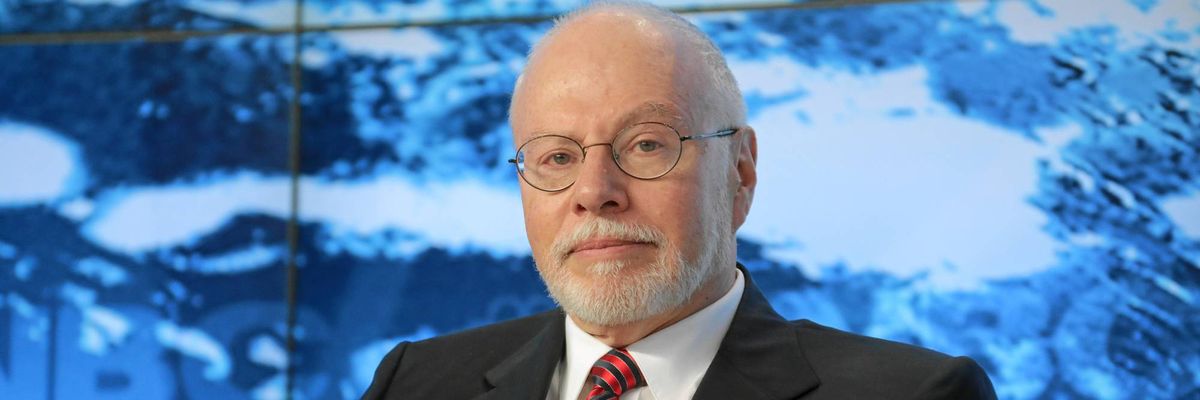
One of President Donald Trump’s top billionaire donors, who has spent the past several months backing a push for regime change in Venezuela, is about to cash in after the president’s kidnapping of the nation’s president, Nicolas Maduro, this weekend.
While he declined to tell members of Congress, Trump has said he tipped off oil executives before the illegal attack. At a press conference following the attack, he said the US would have “our very large United States oil companies” go into Venezuela, which he said the US will “run” indefinitely, and “start making money” for the United States.
As Judd Legum reported on Monday for Popular Information, among the biggest beneficiaries will be the billionaire investor Paul Singer:
In 2024, Singer, an 81-year-old with a net worth of $6.7 billion, donated $5 million to Make America Great Again Inc., Trump’s Super PAC. Singer donated tens of millions more in the 2024 cycle to support Trump’s allies, including $37 million to support the election of Republicans to Congress. He also donated an undisclosed amount to fund Trump’s second transition.
Singer is also a major pro-Israel donor, with his foundation having donated more than $3.3 million to groups like the Birthright Israel Foundation, the Israel America Academic Exchange, Boundless Israel, and others in 2021, according to tax filings.
In November 2025, less than two months before Trump’s operation to take over Venezuela, Singer’s investment firm, Elliott Investment Management, inked a highly fortuitous deal.
It purchased Citgo, the US-based subsidiary of Venezuela’s state-owned oil company, for $5.9 billion—a sale that was forced by a Delaware court after Venezuela defaulted on its bond payments.
The court-appointed special master who forced the sale, Robert Pincus, is a member of the board of directors for the American Israel Public Affairs Committee (AIPAC).
Elliott Management hailed the court order requiring the sale in a press release, saying it was “backed by a group of strategic US energy investors.”
Singer acquired the Citgo’s three massive coastal refineries, 43 oil terminals, and more than 4,000 gas stations at a “major discount” because of its distressed status. Advisers to the court overseeing the sale estimated its value at $11-13 billion, while the Venezuelan government estimated it at $18 billion.
As Legum explained, the Trump administration’s embargo on Venezuelan oil imports to the United States bore the primary responsibility for the company’s plummeting value:
Citgo’s refiners are purpose-built to process heavy-grade Venezuelan “sour” crude. As a result, Citgo was forced to source oil from more expensive sources in Canada and Colombia. (Oil produced in the United States is generally light-grade.) This made Citgo’s operations far less profitable.
Common Dreams for more
Out-Scooped by Trump
by WALDEN BELLO
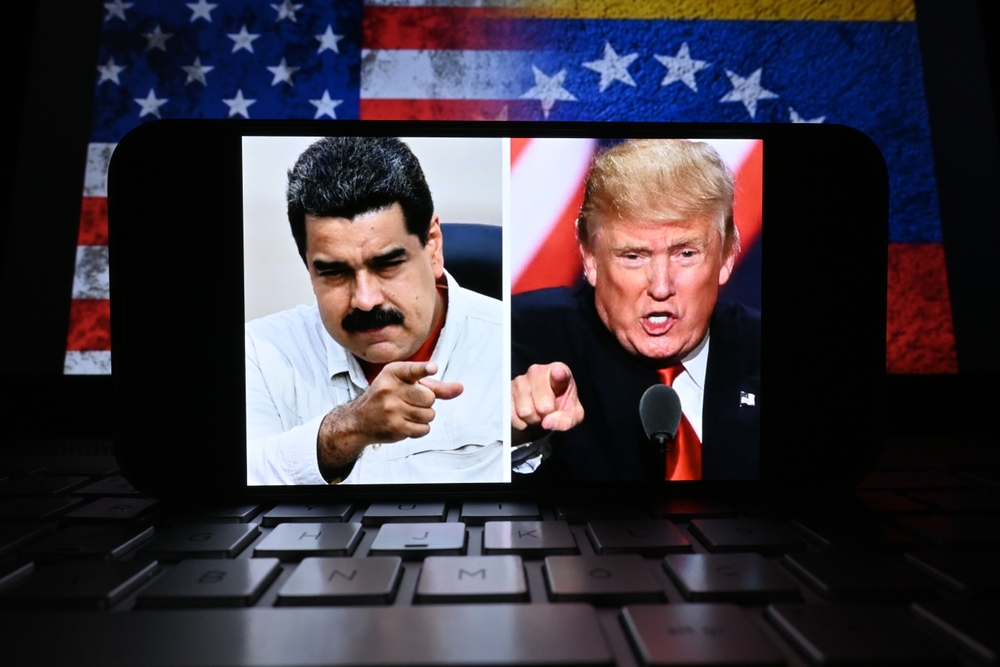
The U.S. attack in Nigeria did indeed point to the operation to kidnap Venezuela’s head of state.
Trump’s kidnapping of Maduro has taught me a lesson: that if you think you have a scoop, you file it immediately, not only to get the story out first but to warn the world if it’s about something bad that might be coming.
Shortly after Trump bombed Nigeria on Christmas day, I wrote a piece that said his real aim was to send a message to Maduro and that among the options he was entertaining was a SEAL-type operation to capture or kill Maduro. How did I come to this conclusion? I have no assets in the U.S. intelligence community. I was completely running on instinct, and my instincts told me that the egomaniac Trump wanted to eclipse Obama’s feat in sending in the SEALS to kill Osama bin Laden in Abbotabad, just as he wanted badly to get the Nobel Peace Prize that Obama got.
But it was the holidays and, out of consideration for the folks that run my stories, who deserved a New Year’s break to be with their families, I sat on it after I finished it on December 27 and only sent it to Foreign Policy in Focus on January 2, eight hours before the Caracas operation that kidnapped Maduro, in violation of all the norms of civilized conduct among states.
But though out-scooped by Trump, I still think that there are elements in the unfiled article that could be useful in helping us anticipate what could unfold in the days and weeks ahead. So here’s the scoop that wasn’t.
Trump Strikes Nigeria But Real Target Is Venezuela
The Trump regime’s air strikes on Islamic State targets in Nigeria on Christmas Day may have had symbolic significance but no strategic value. There will likely be no impact on the efforts of the militant group called Lakurawa, allied to ISIS, to establish a base in Sokoto state.
Many have been puzzled by the attacks that involved the use of Tomahawk missiles, especially given the relatively minuscule space given to Africa in the recently released National Security Strategy (NSS) 2025. That brief section focuses on transforming the U.S. relationship with Africa from one based on aid to trade, though it does say, “we must remain wary of resurgent Islamist terrorist activity in parts of Africa while avoiding any long-term American presence or commitments.”
It is likely that the attacks were carried out for reasons unrelated to Africa. One is to appease Trump’s Christian evangelical base. As Joshua Keating, an expert in crisis areas, has noted, “Trump’s sudden interest in Africa’s most populous country was likely motivated less by any particular event there — these are all longstanding issues — than by developments in Washington. Though it doesn’t get a ton of mainstream media attention, the plight of Christians in Nigeria has been a galvanizing issue for evangelical Christians in the US in recent years.” On his internet platform Truth Social, Trump has cited figures from the international Christian rights NGO Open Doors, claiming that of the 4,476 Christians killed for their faith globally in 2024, 3,100 were in Nigeria.
In her recent book on the key groups that make up the Make America Great Again (MAGA) movement, Furious Minds, Laura Field says that non-establishment Christian groups have an outsized influence in the Trump administration. With the Republicans struggling in the lead-up to the mid-term elections in 2026, these groups’ muscle on the ground can determine whether the Republicans will continue to control the House of Representatives.
The Main Target: Venezuela
Foreign Policy In Focus for more
Black Agenda Report Venezuela Reading List
THE EDITORS
Black Agenda Report contributors have focused analysis, reporting and interviews on Venezuela’s Bolivarian Revolution for many years. We hope that this list, which is not exhaustive of BAR’s coverage, will assist our readers in understanding why Venezuela was and is seen as a threat to the U.S. state and why independent anti-imperialist journalism is so important.
Glen Ford
May 28, 2014
Black Caucus Members Shame Themselves, as South America Warns U.S. Not to Sanction Venezuela | Black Agenda Report
Danny Haiphong
March 25, 2015
Obama’s War Plans Against Venezuela: Another Act of Imperial Desperation | Black Agenda Report
Glen Ford
September 30, 2015
Blacks Cheer Venezuelan Leader – But Still Support Democratic Party Terror | Black Agenda Report
Ajamu Baraka
February 21, 2018
Venezuela: Revenge of the Mad-Dog Empire | Black Agenda Report
Margaret Kimberley
August 28, 2018
Freedom Rider: The United States Destroys Venezuela’s Economy | Black Agenda Report
Glen Ford
January 31, 2019
The Racist, Imperialist War on Venezuela | Black Agenda Report
Glen Ford
March 14, 2019
The Imperial Racist Saga Comes Home, Where It Began | Black Agenda Report
Danny Haiphong
April 3, 2019
American
Exceptionalism is at the root of the Fake News Epidemic Attempting to
Overthrow Venezuela’s Bolivarian Revolution | Black Agenda Report
Lauren Smith
May 8, 2019
Venezuelan Embassy in DC Under Siege by Guaido’s Racist Mob | Black Agenda Report
Roberto Sirvent
November 6, 2019
BAR Book Forum: Dario Azzellini’s “Communes and Workers’ Control in Venezuela” | Black Agenda Report
Glen Ford, Kevin Zeese
February 10, 2020
Embassy Activists Face Prison in Trial Based on Trump Venezuela Fantasy | Black Agenda Report
November 4,2020
Open Letter to the Africans of Brazil, Colombia and Guyana | Black Agenda Report
Roberto Sirvent
June 2, 2021
BAR Book Forum: Justin Podur and Joe Emersberger’s “Extraordinary Threat” | Black Agenda Report
Ajamu Baraka
November 10, 2021
Class Warfare and Socialist Resistance: Nicaragua, Cuba, Venezuela as Existential Threats to the US | Black Agenda Report
Jacqueline Luqman
May 3, 2022
Venezuela Continues To Be the Model for True Democracy in the Americas | Black Agenda Report
Margaret Kimberley
August 2, 2023
The U.S. Plot to Finalize the Theft of Venezuela’s Oil | Black Agenda Report
Tamanisha John
November 29, 2023
Guyana and Venezuela: The Crisis of Imperialism Currently Unfolding on South America’s Caribbean Coast | Black Agenda Report
Margaret Kimberley
December 22, 2023
Alex Saab Is Free | Black Agenda Report
Ann Garrison
January 31, 2024
Corporate Coup: Venezuela and the End of US Empire | Black Agenda Report
Clau O’Brien Moscoso
February 14, 2024
Peoples
to Peoples Encounters: Venezuela’s Vice Minister of Foreign Affairs for
North America In Dialogue with Local Organizations and Social Movements
in New York | Black Agenda Report
Margaret Kimberley, Ajamu Baraka
July 31, 2024
Don’t Believe the Hype: Venezuela is a Democracy | Black Agenda Report
Ajamu Baraka
August 7, 2024
U.S. Rejection of Venezuela’s Democracy Vindicates Trump Contesting the 2020 Election Result | Black Agenda Report
Roger Harris
August 20, 2025
US Human Rights Report on Venezuela Doesn’t Pass the Mirror Test | Black Agenda Report
Mafa Kwanisai Mafa
September 24, 2025
Venezuela, Imperialism, and the Global Struggle for Sovereignty | Black Agenda Report
Margaret Kimberley
October 15, 2025
Nobel War Prize | Black Agenda Report
Gerald A. Perreira
October 15, 2025
No
to US State Terrorism in the Caribbean Sea No to US Plans for Regime
Change in Venezuela Caricom Must Act Now | Black Agenda Report
Chris Gilbert, Cira Pascual Marquina
October 22, 2025
‘Fishing Provides for Everyone’: The Palmarito Afro-Descendant Commune (Part III) | Black Agenda Report
Margaret Kimberley, Gerald A. Perreira
October 31, 2025
U.S. Threats Against Venezuela Target the Entire Region | Black Agenda Report
Clau O’Brien Moscoso
November 26, 2025
The
Lima Group and “Peaceful Transition”: the Neocolonial Role in
US/Canadian Sanctions and Militarism Against Venezuelan Sovereignty |
Black Agenda Report
Ajamu Baraka, Dimitri Lascaris
December 3, 2025
US Attack On Venezuela Would Cause ‘Chaos’ In The Region w/ Ajamu Baraka | Black Agenda Report
Gerald A. Perreira
December 3, 2025
Hands Off Maduro/Hands Off Venezuela | Black Agenda Report
Margaret Kimberley
December 3, 2025
The Double Tap on Venezuela | Black Agenda Report
Djibo Sobukwe
December 17, 2025
Five Reasons Black/ African People Should Be in Solidarity with Venezuela | Black Agenda Report
Ajamu Baraka
January 7, 2025
Venezuela,
Even More Than Palestine, Is the Linchpin of a Consistent Radical Left
in The Era of Global Neofascism Led by the U.S. | Black Agenda Report
Black Agenda Report for more
U.S. Malevolence, What Now?
by MICHAEL ALBERT
I have met Maduro, Delcy Rodriguez too. And before them Chavez. I have walked around the streets of Caracas. Through other locales in Venezuela as well. And some Communes too. All that was some time back. It is all totally irrelevant. What matters, then? That I am a citizen of the United States. And so I should work to stop my country’s latest infamy. And about the only means I have available is to write.
U.S. malevolence is now directed at Venezuela. On the one hand, we steadily escalated violence in surrounding waters with extra judicial murders. It didn’t work. Then we imposed economic war in the form of a full blockade. Doing so targeted the population. It said to Venezuelans, overthrow your government to stop the punishment we impose. It didn’t work. So now we bombed Caracas and some other “targets.” Trump says, we will run the country. We will get back the oil under their ground that they stole. Our imperial violence will win. So why war? Why now? Put differently, war, what is it good for? Who is it good for?
These assaults have nothing to do with drugs. Trump doesn’t kidnap real drug runners. He pardons them. But if it’s not drugs, what is the motivation?
To try to explain Trump’s behavior is fraught with difficulty even after the fact. Kurt Vonnegut might have said it is like trying to tell time using a cuckoo clock from hell. Nonetheless, I think the three best candidate explanations are grabbing oil power and wealth, exacting vengeance writ large, and perpetual distraction.
Oil, because Trump doesn’t care a whit about the planet and its inhabitants. Instead, like others before him, he likes the idea of controlling as much of that productive but supremely deadly substance as possible. It is because oil conveys power. Because oil impacts prices. Because oil can enrich those who hold it. Trump doesn’t hide this motive. He flaunts it. And Venezuela has by far the largest oil reserves in the world. What a prize. Trump’s true base, his billionaire base, will benefit big from taking over Venezuela’s oil while they still can, before Trump is defanged and removed.
Vengeance, because Trump thinks, like most American President’s have thought, that the U.S. owns the world. We don’t invade anywhere because everywhere is ours. We can’t invade what we own. We don’t attack anyone because anything we do is by definition defense. More, when Venezuela nationalized its oil industry (in 1976 and later intensified under Chavez), Trump believes it stole our oil. After all, we own the world. Everything is ours and everything includes oil sitting under Venezuela. So sure, let’s punish the Venezuelan thieves. Let’s grab back what’s ours. Vengeance is obviously warranted. More, when Cubans overthrew Batista, Castro stole the country he resided in. Fancy that. It’s just imperial calculus. Controlling Venezuela will hurt Cuba.
Z Network for more
Behind the DOJ’s politicized indictment of Maduro: a CIA-created ‘network’ and coerced star witness
by MAX BLUMENTHAL
The US Department of Justice indictment of Venezuela’s kidnapped leader, Nicolas Maduro, is a political rant that relies heavily on coerced testimony from an unreliable witness. Despite DOJ edits, it could expose more Americans to the CIA’s own history of drug trafficking.
The January 3 US military raid on Venezuela to kidnap President Nicolas Maduro and First Lady Cilia Flores was followed by the Department of Justice’s release of its superseding indictment of the two abductees as well as their son, Nicolasito Maduro, and two close political allies: former Minister of Justice Ramon Chacin and ex-Minister of Interior, Justice and Peace Diosdado Cabello. The DOJ has also thrown Tren De Aragua (TDA) cartel leader Hector “Niño” Guerrero into the mix of defendants, situating him at the heart of its narrative.
The indictment amounts to a 25 page rant accusing Maduro and Flores of a conspiracy to traffic “thousands of tons of cocaine to the United States,” relying heavily on testimony from coerced witnesses about alleged shipments that largely took place outside US jurisdiction. It accuses Maduro of “having partnered with narco-terrorists” like TDA, ignoring a recent US intelligence assessment that concluded he had no control over the Venezuelan gang. Finally, the prosecutors stacked the indictment by charging Maduro with “possession of machine guns,” a laughable offense which could easily be applied to hundreds of thousands of gun-loving Americans under an antiquated 1934 law.
DOJ prosecutors carefully avoid precise data on Venezuelan cocaine exports to the US. At one point, they describe “tons” of cocaine; at another, they refer to the shipment of “thousands of tons,” an astronomical figure that could hypothetically generate hundreds of billions in revenue. At no point did they mention fentanyl, the drug responsible for the overdose deaths of close to 50,000 Americans in 2024. In fact, the DEA National Drug Threat Assessment issued under Trump’s watch this year scarcely mentioned Venezuela.
By resorting to vague, deliberately expansive language larded with subjective terms like “corrupt” and “terrorism,” the DOJ has constructed a political narrative against Maduro in place of a concrete legal case. While repeatedly referring to Maduro as the “de facto… illegitimate ruler of the country,” the DOJ fails to demonstrate that he is de jure illegitimate under Venezuelan law, and will therefore be unable to bypass established international legal precedent granting immunity to heads of state.
Further, the indictment relies on transparently unreliable, coerced witnesses like Hugo “Pollo” Carvajal, a former Venezuelan general who has cut a secret plea deal to reduce his sentence for drug trafficking by supplying dirt on Maduro. Carvajal was said to be a key figure in the so-called “Cartel of the Suns” drug network which the DOJ claims was run by Maduro. If and when he appears to testify against the abducted Venezuelan leader, the American public could learn that the “cartel” was founded not by the deposed Venezuelan president or one of his allies, but by the CIA to traffic drugs into US cities.
The Grayzone for more
“It’s All About the Oil, Stupid!”: Mehdi Hasan on Trump Attacking Venezuela & Kidnapping Maduro
DEMOCRACY NOW
Zeteo‘s Mehdi Hasan outlines Donald Trump’s “Donroe Doctrine,” a throwback foreign policy exemplified by the Trump administration’s shocking intervention in Venezuela. With his claims of U.S. sovereignty over nations in the Western Hemisphere, “Trump’s basically saying, ‘Well, this is ours, and China, Russia can have their spheres of influence.’ And it is very 19th-century-esque. ’Let’s divide up the world between the powers.’” This orientation is a major shift from U.S. foreign policy of recent decades, such as the 2003 invasion of Iraq, when interventionist actions were framed around ideological motivations, explains Hasan. “They said it was WMDs. They said it was democracy. They said it was al-Qaeda. They at least pretended that it wasn’t about the oil.” Meanwhile, Trump is brazen about his aims to seize control of Venezuela’s resources and demonstrate that “might is right.”
Democracy Now for more
Editorial Boards Cheer Trump Doctrine in Venezuela
by ARI PAUL
“History doesn’t repeat itself, but it often rhymes,” Mark Twain allegedly quipped. On January 3, 1990, Panamanian Commander Manuel Noriega surrendered to US forces, who carried him off to face drug charges. Thirty-six years to the day later, US forces swooped into Venezuela, abducting President Nicolás Maduro and his wife, following decades of hostility between the oil-rich socialist country and the United States. The pretext offered: Maduro had to be taken to the US to face drug charges.
The coincidence is a reminder that the US has a long history of both covert and military intervention in Latin America: President Donald Trump, as extreme as he might be, isn’t an outlier among American presidents in this regard. And despite the right’s attempt to paint Trump as some sort of peacenik (Compact, 4/7/23; X, 10/14/25), he is no less an imperialist than his predecessors.
And that’s precisely why many of the nation’s leading editorial pages are hailing Maduro’s capture.
‘Hemispheric hygiene’
The Wall Street Journal editorial board (1/3/26) called the abductions “an act of hemispheric hygiene,” a dehumanizing comparison of Venezuela’s leaders to germs needing to be cleansed.
For the Journal, the abductions were justified because they weren’t just a blow to Venezuela, but to the rest of America’s official enemies. “The dictator was also part of the axis of US adversaries that includes Russia, China, Cuba and Iran,” it said. It called Maduro’s “capture…a demonstration of Mr. Trump’s declaration to keep America’s enemies from spreading chaos in the Western Hemisphere.” It amplified Trump’s own rhetoric of adding on to the Roosevelt Corollary, saying “It’s the ‘Trump Corollary’ to the Monroe Doctrine”—a nod to the long-standing imperial notion that the US more or less owns the Western Hemisphere.
The next day, the Journal editorial board (1/4/26) even seemed upset that the Trump administration didn’t go far enough in Venezuela, worrying that it left the socialist regime in place, whose “new leaders rely so much on aid from Cuba, Russia, China and Iran.” “Despite Mr. Trump’s vow that the US will ‘run the country,’ there is no one on the ground to do so,” the paper complained, thus reducing “the US ability to persuade the regime.”
The Washington Post board (1/3/26) took a similar view to the Journal. “This is a major victory for American interests,” it wrote. “Just hours before, supportive Chinese officials held a chummy meeting with Maduro, who had also been propped up by Russia, Cuba and Iran.”
The Post, which has moved steadily to the right since Trump’s inauguration a year ago, seemed to endorse extreme “might makes right” militarism. “Maduro’s removal sends an important message to tin-pot dictators in Latin America and the world: Trump follows through,” the board wrote. (Really? Did we miss when Trump “followed through” on his promise to end the Ukraine War within 24 hours? Or to take back the Panama Canal? Or make Canada the 51st state?) It belittled Democratic President Joe Biden, who “offered sanctions relief to Venezuela, and Maduro responded to that show of weakness by stealing an election.”
Like the Journal, the Post board (1/4/26) followed up a day later to push Trump to take a more active role in Venezuela’s future. It worried about his decision to leave in place “dyed-in-the-wool Chavista” Delcy Rodriguez and other “hard-liners” in Maduro’s administration.
The Post chided Trump for dismissing the idea of installing opposition leader María Corina Machado, who it deemed a worthy partner in imperial prospects: “She has a strong record of standing for democracy and free markets, and she’s committed to doing lucrative business with the US.” As with the Journal, the assumption that it’s up to the US to choose Venezuela’s leadership went unquestioned.
‘Fueled economic and political disruption’
The New York Times editorial board (1/3/26), on the other hand, condemned the abductions, saying Trump’s attack “represents a dangerous and illegal approach to America’s place in the world.”
But the board only did so after the requisite vilifying, asserting that “few people will feel any sympathy for Mr. Maduro. He is undemocratic and repressive, and has destabilized the Western Hemisphere in recent years.”
You’re writing from the country that has spent the past four months blowing up small craft in the Caribbean, and you think it’s Maduro who has “destabilized the Western Hemisphere”?
Even as CBS News content czar Bari Weiss spiked a 60 Minutes piece about the plight of Venezuelan migrants under the administration’s brutal round-ups, the Times editorial blamed Maduro alone for the humanitarian crisis at hand. “He has fueled economic and political disruption throughout the region by instigating an exodus of nearly 8 million migrants,” the editorial said. As is typical in US commentary on Venezuela (FAIR.org, 2/6/19), the word “sanctions” does not appear in the editorial, though US strictures have fueled an economic collapse three times worse than the Great Depression.
And it comes after the Times opinion page gave space calling for regime change in Venezuela. “Washington should approach dismantling the Maduro regime as we would any criminal enterprise,” wrote Jimmy Story (New York Times, 12/26/25), a former US ambassador to Venezuela. Right-wing Times columnist Bret Stephens wrote a piece simply headlined “The Case for Overthrowing Maduro” (11/17/25).
FAIR for more
They Kidnapped Maduro Because The World Is Ruled By Unaccountable Tyrants
by CAITLINE JOHNSTONE
Well, Trump finally did it. US special forces attacked Venezuela and abducted President Maduro from Caracas, reportedly killing at least 40 people in the process.
And now that it’s all over, the White House is getting a lot more honest about the real motives behind its actions. After all those months of babbling about fentanyl and “narcoterrorism” and freedom and democracy, the Trump administration has come right out and admitted that its regime change interventionism in Venezuela has always been a good old-fashioned oil grab.
“We’re gonna take back the oil that frankly we should have taken back a long time ago,” Trump told the press following Maduro’s abduction, saying “We’re going to be taking out a tremendous amount of wealth out of the ground, and that wealth is going to the people of Venezuela, and people from outside of Venezuela that used to be in Venezuela, and it goes also to the United States of America in the form of reimbursement for the damages caused us by that country.”
“We’re going to have our very large United States oil companies, the biggest anywhere in the world, go in, spend billions of dollars, fix the badly broken infrastructure, the oil infrastructure, and start making money for the country, and we are ready to stage a second and much larger attack if we need to do so,” Trump said.
“We have tremendous energy in that country. It’s very important that we protect it. We need that for ourselves, we need that for the world,” the president added.
Trump made it explicitly clear that this is going to be some sort of long-term US occupation project, contradicting early claims of his supporters who had defended the president’s actions in Venezuela as a brief in-and-out, one-and-done special ops intervention.
“We’re going to run the country until such time as we can do a safe, proper and judicious transition,” Trump said. “So we don’t want to be involved with having somebody else get in. And we have the same situation that we had for the last long period of years. So we are going to run the country until such time as we can do a safe, proper and judicious transition.”
“We’re not afraid of boots on the ground,” the president said. “And we have to have, we had boots on the ground last night at a very high level. Actually, we’re not afraid of it, we’re we don’t mind saying it, but we’re going to make sure that that country is run properly. We’re not doing this in vain.”
You would think, after all these incredibly honest admissions, that this was a regime change operation aimed at controlling the resources of the nation with the largest proven oil reserves on the planet, people would get real and accept that they were lied to about the Trump administration’s real reasons for targeting Venezuela. But I am still getting Trump supporters prattling on about drugs, terrorism, and democracy in my social media replies defending my criticisms of his monstrous act of war.
Dissident Voice for more
U.S. attacks Venezuela & kidnaps Maduro
Venezuela’s Revolution Still Stands, Debunking Trump’s Psyop
by MANOLO DE LOS SANTOS
In the aftermath of the illegal US operation against Venezuela, a deliberate misinformation campaign has been waged to sow doubt about the survival of the country’s revolution.
The events of the past 72 hours represent a qualitative escalation in the 25 years of regime change operations by the US government against the Bolivarian Revolution in Venezuela. The United States’ execution of “Operation Absolute Resolve”, a targeted bombing raid and the illegal abduction of President Nicolás Maduro, has created a moment of profound crisis but also profound clarity. For revolutionary forces globally, a concrete analysis is required to cut through the disinformation, understand the objective balance of forces, and chart a path forward.
The objective conditions of the US military intervention
In the wake of the operation, there has been great talk of the unmatched military capabilities of the US Empire. But Marxists should begin with an understanding of the political relationship of forces. Under closer examination, that the Trump administration had to carry out an operation in this fashion is also proof of imperialism’s political weaknesses – in Venezuela, internationally, and at home.
The decision by the Trump regime to undertake this operation, rather than a full-scale invasion, is a testament to the power of organized popular resistance. Two primary factors constrained US options:
- Mass mobilization in Venezuela: President Maduro’s call to massively expand the Bolivarian Militias saw over eight million citizens arm themselves. Combined with Venezuela’s professional military, which has not fractured, this created a scenario where any ground invasion would degenerate into a protracted people’s war, with unacceptable political and material costs for the United States. There remains a strong base of support for Chavismo and the Bolivarian Revolution, which the Trump administration tacitly admitted when it said there must be “realism.” They admitted that the Venezuelan right wing lacks the support to lead the country.
- Domestic US Opposition: Widespread public rejection of military intervention, spanning the political spectrum, including significant sectors of Trump’s own base, made a large-scale deployment politically untenable.
Faced with these deterrents, the White House pivoted to a strategy of decapitation: using its overwhelming technological and military superiority to sever the head of the revolutionary state while avoiding a quagmire. In deciding to utilize a “surgical” strike, involving over 150 aircraft and elite Delta Force units, rather than a war to destroy the Venezuelan state, they are tacitly recognizing that it is here to stay. The US has, in the aftermath of two failed and costly military interventions in Iraq and Afghanistan, sought the path of least resistance, preferring bombing campaigns and abductions that can serve as political “trophies.” But underneath the hyper-emotional style of Trump and the hyper-aggressive military tactics – recalling prior eras of “gunboat diplomacy” in Latin America – there is also a reluctance to go all the way to a regime change war. It is a return to a 19th-century gangster imperialism, forcing concessions at gunpoint; this is what Trump really means by “running” Venezuela.
The asymmetry of power and the question of “betrayal”
Although the Venezuelan masses, party, and state were prepared to counter a full-scale US invasion in a decentralized people’s war of resistance, no country on the planet has the preparation or the capacity at present to prevent the overwhelming and brutal force of a US special operation such as the one conducted. No nation, no matter how morally justified, popularly mobilized, or militarily capable, can presently match the concentrated, high-tech lethal force of the US war machine in this respect. The coordinated mass bombing, disabling of communications, electricity, and anti-air defenses, followed by the raid on President Maduro’s secure residence, was an application of this asymmetrical power. The heroic resistance of the security detail, comprising Venezuelan forces and Cuban internationalists, resulting in 50 combat deaths, confirms this was an act of war, not a “surrender” – despite all earlier claims.
News Click for more
The mass media’s blind spot on Trump’s Venezuela escalation
by SOPHIA TESFAYE
Iraq-era mistakes of blind deference by the mainstream press are back
The story the American media is missing about Venezuela right now is not really about Venezuela. It is not about the country’s strongman president Nicolás Maduro, electoral legitimacy, corruption or even oil — at least not in the way Donald Trump pretends it to be. It is about something far more unsettling. The world’s most powerful country is openly asserting the right to invade, occupy and “run” any nation it chooses, and by failing to connect the dots for the American people, the media is helping to normalize Trump’s expansionist project.
What we are watching is not simply another foreign policy crisis; it is the construction of a permission structure for imperialism, built by stenography and deference. Mainstream media coverage of Trump’s attack on Venezuela and capture of Maduro and his wife, Cilia Flores, has not merely failed to interrogate the Pentagon’s actions, it has actively laundered them, presenting an act of war as a technocratic maneuver, a coup as a “capture” and an invasion as an “operation.” Americans have seen this pattern before, and the consequences were catastrophic.
Like George W. Bush’s regime change operation in Iraq, Trump’s removal of Maduro is premised on a transparent lie. Instead of Bush and Dick Cheney’s weapons of mass destruction, Trump has made a jumble of claims about electoral illegitimacy, corruption and “hemispheric defense” that sound like post-hoc rationalization — and that the administration didn’t care enough to conjure a logical or legal justification for an outcome decided in advance.
The sense of déjà vu is undeniable. In 2003, the U.S. ousted Saddam Hussein, triggering a nearly two decade debacle that killed almost 5,000 American troops, cost more than a trillion dollars, destabilized an entire region and helped incubate movements far more violent than the regime it replaced. At the time, the American press largely went along with the Bush administration, amplifying official claims while marginalizing opposition voices.
This time, as Semafor reported, the New York Times and the Washington Post knew in advance about Trump’s unprovoked attack and chose to sit on the story, ostensibly to “avoid endangering U.S. troops.” Yet the administration gave no advance notice to Congress.
Salon for more
MONOLOGUE: Trump has metaphorsed into Caligula
The United States attacks Venezuela and kidnaps its President in an illegal operation
by VIJAY PRASHAD & TAROA ZUNIGA SILVA
A little after 2 am Venezuela time on January 3, 2026, in violation of Article 2 of the United Nations Charter, the United States began an attack on several sites in the country, including Caracas, the capital. Residents awoke to loud noises and flashes, as well as large helicopters in the sky. Videos began to appear on social media, but without much context. Confusion and rumor flooded social media.
Within an hour, the sky was quiet. U.S. President Donald Trump announced at 4:21 am that his forces had conducted attacks on Venezuela and had seized President Nicolás Maduro Moro and his wife Cilia Flores. A short while later, Venezuela’s Vice President Delcy Rodriquez confirmed that the whereabouts of Maduro and Flores are unknown. The U.S. Attorney General Pamela Bondi confirmed that Maduro and Flores were in the United States and had been charged with “Narco-Terrorism Conspiracy.”
The outcome of this attack on Venezuela is unclear. The government remains in control, even with the President having been kidnapped. The people of Venezuela are in shock but defiant. It is unclear if the United States will strike again, or if the U.S. government has a clear political plan for the aftermath of this strike.
The war against Venezuela
The attack on January 3 is not the first against Venezuela. In fact, the pressure campaign began in 2001 when the government of Hugo Chávez enacted a Hydrocarbons Law in accordance with the sovereignty provisions in the Bolivarian Constitution of 1999. That campaign had the following aspects (this is an illustrative and not a comprehensive list):
- (2001) U.S. funding of anti-Bolivarian social and political groups through the National Endowment for Democracy and USAID.
- (2002) U.S. role in the attempted coup d’état.
- (2002) Creation by USAID’s Office of Transition Initiatives of a Venezuela program.
- (2003—04) Funding and political direction for the work of Súmate (led by Maria Corina Machado) to recall Chávez by referendum.
- (2004) Development of a 5-Point Strategy to “penetrate” Chávez’s base, “divide” Chavismo, “isolate” Chávez, build up groups such as Súmate, and “protect vital U.S. business interests”.
- (2015) U.S. President Barack Obama signs an executive order that declares Venezuela to be an “extraordinary threat,” which is the legal basis for the sanctions that followed.
- (2017) Venezuela banned from access to U.S. financial markets.
- (2018) International banks and shipping companies pressured to over-comply with illegal U.S. sanctions, while the Bank of England seized the Venezuelan Central Bank gold reserves.
- (2019) Creation of an “interim” government by “appointing” Juan Guaidó as the U.S. authorized president and organizing a (failed) uprising, and freezing Venezuela’s ability to sell oil as well as seize its oil assets overseas.
- (2020) Attempt to kidnap Maduro through Operation Gideon (and by placing a bounty for his capture), while the United States put a “maximum pressure” campaign on Venezuela during the pandemic (including International Monetary Fund denial of Venezuela’s own reserves).
- (2025) Gift of the Nobel Peace Prize to Maria Corina Machado with the Nobel Committee saying that Maduro should leave office.
- (2025—26) The attacks on small boats off the coast of Venezuela, the positioning of an armada to form an embargo of Venezuela, and the seizure of oil tankers from Venezuela.
The attack on January 3 is part of this war that began in 2001 and will continue long after the engines of the Chinook helicopters cool down.
The eagle is angry
When the United States government decides to act unilaterally, whether against Iraq in 2003 or Venezuela between 2001 and 2026, no other force has been able to stop it yet. In 2003, millions of people—including in the United States—marched in the streets to demand no war, and most governments in the world cautioned against the war, but the governments of George W. Bush and Tony Blair (of the United Kingdom, acting as his no. 2) went ahead with their illegal war. This time, major powers informed the United States that a war in South America and the Caribbean would be immensely destabilizing: this was the view of leaders who govern countries that neighbor Venezuela (Brazil and Colombia) and major powers such as China (whose special envoy, Qiu Xiaoqi, met with Maduro only hours before the U.S. attack). Not only could the world not stop the United States in 2003, but it has also been unable to stop the United States between 2001 and now in its obsessive war for oil against Venezuela.
The attack on Venezuela was timed so that Trump could stand before the U.S. houses of Congress on January 4, when he will give his annual address, and claim that he has scored a major victory. This is not a victory. It is just another example of unilateralism that will not improve the situation in the world. The U.S. illegal war on Iraq ended with the U.S. forced to withdraw after a million civilians had been killed in a ruthless decade; the same transpired in Afghanistan and Libya—two countries ruined by the American Eagle.
MR Online for more
Venezuela is Merely the Front Line in America’s China War
by MANOJ JOSHI
The US is likely to press on in its aggressive phase and push for the divestment of the Chinese port companies in Panama. They will, no doubt, use the instability created by their actions to push against other Chinese projects and investments in Latin America.
There is a subtext in the American action in Venezuela which is all-too-visible – the United States’s rivalry with China.
The American rationale for the invasion of Venezuela and the kidnapping of its president and his wife has been shifting rapidly. From illegal immigration and drug smuggling, it now seems to be centered around Venezuelan oil. But behind that is a larger theme which was spelt out in the National Security Strategy document released recently.
This is what was termed as the “ ’Trump Corollary’ to the Monroe Doctrine.” The US may want stability in Latin America to prevent mass migration to the US, or governments who will crack down on narco-terrorism but what it also wants is a hemisphere free from “hostile foreign incursion or ownership of key assets.” As Trump noted in his January 3 press conference:
“Under our new national security strategy, American dominance in the Western hemisphere will never be questioned again. Won’t happen.”
If you read carefully, it’s clear that the target is China. And this is emphasised in the NSS observation that as part of this policy, the US “will deny non-Hemispheric competitors” military facilities in the region “or to own or control strategically vital assets in our Hemisphere.”
Speaking to NBC on Sunday, US secretary of state, Marco Rubio, who is supposed to be running Venezuela as the US proconsul, declared, “This is the Western Hemisphere. This is where we live – and we’re not going to allow the Western Hemisphere to be a base of operation for adversaries, competitors, and rivals of the United States.”
Venezuela has the world’s largest oil reserves, some 303 billion barrels. Its current production is roughly 1 million barrels per day, down from 3 million bpd on account of poor management and US sanctions. But China is the destination of 80% of this oil. It has also invested in the Venezuelan oil industry, as has the US (through Chevron, that still operates there) and some European companies.
Trump has now expansively suggested that the US will take over the country and revitalise its oil industry, of course, at a cost to the Venezuelans. But, his intentions are clear. As he noted in his January 3 press conference, “We built Venezuela’s oil industry with American talent, drive and skill, and the socialist regime stole it from us during those previous administrations, and they stole it through force.” In essence he wants reimbursement for the nationalisation, as well as the alleged damage done to the US through the drug smuggling.
China in Latin America
China has developed substantial interests in Latin America, underscored now by the fact that some 24 countries in Latin America have signed up to the Belt & Road Initiative (BRI). In practical terms, Chinese interests involve copper in Peru, lithium in Argentina and Chile as well as iron ore. It owns extensive hydropower facilities in Brazil, is involved in electricity distribution in Chile, as well as oil extraction in Venezuela and Ecuador. There is growing Chinese investment in renewables in Latin America.
Among infrastructure developments, what stands out is the Chancay port in Peru and development of railroads in Colombia and power grids in several countries, including Argentina. Huawei operates in several countries of the region and has data centres and cloud computing assets there. As for space, China’s largest non-domestic space facility is in Argentina.
The Wire for more
Donroe Doctrine: Trump attack on Venezuela is part of imperial plan to impose U.S. hegemony in Latin America
by BEN NORTON
Donald Trump’s bombing of Venezuela and abduction of President Maduro is part of a larger imperialist plan to impose US hegemony in Latin America, control the region’s natural resources (oil, gas, critical minerals, rare earths), and create a new supply chain that cuts out China.
The United States has launched a full-frontal attack not only against Venezuela, but against all of Latin America — and even against the basic concept of sovereignty.
Donald Trump ordered the US military on January 3 to bomb Venezuela, to kidnap its constitutional President Nicolás Maduro, and to send him to New York to be subjected to a show trial on politically motivated charges.
GE for more
Analysts Warn Venezuela Invasion Could Empower Trump to Take Actions Elsewhere
by MICHAEL FOX
The US’s first unilateral invasion in South America is Trump’s testing ground for military supremacy in the region.
The bombs fell in the early hours of January 3. They cascaded over the city, one and then another. The bright orange explosions rocked Venezuela’s capital, Caracas, shaking people awake.
“The bombs lasted a while,” Caracas resident and community organizer Yanahir Reyes told Truthout. “And you could hear the helicopters, the planes. It was terrifying.”
The U.S. forces rained down fire — focused on the military barracks in the capital and nearby states, but also hitting surrounding neighborhoods.
Videos of the invading forces spiraled quickly onto social media. Countless videos of the bombs falling, people screaming, trying to make sense of it all, while the explosions shook buildings and destroyed homes. And the sound of the arrival of the U.S. forces echoed across the city.
Shock. Fear. Confusion.
“The scariest part was videos of helicopters — helicopters flying in Caracas and bombing targets on the ground around Fuerte Tiuna [Venezuela’s largest military barracks],” Caracas-based journalist Ricardo Vaz told Truthout. “What are they here for? Are there troops on the ground?”
U.S. forces would kidnap Venezuelan President Nicolás Maduro and his wife, Cilia Flores, under charges of drug trafficking. Maduro is now in New York, awaiting trial at the Southern District Court. According to the BBC, a Venezuelan official says at least 80 people were killed in the U.S. invasion.
This was the invasion that Donald Trump had vowed for months. An invasion that U.S. administrations had threatened for years and decades, going all the way back to President George W. Bush.
And it marked the U.S. once again deploying direct military action in other countries in the region. A return to President Theodore Roosevelt’s gunboat diplomacy, where the United States pushes its agenda and its interests by force. The Monroe Doctrine on steroids, or what Trump has called it his own “Donroe Doctrine” — Donald plus Monroe.
It is a terrifying precedent. It is the first time the United States has taken unilateral military action against a nation in Latin America in more than 35 years. Many analysts and Latin Americans had hoped this bellicose foreign policy and direct U.S. aggression had been relegated to the history books.
But those playbooks have been dusted off and are being used again, echoing the December 20, 1989, U.S. invasion of Panama. And it was a copy and paste job — give or take some minor alterations.
Truthout for more
Trump and Miller’s “iron law” of imperialist barbarism
ANDRE DAMON
In the aftermath of Saturday’s US attack on Venezuela and the kidnapping of President Nicolás Maduro, the Trump administration has unleashed a torrent of threats against countries around the world, targeting Cuba, Colombia, Iran, China, Russia and even the European Union.
Following Maduro’s abduction on Saturday, the Trump administration presented a series of demands to Venezuela’s interim president, Delcy Rodríguez, aimed at subordinating the country’s foreign and economic policy to US geopolitical and corporate interests. US officials told Rodríguez that Caracas must first “kick out China, Russia, Iran and Cuba and sever economic ties,” according to ABC News, and then “agree to partner exclusively with the US on oil production and favor America when selling heavy crude.”
This is, in essence, the transformation of Venezuela into a colonial protectorate of the US. American imperialism intends to steal Venezuela’s oil and reverse the nationalization of the oil companies, which is directed not only against Venezuela itself but also Russia and China. Trump issued a direct threat to Rodríguez, stating that if she “doesn’t do what’s right, she is going to pay a very big price, probably bigger than Maduro.”
Over the weekend, Trump also renewed his declared intent to annex Greenland, an overseas territory of EU and NATO member Denmark, through military force.
In a CNN interview Monday, White House Deputy Chief of Staff Stephen Miller laid out the criminal character of the assault on Venezuela and American imperialism as a whole. When asked what Trump meant when he said the US would “run” Venezuela, Miller declared, “We live in a world that is governed by strength, that is governed by force, that is governed by power. These are the iron laws of the world that have existed since the beginning of time.”
Miller dismissed international law as “international niceties” and declared flatly: “The United States of America is running Venezuela … we are in charge, because we have the United States military stationed outside the country. We set the terms and conditions. We have a complete embargo on all of their oil and their ability to do commerce.”
Miller made clear that this “iron law” applies not just to the former colonies but the territories of the European powers themselves. When asked about Greenland, Miller declared that “Greenland should be part of the United States” and refused to rule out the use of military force. “Nobody’s going to fight the United States militarily over the future of Greenland,” he sneered.
This is the language of the Nazis, drawn from Hitler’s Mein Kampf and its talk of “iron laws of Nature” in relation to races and racial-state conflict.
In the aftermath of Saturday’s US attack on Venezuela and the kidnapping of President Nicolás Maduro, the Trump administration has unleashed a torrent of threats against countries around the world, targeting Cuba, Colombia, Iran, China, Russia and even the European Union.
Following Maduro’s abduction on Saturday, the Trump administration presented a series of demands to Venezuela’s interim president, Delcy Rodríguez, aimed at subordinating the country’s foreign and economic policy to US geopolitical and corporate interests. US officials told Rodríguez that Caracas must first “kick out China, Russia, Iran and Cuba and sever economic ties,” according to ABC News, and then “agree to partner exclusively with the US on oil production and favor America when selling heavy crude.”
This is, in essence, the transformation of Venezuela into a colonial protectorate of the US. American imperialism intends to steal Venezuela’s oil and reverse the nationalization of the oil companies, which is directed not only against Venezuela itself but also Russia and China. Trump issued a direct threat to Rodríguez, stating that if she “doesn’t do what’s right, she is going to pay a very big price, probably bigger than Maduro.”
Over the weekend, Trump also renewed his declared intent to annex Greenland, an overseas territory of EU and NATO member Denmark, through military force.
In a CNN interview Monday, White House Deputy Chief of Staff Stephen Miller laid out the criminal character of the assault on Venezuela and American imperialism as a whole. When asked what Trump meant when he said the US would “run” Venezuela, Miller declared, “We live in a world that is governed by strength, that is governed by force, that is governed by power. These are the iron laws of the world that have existed since the beginning of time.”
Miller dismissed international law as “international niceties” and declared flatly: “The United States of America is running Venezuela … we are in charge, because we have the United States military stationed outside the country. We set the terms and conditions. We have a complete embargo on all of their oil and their ability to do commerce.”
Miller made clear that this “iron law” applies not just to the former colonies but the territories of the European powers themselves. When asked about Greenland, Miller declared that “Greenland should be part of the United States” and refused to rule out the use of military force. “Nobody’s going to fight the United States militarily over the future of Greenland,” he sneered.
This is the language of the Nazis, drawn from Hitler’s Mein Kampf and its talk of “iron laws of Nature” in relation to races and racial-state conflict.
Beyond the specific ideological influences of Miller’s statements, however, he is expressing what is in fact the essential character of imperialist policy. Lenin, in his 1916 work Imperialism, the Highest Stage of Capitalism, in analyzing the competition between different banks and corporate conglomerates, explained that influence and power are divided “‘in proportion to capital,’ ‘in proportion to strength,’ because there cannot be any other method of division under commodity production and capitalism.”
Polemicizing against those, including Karl Kautsky, who claimed that capitalism was capable of peaceful development, he wrote:
Monopolies, oligarchy, the striving for domination and not for freedom, the exploitation of an increasing number of small or weak nations by a handful of the richest or most powerful nations—all these have given birth to those distinctive characteristics of imperialism which compel us to define it as parasitic or decaying capitalism.
In the aftermath of World War II, under conditions of immense social upheaval and enormous popular outrage over the crimes of the Nazi regime, the capitalist powers outlined and expanded certain principles of international law that were supposed to regulate the relations among states. A limited number of the surviving leaders of the Nazi regime were tried for crimes against peace, war crimes and crimes against humanity. In its ruling, the International Tribunal declared a “war of aggression” to be the “supreme international crime.”
World Socialist Web Site for more
The US War on Venezuela began in 2001
by VIJAY PRASHAD
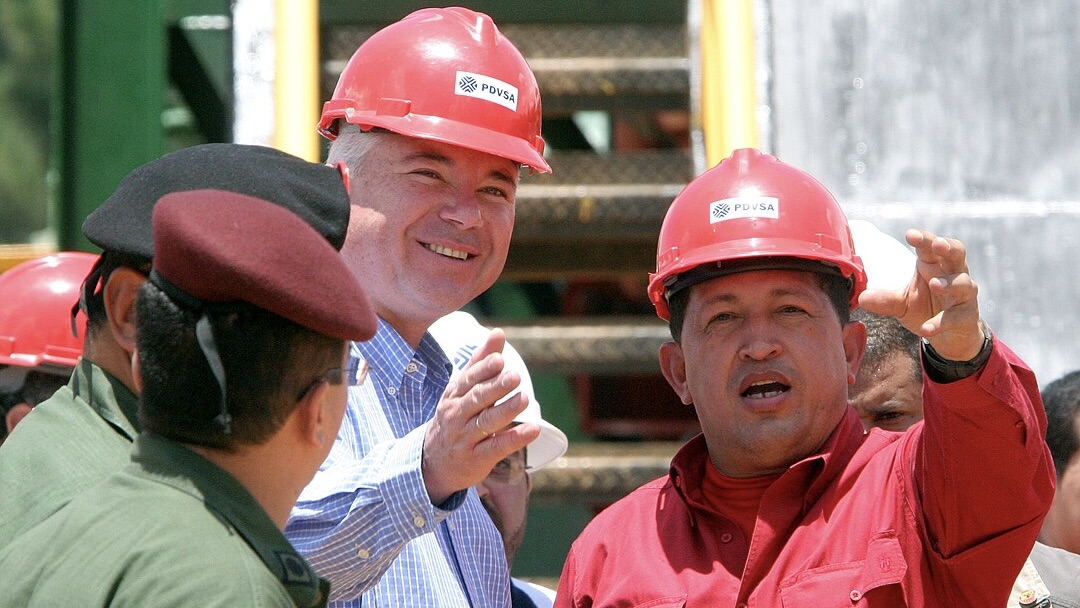
The current US attacks against Venezuela are part of a two-decade process led by the US and the Venezuelan right wing to undermine the Bolivarian project and its bold decision to use the country’s oil wealth for the betterment of its people.
The United States had no problem with Venezuela per se, not with the country nor with its former oligarchy. The problem that the United States government and its corporate class have is with the process set in motion by the first government of Venezuelan President Hugo Chávez.
In 2001, Chávez’s Bolivarian process passed a law called the Organic Hydrocarbons Law, which asserted state ownership over all oil and gas reserves, held upstream activities of exploration and extraction for the state-controlled companies, but allowed private firms – including foreign firms – to participate in downstream activities (such as refining and sale). Venezuela, which has the world’s largest petroleum reserves, had already nationalized its oil through laws in 1943 and then repeated in 1975. However, in the 1990s as part of the neoliberal reforms pushed by the International Monetary Fund (IMF) and by the large US-owned oil companies, the oil industry was substantially privatized.
When Chávez enacted the new law, it brought the state back into control of the oil industry (whose foreign oil sales were responsible for 80% of the country’s external revenues). This deeply angered the US-owned oil companies – particularly ExxonMobil and Chevron – which put pressure on the government of US President George W. Bush to act against Chávez. The US tried to engineer a coup to unseat Chávez in 2002, which lasted for a few days, and then pushed the corrupt Venezuelan oil company management to initiate a strike to damage the Venezuelan economy (it was eventually the workers who defended the company and took it back from the management). Chávez withstood both the coup attempt and the strike because he had the vast support of the population. Maria Corina Machado, who was awarded the Nobel Peace Prize in 2025, started a group called Sumaté (“Join Up”), which placed a recall referendum on the ballot. About 70% of the registered voters came to the polls in 2004, and a large majority (59%) voted to retain Chávez as the president.
But neither Machado nor her US backers (including the oil companies) rested easy. From 2001 till today, they have tried to overthrow the Bolivarian process – to effectively return the US-owned oil companies to power. The question of Venezuela, then, is not so much about “democracy” (an overused word, which is being stripped of meaning) but about the international class struggle between the right of the Venezuelan people to freely control their oil and gas and that of the US-owned oil companies to dominate Venezuelan natural resources.
The Bolivarian process
When Hugo Chávez appeared on the political scene in the 1990s, he captured the imagination of most of the Venezuelan people – particularly the working-class and the peasantry. The decade was marked by the dramatic betrayals by presidents who promised to secure the oil-rich country from IMF-imposed austerity and then adopted those same IMF proposals. It did not matter if they were social democrats (such as Carlos Andrés Pérez of Democratic Action, president from 1989 to 1993) or conservatives (such as Rafael Caldera of the Christian Democrats, president from 1994 to 1999). Hypocrisy and betrayal defined the political world, while high levels of inequality (with the Gini index at a staggering 48.0) gripped the society. The mandate for Chávez (who won the election with 56% against 39% for the candidate of the old parties) was against this hypocrisy and betrayal.
It helped Chávez and the Bolivarian process that oil prices stayed high from 1999 (when he took office) till 2013 (when he died at 58, very young). Having taken hold of the oil revenues, Chávez turned them over to make phenomenal social gains. First, he developed a set of mass social programs (misiones) that redirected oil revenues to meet basic human needs such as primary healthcare (Misión Barrio Adentro), literacy and secondary education for the working-class and peasantry (Misión Robinson, Misión Ribas, and Misión Sucre), food sovereignty (Misión Mercal and then PDVAL), and housing (Gran Misión Vivienda).
People’s Dispatch for more