Pakistan’s Baluch insurgency

by Selig S Harrison

Serious troubles have erupted in the Pakistan province of Baluchistan since the assassination of an opposition leader in August. Pressure for independence is growing in this region bordering Iran and Afghanistan, which challenges Pakistan’s authority.

THE slow-motion genocide being inflicted on Baluch tribesmen in the mountains and deserts of southwestern Pakistan does not yet qualify as a major humanitarian catastrophe compared with the slaughter in Darfur or Chechnya. “Only” 2,260 Baluch fled their villages in August to escape bombing and strafing by the US-supplied F-16 fighter jets and Cobra helicopter gunships of the Pakistan air force, but as casualty figures mount, it will be harder to ignore the human costs of the Baluch independence (1) struggle and its political repercussions in other restive minority regions of multi-ethnic Pakistan (2).

Already, in neighboring Sindh, separatists who share Baluch opposition to the Punjabi-dominated military regime of General Pervez Musharraf are reviving their long-simmering movement for a sovereign Sindhi state, or a Sindhi-Baluch federation, that would stretch along the Arabian Sea from Iran in the west to the Indian border. Many Sindhi leaders openly express their hope that instability in Pakistan will tempt India to help them, militarily and economically, to secede from Pakistan as Bangladesh did with Indian help in 1971.

Some 6 million Baluch were forcibly incorporated into Pakistan when it was created in 1947. This is the fourth insurgency they have fought to protest against economic and political discrimination. In the most bitter insurgency, from 1973 to 1977, some 80,000 Pakistani troops and 55,000 Baluch were involved in the fighting.

Iran, like Pakistan, was then an ally of the United States. Shah Mohammed Reza Pahlavi, who feared that the insurgency would spread across the border to 1.2 million Baluch living in eastern Iran, sent 30 Cobra gunships with Iranian pilots to help Islamabad. But this time Iran is not a US ally, and Iran and Pakistan are at odds. Tehran charges that US Special Forces units are using bases in Pakistan for undercover operations inside Iran designed to foment Baluch opposition to the regime of President Mahmoud Ahmadinejad.

Much of the anger that now motivates the Baluch Liberation Army (BLA) is driven by memories of Pakistani scorched earth tactics in past battles. In a climactic battle in 1974, Pakistani forces, frustrated by their inability to find Baluch guerrilla units hiding in the mountains, bombed, strafed and burned the encampments of some 15,000 Baluch families who had taken their livestock to graze in the fertile Chamalang Valley, forcing the guerrillas to come out from their hideouts to defend their women and children.

‘Indiscrimate bombing’

In the current fighting, which started in January 2005, the independent Pakistan Human Rights Commission has reported that “indiscriminate bombing and strafing” by F-16s and Cobra gunships are again being used to draw the guerrillas into the open. Six Pakistani army brigades, plus paramilitary forces totalling some 25,000 men, are deployed in the Kohlu mountains and surrounding areas where the fighting is most intense.

Musharraf is using new methods, more repressive than those of his predecessors, to crush the insurgency. In the past Baluch activists were generally arrested on formal charges and sentenced to fixed terms in prisons known to their families. This time Baluch spokesmen have reported large-scale kidnappings and disappearances, charging that Pakistani forces have rounded up hundreds of Baluch youths on unspecified charges and taken them to unknown locations.
The big difference between earlier phases of the Baluch struggle and the present one is that Islamabad has so far not been able to play off feuding tribes against each other. Equally importantly, it faces a unified nationalist movement under younger leadership drawn not only from tribal leaders but also from an emergent, literate Baluch middle class that did not exist three decades ago. Another difference is that the Baluch have a better armed, more disciplined fighting force in the BLA. Baluch leaders say that rich compatriots and sympathisers in the Persian Gulf provide money needed to buy weapons in the flourishing black market along the Afghan frontier.

President Musharraf has repeatedly accused India of supplying weapons to the Baluch insurgents and funds to Sindhi separatist groups, but has provided no evidence to back up these charges. India denies the accusations. At the same time New Delhi has issued periodic statements expressing concern at the fighting and calling for political dialogue.
India brushes aside suggestions that it might be tempted to help Sindhi and Baluch insurgents if the situation in Pakistan continues to unravel. Indian leaders say that. on the contrary, India wants a stable Pakistan that will negotiate a peace settlement in Kashmir so that both sides can wind down their costly arms race. But many India media commentators appear happy to see Musharraf tied down in Baluchistan and hope that the crisis will force him to reduce Pakistani support for extremist Islamic insurgents in Kashmir.

Unlike India, Iran has its own Baluch minority and fears Baluch nationalism. The Baluchistan People’s party, one of the leading Baluch groups in Iran, said on 5 August that a radical Shia cleric, Hojatol Ibrahim Nekoonam, recently installed as the justice minister of Iran’s Baluchistan province, has launched a campaign of military and police repression spearheaded by the Mersad clerical secret police, in which hundreds of Baluch have been rounded up and, in many cases, executed on charges of collaborating with the US.

Apart from being smaller in number, the Baluch in Iran are not as politically conscious or as well organised as those in Pakistan, and their principal leaders dismiss the idea of secession or of union with the Baluch in Pakistan. The Baluchistan People’s party is part of a coalition with groups representing other disaffected minorities in Iran — the Kurds, Azeri Turks and Khuzestani Arabs — which is seeking a federal restructuring in which Iran would retain control over foreign affairs, defence, communications and foreign trade, but cede autonomy in other spheres to three minority autonomous regions.

http://mondediplo.com/2006/10/05baluchistan
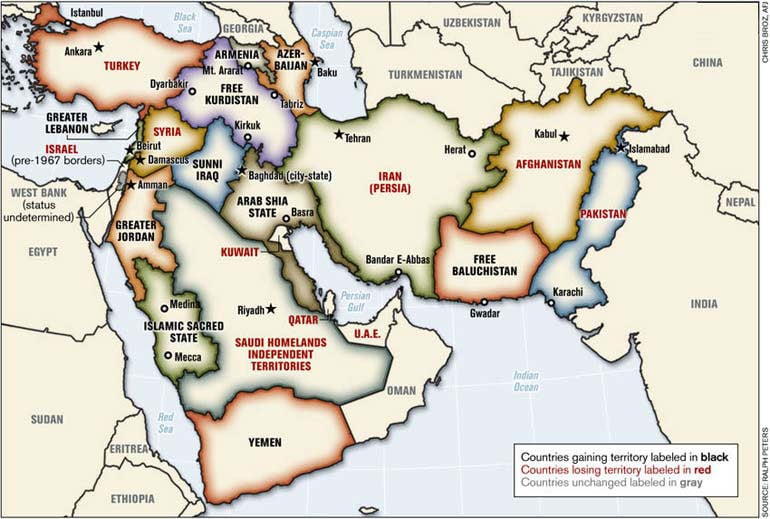
Blood borders How a better Middle East would look

By Ralph Peters

International borders are never completely just. But the degree of injustice they inflict upon those whom frontiers force together or separate makes an enormous difference — often the difference between freedom and oppression, tolerance and atrocity, the rule of law and terrorism, or even peace and war.

The most arbitrary and distorted borders in the world are in Africa and the Middle East. Drawn by self-interested Europeans (who have had sufficient trouble defining their own frontiers), Africa’s borders continue to provoke the deaths of millions of local inhabitants. But the unjust borders in the Middle East — to borrow from Churchill — generate more trouble than can be consumed locally.

While the Middle East has far more problems than dysfunctional borders alone — from cultural stagnation through scandalous inequality to deadly religious extremism — the greatest taboo in striving to understand the region’s comprehensive failure isn’t Islam but the awful-but-sacrosanct international boundaries worshipped by our own diplomats.

Of course, no adjustment of borders, however draconian, could make every minority in the Middle East happy. In some instances, ethnic and religious groups live intermingled and have intermarried. Elsewhere, reunions based on blood or belief might not prove quite as joyous as their current proponents expect. The boundaries projected in the maps accompanying this article redress the wrongs suffered by the most significant “cheated” population groups, such as the Kurds, Baluch and Arab Shia, but still fail to account adequately for Middle Eastern Christians, Bahais, Ismailis, Naqshbandis and many another numerically lesser minorities. And one haunting wrong can never be redressed with a reward of territory: the genocide perpetrated against the Armenians by the dying Ottoman Empire.

Yet, for all the injustices the borders re-imagined here leave unaddressed, without such major boundary revisions, we shall never see a more peaceful Middle East.

Read More

Plans for Redrawing the Middle East: The Project for a “New Middle East”

By Mahdi Darius Nazemroaya

The Map of the “New Middle East”
A relatively unknown map of the Middle East, NATO-garrisoned Afghanistan, and Pakistan has been circulating around strategic, governmental, NATO, policy and military circles since mid-2006. It has been causally allowed to surface in public, maybe in an attempt to build consensus and to slowly prepare the general public for possible, maybe even cataclysmic, changes in the Middle East. This is a map of a redrawn and restructured Middle East identified as the “New Middle East.”
MAP OF THE NEW MIDDLE EAST

Note: The following map was prepared by Lieutenant-Colonel Ralph Peters. It was published in the Armed Forces Journal in June 2006, Peters is a retired colonel of the U.S. National War Academy. (Map Copyright Lieutenant-Colonel Ralph Peters 2006).

Although the map does not officially reflect Pentagon doctrine, it has been used in a training program at NATO’s Defense College for senior military officers. This map, as well as other similar maps, has most probably been used at the National War Academy as well as in military planning circles.
Read More

The danger within

By Ardeshir Cowasjee

Time and time again one must retreat to the beginnings of the country and the exhortation of its founder and maker, Mohammad Ali Jinnah, that the first and paramount duty of any government is the imposition and maintenance of law and order.

What he did not envisage was the deterioration of the judiciary of his country, which was firm and steadfast during the short time he had.

For without an independent and responsible judiciary law and order is a far cry. And as we all well know, within six years of the country’s birth the judiciary had crumbled, by then largely bereft of its inherited judges. There has been no government since 1954 which could tolerate or survive an independent and honourable judiciary. Such has been our fate.

Read More

SOUTH ASIA: Terrorists Aim for Destabilisation, Media Attention

Analysis by Beena Sarwar

KARACHI, Mar 4 (IPS) – South Asia seems to be caught in a vortex of violence as the countries that form this region – from Sri Lanka at the southern-most tip, Bangladesh to the east, Nepal crowning the north, Pakistan along the west and India in the middle – deal with internal nightmares that their governments routinely blame on neighbours.

Wednesday’s armed attack on the Sri Lankan cricket team in the historic city of Lahore in Pakistan has sent shockwaves through a country already racked by regular suicide and other attacks.

Eight Pakistani policemen died and several were injured saving the Sri Lankan cricketers, six of whom were wounded in the attack.

At the other end of the sub-continent, Bangladesh is still reeling from the shock of a border guards’ mutiny over pay and working conditions, resulting in soldiers massacring over 70 officers, including some of their wives.

Some analysts fear that the horrific incident might elicit copycat responses elsewhere too, where soldiers are unhappy with the tasks they are made to do.

Meanwhile, India has yet to recover from the horror of the attacks in Mumbai that claimed some 180 lives. New Delhi had, as a direct result of the attacks, called off participation of the Indian cricket team in the Pakistan tests.

Sri Lanka, in the last stages of a heavy-handed army operation against the Tamil separatists who have been fighting a guerrilla war against the state for over two decades, could hardly have imagined that its cricket team would come under fire in Pakistan, a friendly country.

Read More

Guide songs

(Songs from one of the best movies made in 1965, “Guide”, starring Waheeda Rehman and Dev Anand. Lata Mangeshkar and Mohd Rafi sang the songs while the music is by Sachin Dev Burman and the lyrics are by Shailendra. This was the first commercial movie in India which showed the heroine as a strong and bold woman who left her husband for another man. The film was based on R. K. Narayan’s story of the same name. There was an English version of the movie made too. Ed.)

Saiyan be-imaan
Part I

kya se kya ho gaya
Part II

New Frontier Opens In The Search For Life On Other Planets

Scientists recently discovered a new frontier in the race to find life outside our solar system. Dying red giant stars may bring icy planets back from the dead. Once-frozen planets and moons may provide a new breeding ground for life as their stars enter the last, and brightest, phase of their lives. Previous ideas about the search for extra-solar life had excluded these regions.

Image left: A sun-like star grows into its red giant phase, increasing in size and luminosity. Energy in the form of heat can now reach a once-frozen and dead moon. The icy surface quickly melts into liquid water, filling in old craters with warmer seas. The stage is now set for the possible formation of new life. Credit: NASA. Click on the image above for a .mpg movie

An international team of astronomers estimates that the emergence of new life on a planet is possible within the red giant phase. “Our result indicates that searches for life-giving worlds outside our solar system should include planets around old stars,” said Dr. Bruno Lopez of the Observatoire de la Cote d’Azur, Nice, France. Lopez and his colleagues estimate that more than 150 red giant stars are close enough – within 100 light years – for upcoming or proposed missions to search for the signatures of life on distant worlds. A light year is the distance light travels in one year, almost six trillion miles!

Read More

Nasa Begins Hunt For Life On Other Worlds

Nasa’s “historic mission” to hunt for life on other planets has begun thanks to perfect weather conditions in the US.

Delta II lifted off to take the Kepler telescope into space.
A rocket carrying the powerful Kepler telescope took off from Cape Canaveral in Florida bang on schedule at 3.48am UK time.
The craft – named after the German 17th Century astrophysicist Kepler – will search for planets like Earth in a faraway corner of the galaxy.
The telescope, which is fitted with British-made light detectors so powerful it can spot a fly on a car headlight a mile away, will spend more than three years staring at 100,000 stars.
It will measure their brightness and any winks in the light that may signify orbiting planets.

Read More

Scientists Come Out for Human Rights

By Sonia Shah

Ever hear of a pro bono chemist, or a human rights physicist or an environmental statistician?

Not really, right? True, every now and again, a social crisis has motivated some sector of the scientific community to throw their hats into the political ring: the nuclear threats of the cold war begat the Union of Concerned Scientists, the healthcare crisis Physicians for a National Health Program, the advent of unregulated biotech the Council for Responsible Genetics. But the scientific masses have by and large remained impassively unmoved, churning out their papers, applying for their grants and debating esoterica at their private professional meetings, with nary a head turned for the din and crash of messy social realities outside their rarefied digs.

But cracks in that notoriously apolitical stance have started to appear. Take, for example, a groundbreaking meeting held by the American Association for the Advancement of Science in mid-January. At the AAAS’s elegant DC headquarters, some 200 scientists met with a smattering of human rights activists, sharing stories of a groundswell of interest in social change activism in the scientific community. “People in my organization are very eager to volunteer their services” to human rights organizations, said biostatistician Hormuzd Katki of the Washington Statistical Society. Who knew? “Human rights activists and scientists are both in pursuit of the truth, it’s a natural partnership,” enthused EarthRights International activist Matthew Smith, who attended the meeting.

The result: the AAAS’s new Science and Human Rights Coalition, which aims to enlist dozens of mainstream scientific associations (seventy-five sent representatives to the meeting) in the business of pushing scientists to learn about and speak out on human rights violations and to offer their expertise in support of established human rights organizations. “We’re going to beat all those pro bono lawyers,” announced sociologist and coalition co-founder Mona Younis.

Of course, it will take more than charitable intentions–and inter-professional rivalry–to reorient scientific inquiry to serve rather than undermine human rights. After all, the sciences’ professional culture frowns upon those who speak out, holding that a disinterested, unbiased scientific method requires a concomitantly disinterested and unbiased mind. “Scientists can’t be seen as advocates,” one scientist at the AAAS meeting said, to a sea of nodding heads. Plus, no scientist gets canned for the transgressive social implications of their discoveries. Some get prizes for those very same discoveries, in fact.

Read More