
by ANDREW COCKBURN
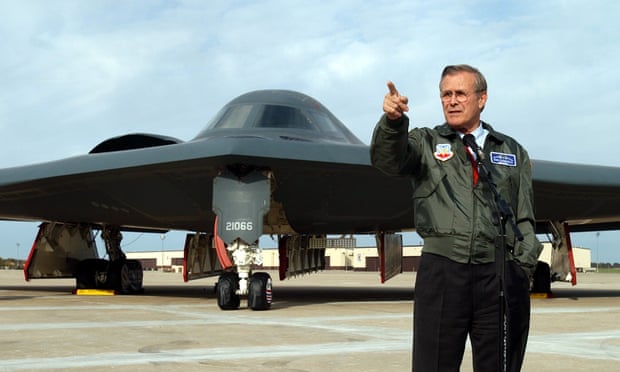
The late defence secretary’s micromanagement style – arrogant, bullying and ignorant – helped ensure the disastrous outcome
Donald Rumsfeld, secretary of defense under George W Bush, who died on 30 June at the age of 88, enjoyed one all-important attribute, which was to appear larger than he actually was. He enhanced his comparatively diminutive 5ft 8in stature with the aid of thickly padded shoes with built-up heels, which caused him to waddle when he walked. His staff called them the “duck shoes”. But he inflated his presence in other ways, too, promoting the image of a clear-thinking, decisive commander while determinedly deflecting responsibility when initiatives he had championed careened into disaster.
When American Airlines flight 77 crashed into the Pentagon on 9/11, he hurried out of his office and headed for the site of the impact, spending a minute or so helping to carry a stretcher bearing one of the casualties. Meanwhile, the country was under attack, but no one knew where the chief executive of the US armed forces was to be found. As a senior White House official later complained to me: “He abandoned his post.” The excursion elevated him to heroic status, as a decisive, take-charge leader, an image that persisted in part thanks to his heavily staffed publicity apparatus. It played no small part in distracting attention from his impatient neglect of warnings prior to 9/11 that a terrorist attack was likely.
Assuming office in 2001, he had loudly proclaimed his intention to “transform” the country’s baroque military apparatus from top to bottom, but left unmentioned for several months the fact that he was recusing himself from decisions on which weapons to buy because he hadn’t yet sold his stocks in defence corporations (which were climbing in value thanks to his promise of a budget boost). Questioned by investigators probing the scandal of a $26bn (£19bn) contract for air force refuelling tankers, which ultimately led to criminal prosecutions and the jailing of several of those involved, he claimed to be completely unaware of the events, asserting that he never met defence contractors unless he “ran into them at a party some place”.
Most famously, he vigorously promoted the 2003 invasion and occupation of Iraq, deploying a special unit in the Pentagon called the Office of Special Plans to generate intelligence asserting Saddam Hussein’s possession of weapons of mass destruction. When it became clear that Saddam had, in fact, no such weapons, he dodged responsibility for the fake intelligence. In the same vein, routine torture of prisoners by US troops came as news to him, while the thinly armoured vehicles in which troops were being killed by roadside bombs were somebody else’s responsibility. Whether the Iraq operation could have ended happily under any circumstances is open to doubt, but Rumsfeld’s micromanagement style – arrogant, bullying and ignorant – helped ensure disaster.
The Guardian for more