
DEMOCRACY NOW
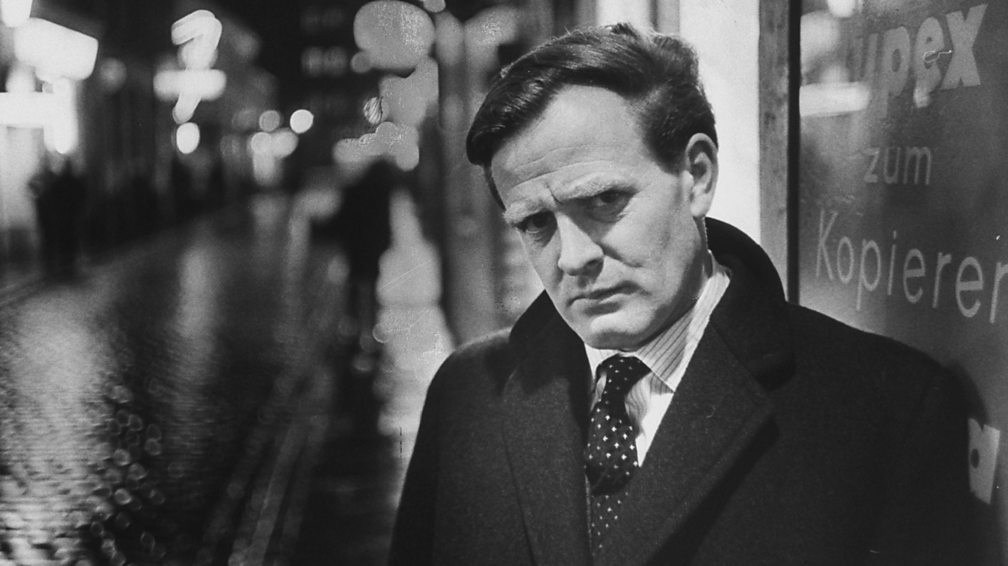
The world-renowned British novelist John le Carré died on December 12 at the age of 89. Le Carré established himself as a master writer of spy novels in a career that spanned more than half a century. He worked in the British Secret Service from the late 1950s until the early ’60s, at the height of the Cold War — which was the topic of his early novels. His later works focused on the inequities of globalization, unchecked multinational corporate power and the role national spy services play in protecting corporate interests. His best-known books include “The Spy Who Came in from the Cold” and “The Constant Gardner.” Le Carré was also a fierce critic of the U.S. response to the 9/11 attacks and the Bush administration’s invasion of Iraq. In 2010, he appeared on Democracy Now! for a rare in-depth interview.
AMY GOODMAN: John le Carré was the pen name for David Cornwell. He died on December 12th at the age of 89. Let’s go back to that conversation with John le Carré in 2010. I interviewed him with Democracy Now!’s Denis Moynihan.
AMY GOODMAN: This is Democracy Now!, democracynow.org, The War and Peace Report. We are on the road in London, just along the Thames, not far from Parliament, not far from MI5 and MI6, the international and domestic spy agencies here, so it is most relevant to bring you John le Carré, this hour we spend with the foremost spy writer of our time.
JOHN LE CARRÉ: Well, I’ve told a lot of lies about that in my time, I have to confess. I began writing when I was still in the British Foreign Service, and it was then understood that even if you wrote about butterfly collecting, you used another name. So the fact that I was in a secret department does not play a part.
Then, I think I decided that I needed three pieces to a name, that they would arrest the “I” and put an accent on the last part. Then the word carré in French has a bunch of ambiguous meanings. A balle carrée, for example, is a dance where the ladies ask the men to dance. Carré at roulette, if you put a numéro carré, you put a counter on each corner of a number. And so it goes on. And I think an homme carré is a little bit a dubious guy. That seemed to me to suit me perfectly at that time.
AMY GOODMAN: Well, in the interests of transparency, we’ll just call you David Cornwell, if that’s OK.
JOHN LE CARRÉ: Just David will do fine.
AMY GOODMAN: Now, we were interested because Channel 4 just said “the last interview” with John le Carré, and yet here we are. Why did you change your mind?
JOHN LE CARRÉ: I didn’t change my mind. The full text with Channel 4 was that that was my last interview in the U.K. And this is the last book about which I intend to give interviews. That isn’t because I’m in any sense retiring. I’ve found that, actually, I’ve said everything I really want to say, outside my books. I would just like — I’m in wonderful shape. I’m entering my 80th year. I just want to devote myself entirely to writing and not to this particular art form of conversation.
AMY GOODMAN: Well, we’re very thankful to be with you today. I want to bring Denis Moynihan into this conversation, my colleague, who invariably has a spy novel in his hand, and it is usually a novel by John le Carré. If he hasn’t read it once, he’s read it three times, and then he’s on to the fourth.
DENIS MOYNIHAN: David, the latest book, your 22nd novel, Our Kind of Traitor, is about — well, I guess, to frame it for our audience, who may not be familiar with your half-century of writing, about half of that time you wrote during the Cold War, and since then you’ve been focusing less on that story and more on the multinational corporate malfeasance and the confluence of kind of corporate interests and government skulduggery. This story, you want to lay it out kind of in broad strokes, the money laundering, the importance of drug money and laundered money in propping up —
JOHN LE CARRÉ: This is really a — it’s a story, and it’s supposed to entertain, and if it doesn’t entertain, there’s no point in the message. The message has — message has got to be carried on the back of the beetle; otherwise, there is none.
So what we have is a young couple. They’re thinking of getting married. They go off and take a holiday in Antigua. They both love tennis. And they’re middle-class. One’s a lawyer. The other is a tutor at Oxford. And they’re playing tennis. Somebody watches them. And all of a sudden, the fellow, Perry, is invited to play tennis with a Russian guy. And from then on — there is purpose behind the invitation. From then on, they are drawn into a world they didn’t know existed. They’re both intelligent, decent, moral people, and they’re faced with the anarchy, in fact, the kind of exported anarchy of post-Cold War Russia. So the Wild East has come to visit them in Antigua. And from then on, they are drawn into an intrigue.
Dima, my Russian character — I don’t spoil the story by telling you this — says he wishes to defect. He has a quarrel with his gang boss, who is the boss of bosses in Russia, and he’s going to get even with him. He’s going to betray him. He’s going to pour out all the secrets about how he launders money on a vast scale on behalf of a collection of Russian brotherhoods, or Vory. Russian crime has been integrated into the — first of all, into the Soviet Union, on a grand scale. It was developed — the crime families were developed in the camps of Siberia. And Dima emerges from that world. He was a bareknuckle gangster, spent a bit of time on Brighton Beach, learned the arts of money laundering, learned to wear suits, learned to speak half-decent English, and settled in Switzerland, and from there operated a vast money laundering scheme.
Now, this isn’t fiction. That part of it isn’t fiction. Money laundering is simply everywhere. On the grand scale, it’s endemic to banking. You have to bear in mind that when Lehman Brothers wasn’t going to function anymore and the big banks weren’t lending to one another, back at that terrible time, $352 billion of illegal money were then tacitly released upon the market, and that was about the only money people were lending to one another. So, money laundering is not some distant fantasy. It’s actually how you handle the profits of extortion, tax evasion, criminal conspiracy and huge quantities of drug money, how you get that into the white sector. And what we are gradually learning from these little exposés that come to light is that there is almost no way of denying people, in the end, the profits of their crime, which is a tragedy. And it’s also a frightful annoyance, because we pay vast sums of money across the way here to agencies that are supposed to stop money laundering. Doesn’t happen.
AMY GOODMAN: I mean, you’ve got a column right there, bringing this right up
Democracy Now for more