
by BEN FOUNTAIN
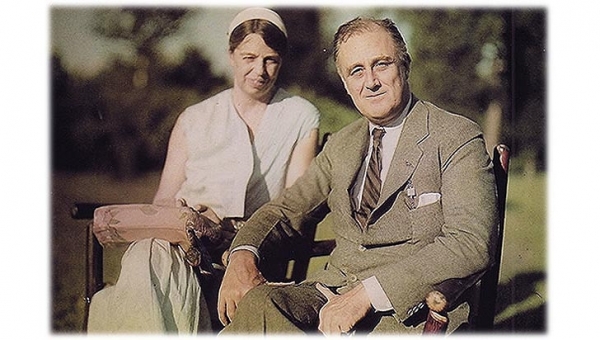 32nd US President Franklin Delano Roosevelt (1882-1945) with First Lady Eleanor Roosevelt PHOTO/Old Magazine Articles
As Clinton and Trump prepare to debate next week, noble ideals are overwhelmed in a culture where most Americans do not know what is real anymore and the dream of equal opportunity is a fantasy
Every child had a pretty good shot
To get at least as far as their old man got
But something happened on the way to that place
They threw an American flag in our face.
Billy Joel, Allentown
It’s one of the greatest inventions of all time, and just like it says on the dollar bill – novus ordo seclorum – it created an entirely new order in human affairs. After millennia of pharaohs, emperors, kings, queens, sultans, caesars and czars, with all their attendant aristocracies and locked-down social structures, a country was founded where birth and lineage didn’t matter so much, where by application of your talents, energy, labor and willingness to play by the rules, you could improve your material lot in life and achieve a measure of economic security for yourself and your family. Peasants and proles could aspire to more than mere survival. Radical!
We know it today as the American Dream. The now-obscure historian James Truslow Adams coined the term in his book The Epic of America, defining “the American dream” as:
a dream of a social order in which each man and each woman shall be able to attain to the fullest stature of which they are innately capable, and be recognized by others for what they are, regardless of the fortuitous circumstances of birth or position.
Adams was writing in 1931, but the dream was there from the start, in Jefferson’s “pursuit of happiness” formulation in the Declaration of Independence, “happiness” residing in its 18th-century sense of prosperity, thriving, wellbeing.
Nobody ever came to America with a starry-eyed dream of working for starvation wages. Plenty of that available in the old country, and that’s precisely why we left, escaping serfdom, peonage, tenancy, indenture – all different iterations of what was essentially a “rigged system”, to put it in current political verbiage – that channeled the profits of our labor upstream to the Man. We came to America to do better, to secure for ourselves the liberation that economic security brings, and for millions – mostly white males at first, and then slowly, sputteringly, women and people of color – that’s the way it worked out, nothing less than a revolution in the human condition.
Upward mobility is indispensable to the American Dream, the notion that people can rise from working to middle class, and middle to upper and even higher on the model of a (fictional) Horatio Alger or an (actual) Andrew Carnegie. Upward mobility across classes peaked in the US in the late 19th century. Most of the gains of the 20th century were achieved en masse; it wasn’t so much a phenomenon of great numbers of people rising from one class to the next as it was standards of living rising sharply for all classes. You didn’t have to be exceptional to rise. Opportunity was sufficiently broad that hard work and steadiness would do, along with tacit buy-in to the social contract, allegiance to the system proceeding on the assumption that the system was basically fair.
The biggest gains occurred in the post-second world war era of the GI Bill, affordable higher education, strong labor unions, and a progressive tax code. Between the late 1940s and early 1970s, median household income in the US doubled. Income inequality reached historic lows. The average CEO salary was approximately 30 times that of the lowest-paid employee, compared with today’s gold-plated multiple of 370. The top tax bracket ranged in the neighborhood of 70% to 90%. Granted, there were far fewer billionaires in those days. Somehow the nation survived.
“America is a dream of greater justice and opportunity for the average man and, if we can not obtain it, all our other achievements amount to nothing.” So wrote Eleanor Roosevelt in her syndicated column of 6 January 1941, an apt lead-in to her husband’s State of the Union address later that day in which he enumerated the four freedoms essential to American democracy, among them “freedom from want”. In his State of the Union address three years later, FDR expanded on this concept of freedom from want with his proposal for a “Second Bill of Rights”, an “economic” bill of rights to counteract what he viewed as the growing tyranny of the modern economic order:
The Guardian for more