
by LIZ KRUESI
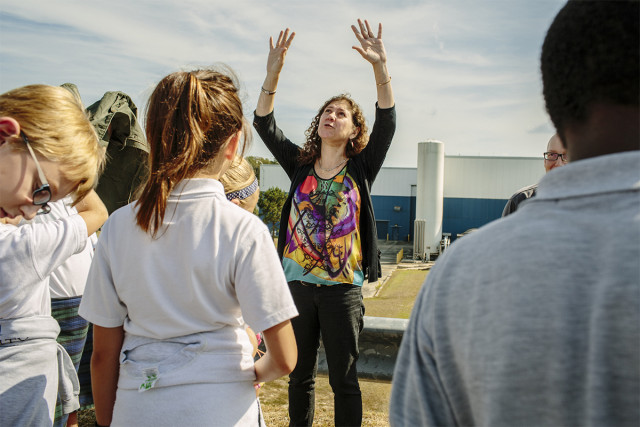 Gabriela González speaks to elementary school students at the LIGO observatory in Livingston, La. PHOTO/William Widmer
The physicist Gabriela González is on the cusp of finding the first direct evidence of gravitational waves — soundlike wobbles in space-time produced by black holes and their kin.
Our ears are now open to gravity’s faint symphony. On September 18, the Advanced Laser Interferometer Gravitational-Wave Observatory, or Advanced LIGO, began to listen for gravitational waves, cosmic ripples that subtly warp the fabric of space-time. Albert Einstein solved the equations that implied that these waves should exist, and nearly a century later, hopes are high that Advanced LIGO is about to directly detect them for the first time.
The long waiting period is an indication of the intense experimental challenges that gravitational-wave researchers face. Even a strong gravitational-wave signal — one produced by the collision of two black holes, for example — might shrink or expand a laser beam several kilometers in length by only a small fraction of the width of a proton. The first iteration of the LIGO experiment, which ran from 2001 to 2010, was thwarted by spurious noises from both human and natural sources — the faint rumbles of a distant cargo train or a felled tree, or even the sudden rush of a gust of wind.
Quanta for more