
by LINDSAY BIGDA
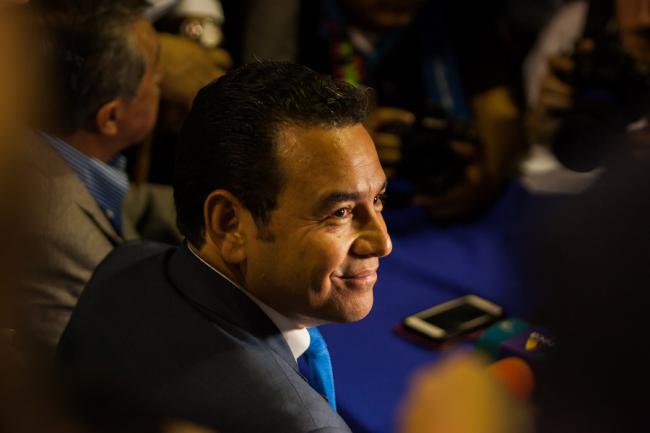 Guatemala’s President-elect Jimmy Morales, despite political inexperience, has close ties to Guatemala’s military dictatorship PHOTO/Jeff Abbott”NACLA
Riding a wave of anti-establishment sentiment, Jimmy Morales — a comedian with no political experience and backed by military hard-liners — has been elected Guatemala’s next president.
Riding a wave of anti-establishment sentiment, Jimmy Morales — a comedian with no political experience and backed by military hard-liners — has been elected Guatemala’s next president.
Morales saw his popularity surge amid a series of corruption scandals that led to mass citizen protests, the arrest of several high-level government officials, and the resignation of former president Otto Pérez Molina this September. Capitalizing on his reputation as a political outsider, Morales achieved an unexpected first-round win in September before defeating former first lady Sandra Torres in the October 25 runoff election.
Many supporters of Molina’s ouster had supported Torres over the military-backed Morales — albeit reluctantly, since she’d faced past corruption allegations herself.
Morales, like his opponent, promised efforts to promote transparency and root out corruption. But he’s drawn criticism for his vague policies, his comedy act’s reliance on racist, sexist, and homophobic tropes, and the fact that some of his backers — including the founders of his political party, the National Convergence Front (FCN) — are conservative members of the military linked to war crimes from the country’s three-decade civil conflict.
Though some Guatemalans are cautiously optimistic about the future, many remain skeptical that Morales will be able to pull the country out of its current political turmoil. “Nothing is going to change,” one voter said via Twitter — even as she cast her ballot.
A Grim Backdrop
Though it was corruption that ultimately felled Pérez Molina, the uprising against him took place amid a broader crackdown on human rights defenders of all stripes — including human rights lawyers, journalists, labor activists, and indigenous groups resisting large-scale development projects.
In Washington, members of Guatemala’s Human Rights Convergence and other civil society organizations recently participated in hearings at the Inter-American Commission on Human Rights and met with U.S. government officials to discuss these challenges.
Foreign Policy in Focus for more