
by BEN ANDERSON
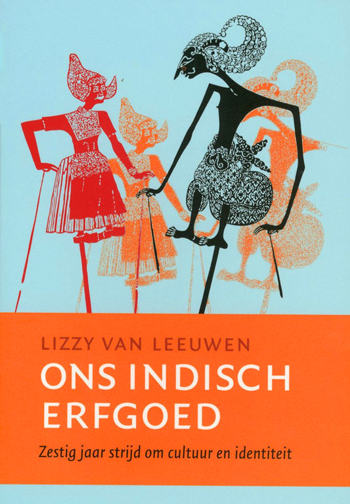
Review: Van Leeuwen’s book considers the struggles and ironies surrounding Indies heritage in Holland, as the outcome of an absurd colonial history
Some years ago, when I read Lizzy’s masterpiece, Lost in Mall: An Ethnography of Middle-Class Jakarta in the 1990s, I found myself laughing over and over again – a delicious pleasure that I had never experienced while reading any of the classic academic books about Indonesia. In them you could find moralising, anger, earnestness, melancholy, cynicism, pedantry, secular missionising, sometimes a dash here and there of irony, but practically never the laughter that best distinguishes us from our animal cousins. Lizzy had had the originality to undertake anthropological fieldwork among the new rich of Jakarta, and the fortitude to endure one year of moral, political and cultural nothingness in one of the quasi-gated communities in which such people lived during the final years of Suharto’s tyranny. The book reaches its climax in the first days of the rioting that led to Suharto’s fall. We are shown a youngish middle-aged wife and mother, facing an existential conundrum. Her dilettante husband has gone off to take photos, and has shut down his cell-phone. Her brutish teenage son is incommunicado in some favourite mall, and the maid has taken the day off. Left alone with the family’s three Mercedes Benz, she thinks of driving one off to a ‘safe’ spot near the city limits, but is paralysed by the fancy that while she is gone, the other two could fall into the hands of the menacing unwashed. Lizzy’s perfect eye and ear for black social comedy makes one laugh, but one also feels her quiet sympathy for the wretched woman. This combination of comedy, melancholy, human warmth and sharp-eyed, unillusioned social observation is Lizzy’s forte.
Her latest book, Ons Indisch Erfgoed: Zestig Jaar Strijd om Cultuur en Identiteit (Our Indies Heritage: Sixty Years of Struggle for Culture and Identity), is another triumph in much the same manner. It analyses the first great post-colonial migration of ‘ex-colonials’ to an imperial step-motherland in Atlantic Europe, and the politico-cultural consequences over the next 60 years. The waves started in 1946 when largely totok or ‘pure Dutch’ bureaucrats, businessmen and soldiers, savagely interned by the occupying Japanese, were repatriated to Holland with their families. After four years of brutal warfare, the Netherlands was forced to transfer legal sovereignty to the Federal Republic of Indonesia. Many Indos, especially those with ‘Dutch’ legal status, who had fought with the Dutch against Indonesian nationalists, imagined the writing on the wall, and started to migrate to the Netherlands, though some went on to warmer (in every sense of the word) climates in California, Australia and Brazil. Late in 1957, in reprisal for The Hague’s stubborn refusal to negotiate West Papua’s joining the infant Republic, Sukarno ordered the nationalisation of all Dutch enterprises in Indonesia, and the expulsion of all those with Dutch nationality.
Who were the traumatised migrants from Indonesia between 1946 and, say, 1965 (‘integration’ of West Papua into Indonesia in 1963 and Sukarno’s effective fall in late 1965)? The two most important groups were ‘pure Dutch’ and Indos. The former included many with long careers behind them in the Indies, many children born and raised there, as well as a minority of families with local roots several generations back. In political terms, they could be easily assimilated into a Dutch society that was still fairly homogeneous. But, with a few exceptions, they would never, in Holland, have the kind of power and prestige (let alone armies of male and female servants) they had once enjoyed and taken for granted in the Indies. The Indo-Europeans were another matter.
Amazingly, from almost the start, Dutch colonial law never acknowledged a status like, for example, the Mmétis in the French colonies or the Anglo-Indians of the Raj. If a ‘European’ acknowledged a child by an ‘Asian’ woman, the little one became Dutch, despite, maybe, a brown skin and beautiful eyes. If he did not – and this was much more common – the child would become a native (inlander) even if s/he had blue eyes and a fair skin. ‘Indos’ never appeared as a statistical category in colonial censuses, but it is probable that they made up three quarters of the 250,000 ‘Europeans’ recorded by the census of 1930. No one has any idea how many inlander Indos there were.
Until 1870 or so, when the colony was still closed to immigration, the ‘European’ Indos did rather well, but once the doors were broken open by Free Trade, whole families could seek their fortunes in the Indies, and thus the economic, political and social position of the Indos steadily declined. Meanwhile the opening of good schools for Indonesians created a growing rivalry in the job-market between Indos and natives. The memoir of journalist Kwee Thiam Tjing, the wittiest satirist of the colonial era, who used the mock-terrifying pen name ‘Tjamboek Berdoeri’ (Whip Laced with Thorns), describes hilariously his relationship – in jail – with a young Indo thief. The boy was taken to court in an automobile, while TB, charged with offences against the press laws, had to walk the same route in chains. The boy had a comfortable mattress, a mosquito net, a personal native servant and large European meals, while TB had none of these privileges. The end of the anecdote has the little thief saying he couldn’t bear the European food, and could he exchange what he was given for the simple native food supplied to TB?
Inside Indonesia for more