
by GEORGIA GEE, MEHEDI MAROF, & TANBIRUL MIRAJ RIPON
Newly revealed contract between Starlink and Bangladesh shows how these deals are made.
In early April, U.S. President Donald Trump launched a salvo of international tariffs that rocked the global economy. Targeting countries from Mexico to Fiji, the announced tariffs led to a market crash while governments around the world jumped into action in attempts to forestall them.
Bangladesh, which sells vast amounts of garments and textiles to the U.S., was particularly threatened. It suddenly faced a 37% rate — one of the highest on the list.
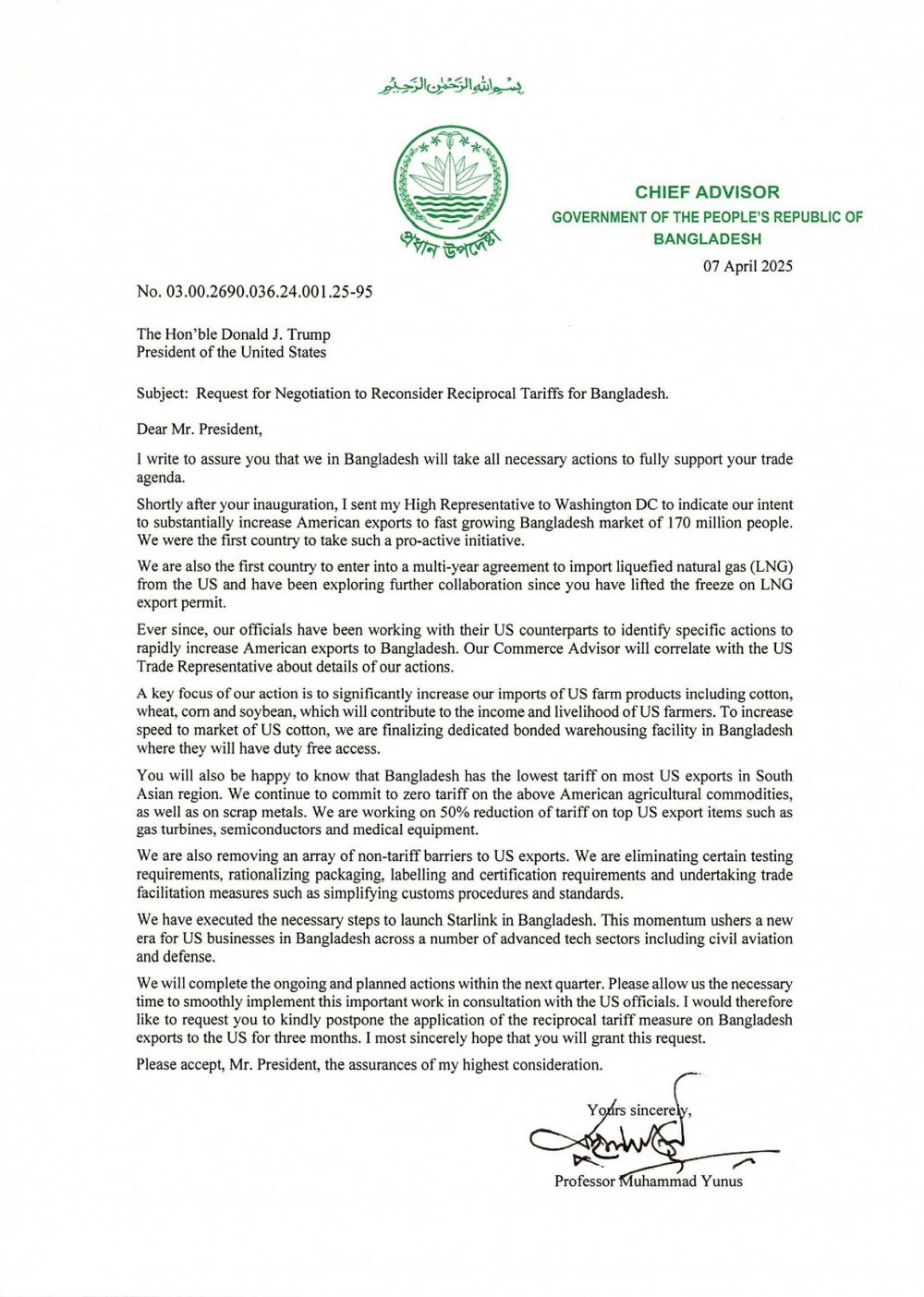
On April 7, Muhammad Yunus, chief adviser of Bangladesh, sent Trump an urgent letter. He listed all the ways that his country was trying to comply with Trump’s agenda and asked him to delay tariffs. The note included a curious addition: “We have executed the necessary steps to launch Starlink in Bangladesh.”
Since Starlink launched its first satellites in 2019, the internet provider owned by billionaire Elon Musk has attempted to expand into markets around the world, often facing regulatory red tape in doing so. But with Musk playing a high-profile role in Trump’s White House from January through May, Yunus and other leaders seemed to recognize that accommodating Starlink could be one means of appeasing the new administration.
The same day Yunus sent his letter, Starlink applied for a license with the Bangladesh Telecommunication Regulatory Commission. Three weeks after Yunus’ letter to Trump, the BTRC approved Starlink’s application. The service launched in Bangladesh the following month.
Bangladesh became the latest country around the world to expedite its regulatory approval process for satellite internet providers while Musk took part in Trump’s second administration. During the first five months of the year — as Musk assumed his lead role in the Department of Government Efficiency — Starlink announced it had become available in at least 13 countries, while its applications were approved in two more. In the six months since Musk broke ties with the administration, Starlink announced its entry into an additional 13 countries, totalling at least 26 countries in 2025.
In some cases, Starlink found quick success in countries it sought to enter for the first time. In others, Starlink’s applications had stalled for years until they were suddenly greenlit.
“With Starlink, none of [the] regular procedures have been followed,” said Mohammad Aminul Hakim, president of the Internet Service Providers Association of Bangladesh, which represents over 900 companies in Bangladesh’s internet sector. He told Rest of World that he had never seen any internet service provider being granted the right to operate in Bangladesh so quickly.
Reporting by outlets including ProPublica and The Washington Post suggests that the support and influence of the White House may have made the difference. Several countries that ushered in Starlink this year appeared to be trying to stave off Trump’s tariffs and were pressured by the U.S. State Department to expedite deployment, prompting calls from Democratic senators for an investigation into the company’s foreign deals.
In a new investigation of Starlink’s dealmaking across the globe, Rest of World obtained Bangladesh’s license agreement, which our research suggests has yet to be publicized. The document is embedded, in full, at the bottom of this article.
Rest of World also reviewed records and official statements in the public domain and interviewed industry stakeholders, satellite experts, and government officials across 10 countries, including some that welcomed Starlink this year and others that continue to elude the satellite internet provider.
Rest of World for more