
by TAMARA PEARSON
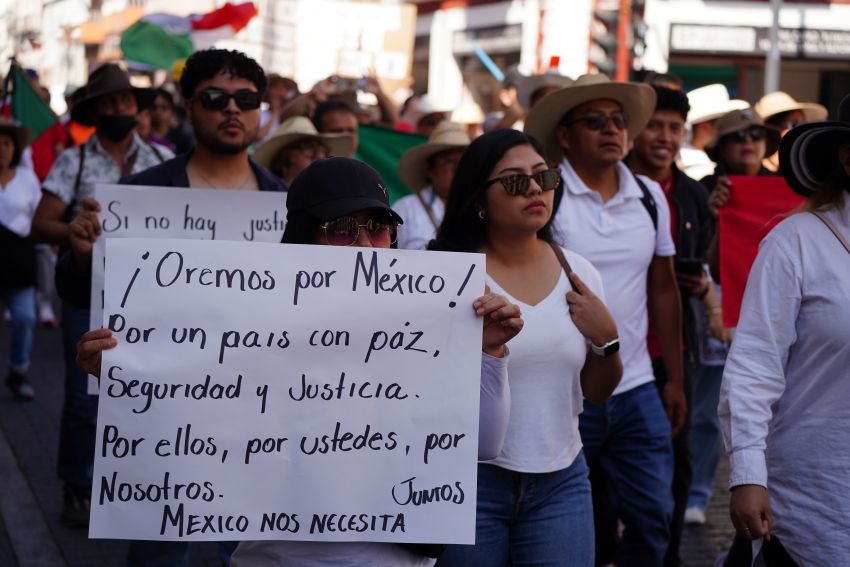
“Down with communism”, they chanted while also waving the One Piece pirate flag, meant to be a symbol of resistance to elitist excess, corruption and inequality. The right-wing march was meant to be a “Generation Z” protest, but most of the people I could see among the 1000 or so marching through the centre of Puebla, were of older generations; clearly the most loyal membership of Mexico’s right-wing parties, the Institutional Revolutionary Party and National Action Party.
Similar marches were held in various cities around the country on November 15. They were a bizarre attempt to copy-paste the recent uprisings and protests in Nepal, the Philippines and Indonesia, but they were built from the top down. Money was spent conjuring the protest from artificial intelligence (AI) campaigns, bots and influencers, rather than involving real social movements.
The main chants in the march were “Out Morena” (Mexico’s governing party) and “No more narco-state”. Meant to be organic, spontaneous anger at the government, crime and corruption, these marches’ vagueness and misuse of symbols left serious and experienced activists in the country amused, and a little annoyed.
As 51% of content is now AI-generated, it’s worth decoding how this protest was fabricated and the impact of its co-option of the symbols and phrases of more genuine causes. AI literacy and awareness of how videos and facts are manipulated for political and economic interests is becoming more important.
Social media
The Instagram account @somosgeneracionzmx (We are Generation Z Mexico) was among the first to publicly call for the November 15 protest.
Although describing itself as “anti-party”, “the disinterested generation” and “enough of the same old shit”, there are dozens of signs the account was not created by movement activists. The account does not follow, tag or interact with other longstanding movements, collectives or grassroots organisations, such as unions or community or alternative media.
The only groups it follows are bot-like replicas of itself that have each posted perhaps four times in total.
The account’s first posts were created exactly a month before the November 15 protest and got hundreds of engagements (likes and comments) straight off the bat: a sign the account holder either has funds to pay for significant boosting or that the posts were supported by bots.
Almost all the account’s content, including videos, is AI-generated.
Likewise, its sister account on Facebook. There are few real humans to be seen. But in Mexico, while people often cover their faces in public videos denouncing crimes and injustice due to fear of persecution, it is always important to show at least the eyes, or the full group of farmers on the land being attacked or the indigenous people meeting, women standing together and so on, to demonstrate that these communities are organising and speaking out.
The Generation Z Mexico accounts don’t have such visuals because they don’t actually meet, discuss and decide based on voting or consensus, hold speak-outs to build larger protests and other staples of real movements.
“Generation Z Mexico” doesn’t have real visuals of activists — and especially not young ones — because it is not led by actual activists or young people. In Mexico, there are strong women’s movements, movements for the forcibly disappeared, for water rights and more, but there is no movement here to revoke the president, so there are no photos of that to be used.
Instead, this group has resorted to AI-generated photos of protests such as this one. After the November 15 march, they will have photos they can use, though even those are being digitally edited to make their crowds look bigger.
Green Left for more