
Jane Goodall, the gentle disrupter whose research on chimpanzees redefined what it meant to be human
by MIREYA MAYOR
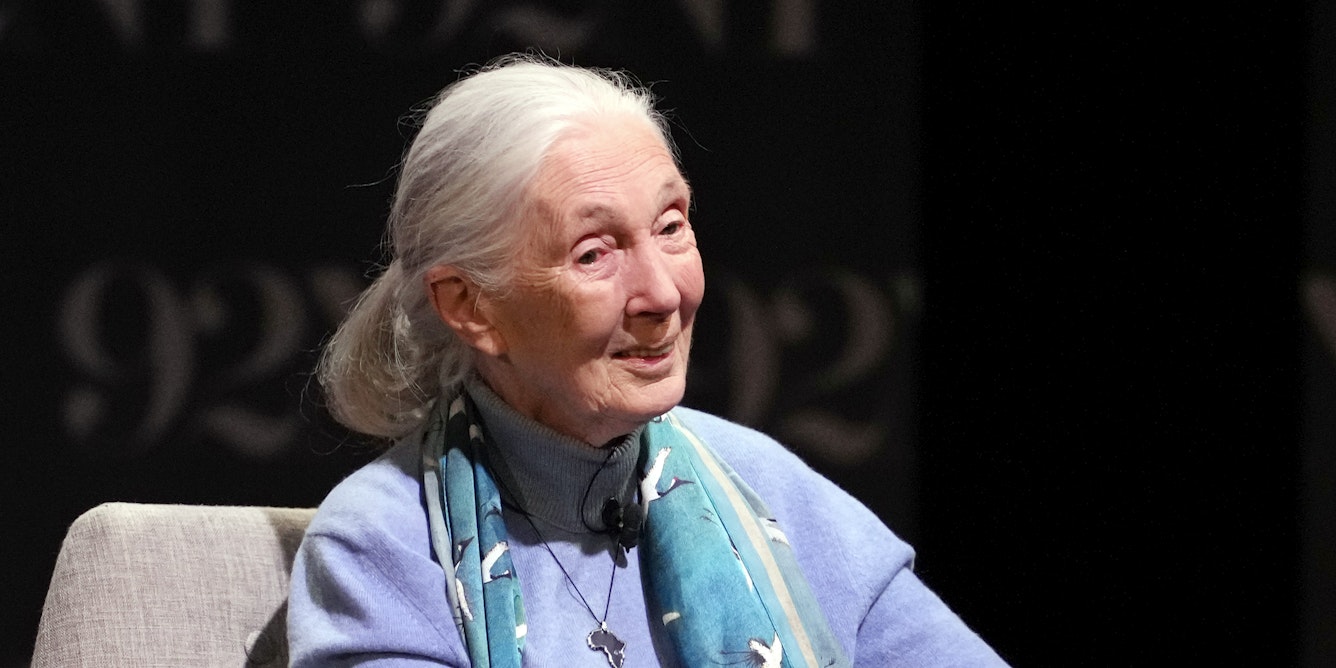
Anyone proposing to offer a master class on changing the world for the better, without becoming negative, cynical, angry or narrow-minded in the process, could model their advice on the life and work of pioneering animal behavior scholar Jane Goodall.
Goodall’s life journey stretches from marveling at the somewhat unremarkable creatures – though she would never call them that – in her English backyard as a wide-eyed little girl in the 1930s to challenging the very definition of what it means to be human through her research on chimpanzees in Tanzania. From there, she went on to become a global icon and a United Nations Messenger of Peace.
Until her death on Oct. 1, 2025 at age 91, Goodall retained a charm, open-mindedness, optimism and wide-eyed wonder that are more typical of children. I know this because I have been fortunate to spend time with her and to share insights from my own scientific career. To the public, she was a world-renowned scientist and icon. To me, she was Jane – my inspiring mentor and friend.
Despite the massive changes Goodall wrought in the world of science, upending the study of animal behavior, she was always cheerful, encouraging and inspiring. I think of her as a gentle disrupter. One of her greatest gifts was her ability to make everyone, at any age, feel that they have the power to change the world. Jane Goodall documented that chimpanzees not only used tools but make them – an insight that altered thinking about animals and humans
Discovering tool use in animals
In her pioneering studies in the lush rainforest of Tanzania’s Gombe Stream Game Reserve, now a national park, Goodall noted that the most successful chimp leaders were gentle, caring and familial. Males that tried to rule by asserting their dominance through violence, tyranny and threat did not last.
The Conversation for more
Remembering the Marshall Islands
by JANE GOODALL & RICK ASSELTA

As a result of nuclear testing on the Marshall Islands 60 years ago, many of the Marshallese Islanders still suffer today. Yet, few Americans know about this shameful chapter of history. Today, June 30, which marks a painful anniversary for many in the South Pacific, is just another day for those unaware of the atrocities that took place there. This year, I hope the anniversary might open the eyes of people in America and around the world: We must acknowledge the damage done in the past and rise up out of our apathy to ensure such horrors are not perpetrated again.
I became aware of the nuclear testing program initiated after World War II from a friend who witnessed the aftermath of the devastation first hand. Rick Asselta was sent to the Marshall Islands as a Peace Corps volunteer to help comfort islanders whose homes and lives were destroyed by the testing. Between 1946 and 1958, the American military tested 67 nuclear weapons at Bikini and Enewetak. Prior to the first of these tests, the islanders were evacuated to other atolls, more than 100 miles away, and, as a precaution, the inhabitants of three other atolls were moved temporarily.
In 1952, the first hydrogen bomb was tested — at 10.4 megatons, it was some 750 times larger than the Hiroshima bomb. In 1954, an even larger hydrogen bomb was detonated. On the eve of this test, code-named Bravo, weather reports indicated that atmospheric conditions were deteriorating, and on the morning of the test, the winds were blowing strongly toward a number of U.S. ships as well as several inhabited islands, including Rongelap and Utrik. Nevertheless, despite the clear danger to the people on these islands, the bomb, 1,000 times the strength of the Hiroshima bomb, was detonated. Great clouds of gritty, white ash rained down on several atolls, affecting many people, including some American weathermen.
It would be two days before people were moved from Rongelap, the worst affected island, and another day passed before Utrik was evacuated. The islanders suffered skin burns, and their hair fell out. Yet, in a statement to the press, the U.S. Atomic Energy Commission stated that some Americans and Marshallese were “unexpectedly exposed to some radioactivity. There were no burns. All were reported well.” Subsequently, the commission drafted a report, not publicly released, in which it concluded that the Bravo fallout may have contaminated as many as 18 atolls and islands. Some years after that, an additional survey by the U.S. Department of Energy revealed that yet other atolls and islands had been affected by one or more of the tests, including five that were inhabited.
Counterpunch for more
Remembering Jane
JANE GOODALL INSTITUTE

1934-2025
Remembering Dr. Jane
Scientist. Conservationist. Humanitarian.
Dr. Jane Goodall, founder of the Jane Goodall Institute and UN Messenger of Peace, was a remarkable example of courage and conviction, working tirelessly throughout her life to raise awareness about threats to wildlife, promote conservation, and inspire a more harmonious, sustainable relationship between people, animals and the natural world. She passed away in her sleep.
Dr. Jane Goodall, DBE, Founder of the Jane Goodall Institute, UN Messenger of Peace and world-renowned ethologist, conservationist, and humanitarian, has died at the age of 91 of natural causes.
Dr. Jane was known around the world for her 65-year study of wild chimpanzees in Gombe, Tanzania. However, in the latter part of her life she expanded her focus and became a global advocate for human rights, animal welfare, species and environmental protection, and many other crucial issues.
Jane was passionate about empowering young people to become involved in conservation and humanitarian projects and she led many educational initiatives focused on both wild and captive chimpanzees. She was always guided by her fascination with the mysteries of evolution, and her staunch belief in the fundamental need to respect all forms of life on Earth.
Born Valerie Jane Morris-Goodall, Jane was the eldest daughter of businessman and racing car driver Mortimer Herbert Morris-Goodall and writer Margaret Myfanwe Joseph.
Jane was passionate about wildlife from early childhood, and she read avidly about the natural world. Her dream was to travel to Africa, learn more about animals, and write books about them. Having worked as a waitress to save enough money for a sea passage to Kenya, Jane was advised to try to meet respected paleontologist Dr. Louis Leakey. Louis employed her as a secretary at the National Museum in Nairobi, and this led to her being offered the opportunity to spend time with Louis and Mary Leakey in at the Olduvai Gorge in search of fossils.
Having witnessed Jane’s patience and determination there, Louis asked her to travel to Tanzania, to study families of wild chimpanzees in the forest of Gombe. Looking back, Jane always said she’d have “studied any animal” but felt extremely lucky to have been given the chance to study man’s closest living relative in the wild.
On 14th July 1960, Jane arrived in Gombe for the first time. It was here that she developed her unique understanding of chimpanzee behaviour and made the ground-breaking discovery that chimpanzees use tools. An observation that has been credited with “redefining what it means to be human.”
Knowing Jane’s work would only be taken seriously if she was academically qualified, and despite her having no degree, Louis arranged for Jane to study for a PhD in Ethology at Newnham College, Cambridge. Jane’s doctoral thesis, The Behaviour of Free-living Chimpanzees in the Gombe Stream Reserve, was completed in 1965. Her three-month study evolved into an extraordinary research program lasting decades and it is still ongoing today.
Jane was married twice. Her first husband, Hugo van Lawick, was a Dutch baron and wildlife photographer working for National Geographic when they met. Jane and Hugo divorced in 1974, and Jane later married Derek Bryceson, a member of Tanzania’s parliament and a former director of Tanzania’s National Parks. Derek died in 1980.
During her life Jane authored more than 27 books for adults and children, and featured in numerous documentaries and films, as well as two major IMAX productions. In 2019, National Geographic opened Becoming Jane, a travelling exhibit focused on her life’s work, which is still touring across the United States. Her latest publication, The Book of Hope: A Survival Guide for Trying Times, has been translated into more than 20 languages.
Jane Goodall for more