
by CHRISTOPHE JAFFRELOT
As India prepares to re-elect its parliament, Christophe Jaffrelot, Director of Research at the CNRS and a leading expert on India, answers our questions about the elections that are taking place from 19 April until 1 June of this year, and the future of India under Modi.
General elections are being held in India from 19 April to 1 June. Can you tell us how these unusual elections will be conducted?
The elections are taking place over six weeks this year, a record! The reason is undoubtedly to allow Narendra Modi to criss-cross the country, given that he remains the trump card of the BJP, as the ruling party is far less popular than its leader: he is the one who can get enough MPs elected to win the elections.
In addition, electronic machines will once again be used to record citizens’ votes, but they are coming in for increasing criticism because computer engineers have proved that they can be easily falsified. For years, the opposition has been demanding the implementation of a vote verification system, at least in constituencies where the difference in votes is small.
The Electoral Commission, which is responsible for organising the ballot and ensuring that it runs smoothly, refuses outright to implement this simple measure, which increases suspicions of fraud, especially since, this year, the government refused to include the head of the Supreme Court in the college responsible for appointing the members of this commission (with the result that the government has a free hand in making appointments), and two of its three members have just been newly appointed following a surprise resignation and a scheduled vacancy…
The fact that these elections will not be as free and fair as previous ones has already been demonstrated by the arrest of the Chief Minister of Delhi, Arvind Kejriwal, a fairly popular opposition figure, and by the freezing of bank accounts belonging to the Congress Party, which therefore limits their means of campaigning.
The 2024 elections are also less fair than previous ones because of the imbalance in terms of media coverage: since the takeover of New Delhi Tele Vision (NDTV) by Gautam Adani, the rising star of the oligarchs who have come to dominate the Indian business world, there is not a single television channel that is even remotely critical of the government.
The BJP also enjoys abundant financial resources thanks to the system of electoral bonds, which, since 2017, has allowed political parties to receive anonymous donations, while the donors may benefit from favours in return. The Supreme Court declared this scheme unconstitutional last month, but the ruling party’s coffers are already full! In 2019, the BJP spent US$3.5 billion…
What are the main campaign themes?
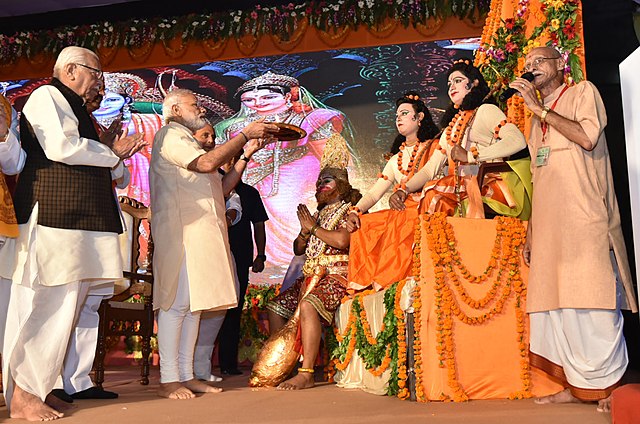
In India, elections are not only based on issues, but also on emotions. And Narendra Modi is taking advantage of ethno-nationalist sentiment in at least two ways. Firstly, he appeals to the religious fibre of the Hindu community (which represents around 80% of Indians). On 22 January, he played the role of Hindu high priest when he presided over the inauguration ceremony of the Ayodhya temple, built on the rubble of a sixteenth-century mosque that was destroyed by Hindu nationalist militants in 1992. This ceremony, which was broadcast on a loop on all channels, marked the launch of the BJP’s election campaign. At the same time, he polarises voters along religious lines by stigmatising Muslims, thereby consolidating his Hindu majoritarian voter base. He recently described Muslims as “infiltrators” (a term alluding to Bangladeshi migrants) and as those who have “more children” (appealing to the demographic fears of Hindus – who still make up 80 % of the population).
Alternatives International for more