
by JOHN WALLINGFORD
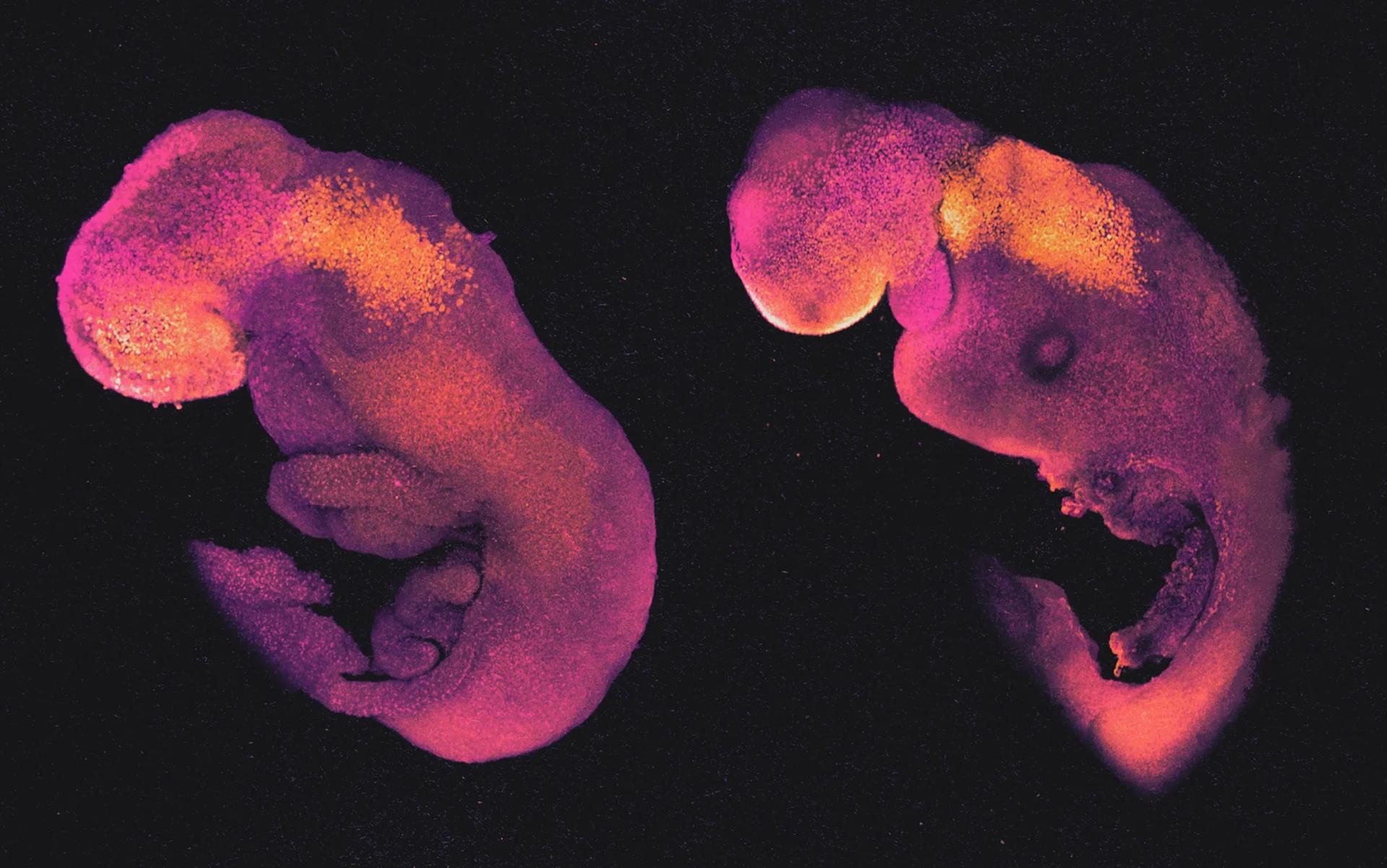
For 3,000 years, humans have struggled to understand the embryo. Now there is a revolution underway
Fifty-four years ago, I did something extraordinary. I built myself. I was a single, round cell with not the slightest hint of my final form. Yet the shape of my body now – the same body – is dazzlingly complex. I am comprised of trillions of cells. And hundreds of different kinds of cells; I have brain cells, muscle cells, kidney cells. I have hair follicles, though tragically few still decorate my head.
But there was a time when I was just one cell. And so were you. And so were my cats, Samson and Big Mitch. That salmon I had for dinner last night and the last mosquito that bit you also started as a single cell. So did Tyrannosaurus rex and so do California redwoods. No matter how simple or complex, every organism starts as a single cell. And from that humble origin emerges what Charles Darwin called ‘endless forms most beautiful’.
Once you’ve come to terms with that mind-boggling fact, consider this: all organisms, including humans, build themselves. Our construction proceeds with no architects, no contractors, no builders; it is our own cells that build our bodies. Watching an embryo, then, is rather like watching a pile of bricks somehow make themselves into a house, to paraphrase the biologist Jamie Davies in Life Unfolding (2014).
This process of body sculpting is called embryonic development, and it is a symphony of cells and tissues conducted by genetics, biochemistry and mechanics. People who study this, like me, are called developmental biologists. And while you may not know it, our field is in a period of tremendous excitement, but also upheaval.
In the summer of 2022, I sat in the back of a lecture hall in Santa Cruz, California listening to a lecture from Magdalena ?ernicka-Goetz, professor of mammalian development and stem cell biology at the University of Cambridge, UK. She is a controversial figure and one of many scientists trying to push the limits of understanding human embryos. I heard, too, from Ruth Lehmann, director of MIT’s prestigious Whitehead Institute for Biomedical Research. She’d been in the news for firing a famous scientist for sexual harassment, but what’s made her an international leader in biology for decades is her brilliant and creative study of developmental biology, in fruit flies.
This juxtaposition of fly and human embryos wasn’t surprising; developmental biology is propelled by a whole zoo of embryos – fruit flies, yes, but also sea urchins, worms, frogs, mice. Indeed, our great triumph in the 20th century was revealing the astonishing molecular similarity of all embryos; and, for precisely that reason, studies of animal embryos have garnered seven Nobel Prizes in the past 30 years alone. What surprised me in Santa Cruz was just how fast our collective understanding of animal embryos is making possible truly explosive advances in human embryology. So, while Lehmann’s fascinating new work on cell migration in fly embryos kept the audience rapt, it was ?ernicka-Goetz who caught the media’s attention.
Aeon for more