
by DOROTHY HERNANDEZ
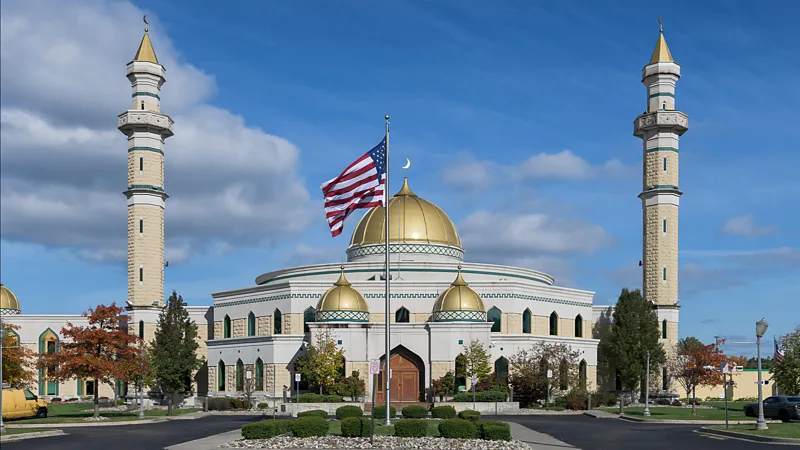
Located just outside Detroit, Dearborn offers travellers a unique chance to eat their way through the Middle East while exploring how Arab Americans have shaped the nation.
On a recent Sunday afternoon at Shatila Bakery in Dearborn, Michigan, a line of customers were crowded around display cases filled with flaky baklava, mounds of meshabek (Egyptian funnel cake) and golden-brown Lebanese-style macarons. As employees rushed to fill orders, locals excitedly spoke to each other in a mixture of Arabic and English, with one quipping to a friend, “There go my plans for eating healthy!”
In many ways, Shatila is a microcosm of Dearborn. Started by a Lebanese immigrant in the 1970s, the 45-year-old bakery is surrounded by dozens of Arab American-owned restaurants, businesses, markets, halal butcher shops, hair salons and mosques. Signs in both Arabic and English line Dearborn’s two biggest throughfares – Warren Avenue and Michigan Avenue – and over the past century this city located just outside of Detroit that has long been synonymous with Ford Motor Company auto manufacturing has blossomed into arguably the most Arab place in America.
In 2023, Dearborn became the first Arab-majority city in the US. The 110,000-person city is home to both the Arab American National Museum and the largest mosque in North America. It’s one of the few US cities whose mayor is both Muslim and Arab, the first US city to make Eid a paid holiday for city employees and one of only a handful of places in the country where the Islamic adhan (call to prayer) is allowed to be broadcast from a mosque’s loudspeakers. It is, as one local told me, “the motherland away from the motherland”.
Today, it offers travellers an enticing opportunity to eat their way through the Middle East, so to speak, while exploring how Arab Americans have shaped the city – and the nation.
According to Jack Tate, a curator at the Dearborn Historical Museum, the city was little more than sparsely populated farmland until the early 1900s. That all changed in the 1920s when car maker and future business magnate Henry Ford relocated the headquarters of his Ford Motor Company from Highland Park 10 miles away to Dearborn.
“It was rather a sleepy little community at that point. And once the [new] plant opened, people were coming from all over the United States, all over the world to work for Mr Ford,” Tate said. “That was the big start of the Middle Eastern population here.”
When Ford began creating his famous Model T automobiles in 1908, he needed people to build them. The industrialist, who was known for his racist hiring policies towards African Americans and antisemitism towards Jews, looked to the Detroit area’s newly arrived Middle Eastern immigrants for labour. Soon, waves of workers from areas now covered by Lebanon, Syria, Iraq, Yemen and the Palestinian Territories flocked to greater Detroit in search of these new high-paying jobs. (There’s even a local legend that Ford once told a Yemeni sailor at a port that his factory paid workers the then-generous salary of $5 a day, which sparked this wave of Yemenis and others from the Middle East to come the area.)
By the early 1920s, the majority of the workers on Ford’s Model T assembly line were of Arab descent. When Ford relocated to Dearborn, many of his employees followed. This not only transformed the town from a sleepy 2,400-person hamlet to the headquarters of the world’s single largest industrial site, it also paved the way for Dearborn to become home to the greatest concentration of Arab Americans in the US. According to the 2020 Census, 54.5% of the city’s nearly 110,000 people claim Middle Eastern or North African ancestry.
According to Matthew Jaber Stiffler, director of the Center for Arab Narratives, as more Arab and Arab Americans relocated to Dearborn over the decades, they created a community network that encouraged others to follow. “Doctors’ offices started to open, restaurants, grocery stores – so you have an enclave. And then, unfortunately, in the home countries – especially Lebanon, Yemen, Palestine, Iraq – there were continual disruptions – civil war, US military invasion – [which] kept forcing people to migrate. So, Dearborn continually kept receiving new people because there were [already] people here [from those countries].”
It was a similar story with Amanda Saab‘s family. The Lebanese American chef was born and raised in Dearborn after her parents immigrated here in the 1970s as children. Like so many others, their fathers were attracted to the promise of well-paying auto jobs, and the city called to them because other family members were already here.
“[Dearborn has] always just kind of been the beacon, the centre, the stronghold… All the things that really connect us to community and faith for me are in Dearborn,” she said.
In 2015, Saab was the first Muslim woman in a hijab to compete on the reality TV show MasterChef USA. In response to the Israel-Gaza war, she founded Chefs for Palestine, a dinner series featuring some of the area’s top chefs coming together to raise money in support of the Palestinian Children’s Relief Fund and the Palestinian American Medical Association. As Saab explained, because so many residents came to Dearborn in search of a better life after enduring conflict in their home countries, the city has not only served as a refuge of hope for Arab Americans, but also as a support system for those whose extended families are suffering abroad. “Dearborn is one of the most hospitable, kind, generous communities,” Saab said.
BBC for more