

Make no mistake, artificial Intelligence (AI) has already gone into battle in a big-time way. The Israeli military is using it in Gaza on a scale previously unknown in wartime. They’ve reportedly been employing an AI target-selection platform called (all too unnervingly) “the Gospel” to choose many of their bombing sites. According to a December report in the Guardian, the Gospel “has significantly accelerated a lethal production line of targets that officials have compared to a ‘factory.’” The Israeli Defense Forces (IDF) claim that it “produces precise attacks on infrastructure associated with Hamas while inflicting great damage to the enemy and minimal harm to noncombatants.” Significantly enough, using that system, the IDF attacked 15,000 targets in Gaza in just the first 35 days of the war. And given the staggering damage done and the devastating death toll there, the Gospel could, according to the Guardian, be thought of as an AI-driven “mass assassination factory.”
Meanwhile, of course, in the Ukraine War, both the Russians and the Ukrainians have been hustling to develop, produce, and unleash AI-driven drones with deadly capabilities. Only recently, in fact, Ukrainian President Volodymyr Zelensky created a new branch of his country’s armed services specifically focused on drone warfare and is planning to produce more than one million drones this year. According to the Independent, “Ukrainian forces are expected to create special staff positions for drone operations, special units, and build effective training. There will also be a scaling-up of production for drone operations, and inclusion of the best ideas and top specialists in the unmanned aerial vehicles domain, [Ukrainian] officials have said.”
And all of this is just the beginning when it comes to war, AI-style, which is going to include the creation of “killer robots” of every imaginable sort. But as the U.S., Russia, China, and other countries rush to introduce AI-driven battlefields, let TomDispatch regular Michael Klare, who has long been focused on what it means for the globe’s major powers to militarize AI, take you into a future in which (god save us all!) robots could be running (yes, actually running!) the show. Tom
“Emergent” AI Behavior and Human Destiny
What Happens When Killer Robots Start Communicating with Each Other?
by MICHAEL KLARE
Yes, it’s already time to be worried — very worried. As the wars in Ukraine and Gaza have shown, the earliest drone equivalents of “killer robots” have made it onto the battlefield and proved to be devastating weapons. But at least they remain largely under human control. Imagine, for a moment, a world of war in which those aerial drones (or their ground and sea equivalents) controlled us, rather than vice-versa. Then we would be on a destructively different planet in a fashion that might seem almost unimaginable today. Sadly, though, it’s anything but unimaginable, given the work on artificial intelligence (AI) and robot weaponry that the major powers have already begun. Now, let me take you into that arcane world and try to envision what the future of warfare might mean for the rest of us.
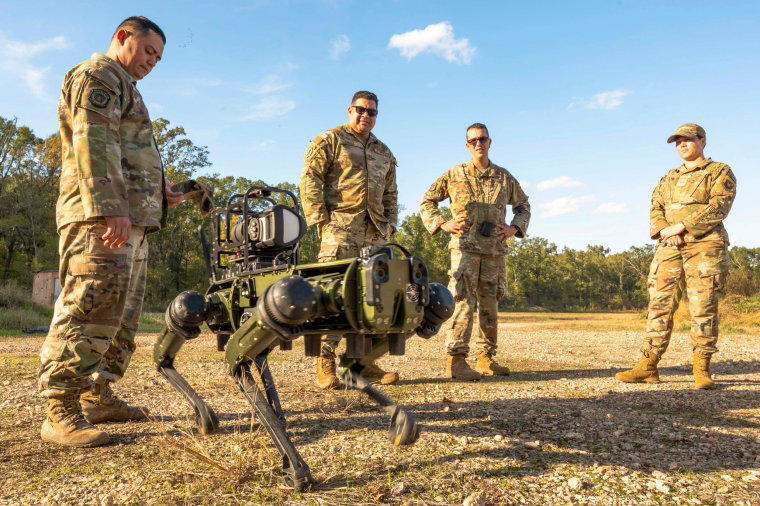
By combining AI with advanced robotics, the U.S. military and those of other advanced powers are already hard at work creating an array of self-guided “autonomous” weapons systems — combat drones that can employ lethal force independently of any human officers meant to command them. Called “killer robots” by critics, such devices include a variety of uncrewed or “unmanned” planes, tanks, ships, and submarines capable of autonomous operation. The U.S. Air Force, for example, is developing its “collaborative combat aircraft,” an unmanned aerial vehicle (UAV) intended to join piloted aircraft on high-risk missions. The Army is similarly testing a variety of autonomous unmanned ground vehicles (UGVs), while the Navy is experimenting with both unmanned surface vessels (USVs) and unmanned undersea vessels (UUVs, or drone submarines). China, Russia, Australia, and Israel are also working on such weaponry for the battlefields of the future.
Tom Dispatch for more