
by BRETT HEINZ
(Graphic: Brett Heinz/ Responsible Statecraft)
Sitting awkwardly with this phenomenon is a strange fact: According to Washington Metropolitan Area Transit Authority policy, “Advertisements that are intended to influence public policy are prohibited.”
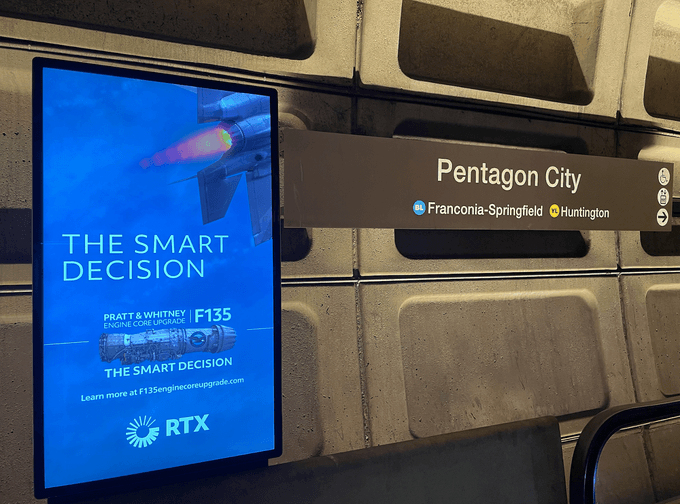
The first thing commuters saw when stepping into the Metro station beneath the Pentagon in late August was a poster for RTX: the world’s second largest defense contractor, formerly known as Raytheon.
RTX made $30.3 billion in sales to the U.S. government last year, 45% of its total income. To advertise to its biggest customer, why not target government decision-makers in the places they visit most? Thus, the thousands of commuters entering the Pentagon station each day were greeted by more than 60 RTX advertisements plastered across the walls, floors, escalators, and fare gates such that it was physically impossible to pass through the station without seeing one.
This ad campaign wasn’t the company’s first rodeo, either. Ten years ago, RTX placed advertisements in the Pentagon station to promote a satellite control system. That same project is now seven years late and billions of dollars over-cost.
The catch is that, technically, advertisers aren’t supposed to be able to do this, as the Washington Metropolitan Area Transit Authority (WMATA, which operates the greater D.C. metro system) forbids advertisements that “are intended to influence public policy.” But government contractors, reliant on public policy for their survival, are nonetheless allowed to promote their brands and hawk their products to the officials responsible for deciding whether or not to buy from them. A closer investigation into their marketing tactics reveals how companies like RTX and Google have taken advantage of this lax enforcement to hijack D.C.’s public transportation system for their own gain. WMATA is not just allowing it, they’re profiting from it.
Notes From Underground
As the home to countless government agencies, Washington D.C.’s population is dense with people whose choices at work can affect the entire world. This has made the capital metro system a magnet for government contractors and other advertisers looking to shape policymakers’ activities.
Yet a systematic analysis of that advertising has proven difficult. WMATA does not make advertising data available to the public, and has yet to respond to multiple requests for the data. A similar request was denied by Outfront Media, the private marketing firm contracted by WMATA to handle transit ads.
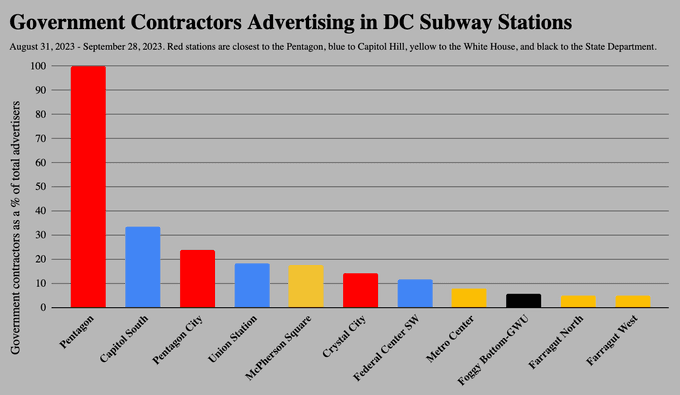
So, I obtained what information I could the old-fashioned way—I rode the Metro, a lot. For five consecutive weeks, I visited 11 WMATA Metro stations and recorded the names of every advertiser. All were located within one mile of major policymaking institutions: Capitol Hill, the White House, the Pentagon, and the State Department.
Common Dreams for more