
by REV GRAYLANE SCOTT HAGLER
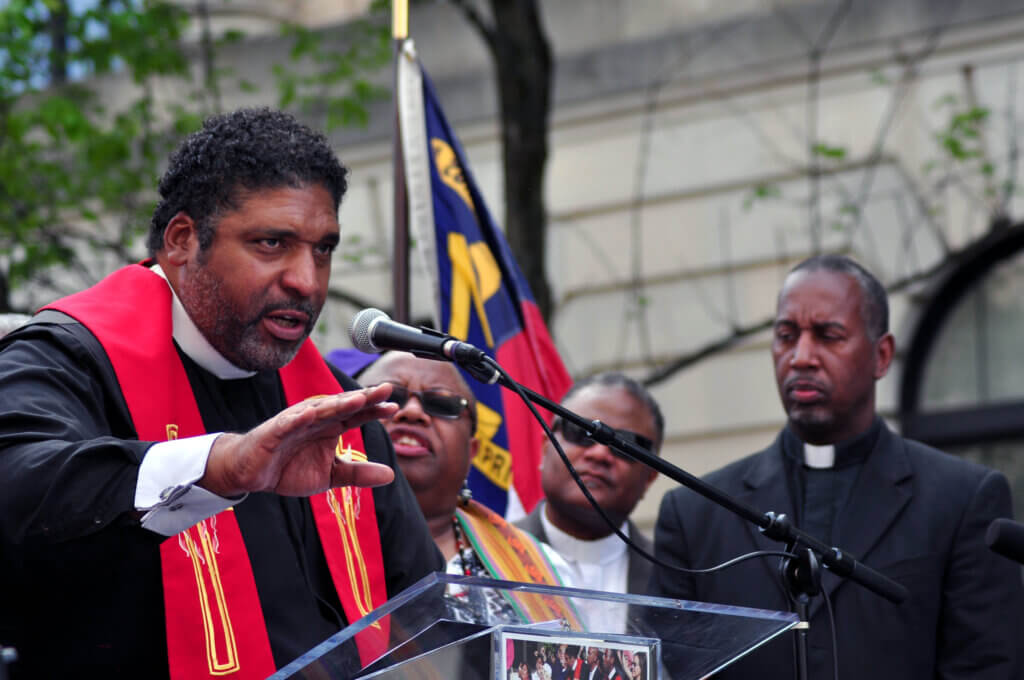
Rev. William Barber’s ahistorical criticisms of Palestinian resistance show a profound ignorance of the history of settler colonialism endured by Palestinians.
The Bishop William Barber, II, of the Poor People’s Campaign wrote an Op-Ed that appeared in The Guardian on October 13, 2023, entitled, “We must say an emphatic ‘no’ to Hamas a thousand times“. I feel compelled to respond to that Op-Ed. I am hesitant to challenge a friend and a colleague, but on this issue, I must.
I understand Rev. Barber’s need to thread the needle, but in a time like this, we need truth-telling and not outrage when it is politically expedient to do so. As Bishop Barber decries and mourns the killings and atrocities carried out by Hamas, he makes the same error that he has made in the past, by diminishing — and at times ignoring the horrendous history of settler colonialism endured by Palestinians. I am not suggesting equivocation, where a massacre by Hamas in Israel is justified by the long history of Palestinian dispossession and oppression. But I am advocating for the consistent and equal acknowledgment of the long pain and suffering of the Palestinian people. Rev. Barber has not done that historically or even in the structure of his Op-Ed, where he mentions Palestinian suffering in a secondary position to the recent attacks upon Israel.
Rev. Barber seems to want to excuse 75 years of oppression and harm perpetuated by the Israeli regime and aided by a general silence from the world. Through the years, Israelis, Palestinians, Muslims, Christians, and Jews have worked to draw attention to the gross violence and injustices of Israeli occupation. Yet, it seemed that the world was not interested in war crimes, or the genocidal pogroms carried out against the Palestinians. In most cases, the death of a Palestinian child, or the eviction of a Palestinian family did not even amount to a footnote in the concerns of the U.S. government or many religious leaders, including Rev. Barber.
The pain experienced throughout the years by Palestinians did not seem to warrant the outcry that Israeli deaths do. We mourn Israeli suffering, but just as equally, we mourn the suffering of Palestinians. The insanity of killing on all sides will never lead to peace, justice, or co-existence. Yet, it has become clear that one life seems to matter more than another life. As a Black person, this is familiar because, in general, Black lives do not matter, and it would seem that the same is true for Palestinian lives as well.
The extreme historical silence to the blatant acts of dispossession and oppression by Israel against Palestinians lessens the morality of any voice outraged against this recent horrendous violence, particularly when many of those voices have been previously anemic in speaking out against Palestinian death and oppression. President Biden is included in this criticism, and so is every leader and head of state who has turned a blind eye or kept their mouths shut during this continuing tragic history.
Bishop Barber would ring truer and be less self-serving if his voice was just as stringent and condemning of every other Palestinian death throughout the years leading up to these moments.
I first set foot on Palestinian/Israeli soil in 1974 and have watched this trajectory of inequality, violence, and death continue unabated and, in instances, flare up in more graphic ways. But this equation of one life valued more than the other has created a deep frustration and anger that those who are moralizing will never fully grasp. Obviously, Bishop Barber cannot grasp what 75 years of oppression and injustice has meant or how it is felt, particularly when many Israeli acts of injustice have taken place in plain view and yet have been met many times with callous silence.
Bishop Barber’s historical amnesia regarding Palestine/Israel is matched by an incomplete understanding of the Black struggles. He writes about being a descendant of enslaved people and how his people never resorted to violence over grievances. That may be true for what he knows of his family. But there were numbers of enslaved people who reacted to the viciousness and inhumanity of slavery through rebellion which often spilled over into violent reaction. We know of some of those rebellions, but there are numbers of acts of resistance that we will never know of. There was Nat Turner’s Rebellion, and there was the thwarted rebellion crafted by Denmark Vesey in South Carolina. Some scholars have found over 300 armed rebellions that were planned and carried out in the US before and after the founding of the nation. There was the Stono Rebellion of 1739, the New York Conspiracy of 1741, Gabriel’s Conspiracy of 1800, and the uprising on the Slave ship La Amistad, just to name a few. People did rebel. Rebellion, resistance, and sometimes violence are the tools of people whose legitimate grievances have been silenced or ignored.
Where were the voices when people from Gaza staged the nonviolent Great March of Return? Many people in Gaza are refugees or the descendants of refugees. In March 2018, and for the remainder of that year, Gazans attempted a nonviolent march back to the towns and villages of their heritage. The march was met with severe Israeli violence killing over 150 Palestinians with 10,000 people injured. 1,849 of the injured marchers were children, 424 women, 115 paramedics and 115 journalists. Where are the Palestinian Gandhis and MLKs? They are in Israeli jails.
Mondoweiss for more