
by WENDY SAWYER & PETER WAGNER
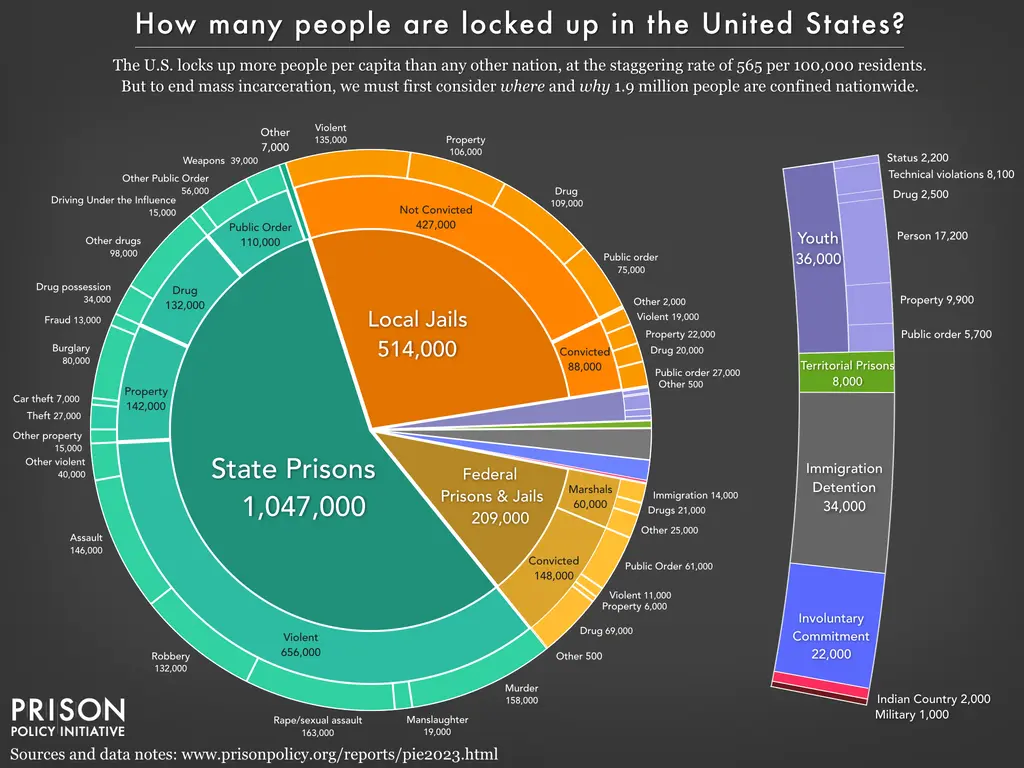
Can it really be true that most people in jail are legally innocent? How much of mass incarceration is a result of the war on drugs, or the profit motives of private prisons? How has the COVID-19 pandemic changed decisions about how people are punished when they break the law? These essential questions are harder to answer than you might expect. The various government agencies involved in the criminal legal system collect a lot of data, but very little is designed to help policymakers or the public understand what’s going on. As public support for criminal justice reform continues to build — and as the pandemic raises the stakes higher — it’s more important than ever that we get the facts straight and understand the big picture.
Further complicating matters is the fact that the U.S. doesn’t have one “criminal justice system;” instead, we have thousands of federal, state, local, and tribal systems. Together, these systems hold almost 2 million people in 1,566 state prisons, 98 federal prisons, 3,116 local jails, 1,323 juvenile correctional facilities, 181 immigration detention facilities, and 80 Indian country jails, as well as in military prisons, civil commitment centers, state psychiatric hospitals, and prisons in the U.S. territories.
This report offers some much-needed clarity by piecing together the data about this country’s disparate systems of confinement. It provides a detailed look at where and why people are locked up in the U.S., and dispels some modern myths to focus attention on the real drivers of mass incarceration and overlooked issues that call for reform.
This big-picture view is a lens through which the main drivers of mass incarceration come into focus; it allows us to identify important, but often ignored, systems of confinement. The detailed views bring these overlooked systems to light, from immigration detention to civil commitment and youth confinement. In particular, local jails often receive short shrift in larger discussions about criminal justice, but they play a critical role as “incarceration’s front door” and have a far greater impact than the daily population suggests.
While this pie chart provides a comprehensive snapshot of our correctional system, the graphic does not capture the enormous churn in and out of our correctional facilities, nor the far larger universe of people whose lives are affected by the criminal justice system. In 2021, about 421,000 people entered prison gates, but people went to jail almost 7 million times. Some have just been arrested and will make bail within hours or days, while many others are too poor to make bail and remain behind bars until their trial. Only a small number (about 87,500 on any given day) have been convicted, and are generally serving misdemeanors sentences of under a year. At least 1 in 4 people who go to jail will be arrested again within the same year — often those dealing with poverty, mental illness, and substance use disorders, whose problems only worsenwithincarceration.
Prison Policy Initiative for more