
by RIZWANA NAQVI
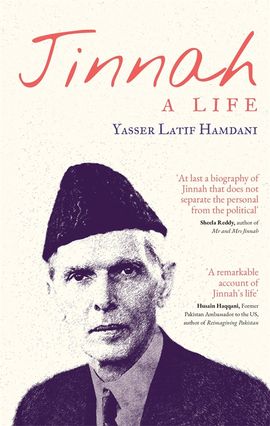
A large number of books have been written by both Pakistani and Western writers about Mohammed Ali Jinnah. The most known among them being Stanley Wolpert’s Jinnah of Pakistan and Ayesha Jalal’s Sole Spokesman, which present deep insights into the life and politics of this great man we fondly call Quaid-e-Azam.
An addition to the array of Jinnah’s biographies is Yasser Latif Hamdani’s third book Jinnah: A Life. Hamdani is a well-known human rights barrister and writer based in Pakistan. His earlier books are Jinnah: Myth and Reality (2012) and Between Worlds, A Pakistani’s Quest to Forge Meaning (2016). Hamdani is also a member of the Honourable Society of Lincoln’s Inn, London, as was Jinnah.
Tracing the life of the great leader from his birth till his passing away, the book presents many little known facts as well as clarifications of many assertions wrongly attributed to the Quaid.
Mohammad Ali Jinnah is often regarded as the person who was bent upon the Partition of India and the tragic events that followed, and a champion of Islam who stood for a new Islamic renaissance. However, Hamdani’s book shows that this is not true on both counts. According to him, Jinnah was an ambassador of Hindu Muslim unity and never mentioned that Pakistan was to be an Islamic state.
So the book sheds light on how eventually came to be regarded as the sole driving force behind the Partition. “The tragic demise of the old ambassador of Hindu-Muslim unity and Jinnah’s rebirth as the Quaid-e-Azam of Muslim India did not happen overnight,” writes Hamdani. Throughout the struggle for independence from the British, Jinnah tried to maintain Hindu-Muslim unity but did not get equal response from Congress leaders, making him look for alternatives.
Hamdani writes: “Jinnah stood with his hands extended towards Congress, Gandhi and Nehru but, for some reason, the great future founding fathers of independent India were not forthcoming. Every overture and every attempt by Jinnah to reach out to Nehru was rebuffed by a measure of arrogance that was quite unbecoming of Nehru.”
During the election campaign Jinnah continued to remind the Congress that Muslim League was a patriotic, nationalistic, and liberal political party of Muslims “which was ready to cooperate with Hindus and Sikhs for India’s freedom from colonialism.”
However, after the 1937 elections, rather than form a coalition ministry in UP where Muslim League had won 29 seats and Congress was wiped out on Muslim seats, winning just one, Congress got busy in actions, like mass contact movement aimed at Muslims, which seemed to indicate to Jinnah that “Congress was going to try and absorb the Muslim League in a way so as to completely bulldoze the objective of having adequate safeguard for Muslims.”
This was the turning point for Jinnah. No longer would he call for Hindu-Muslim unity but “rather depend on the Muslim nation whose scabbard he now had his hand on.”
The Lucknow session of Muslim League in 1937 turned out to be a landmark in the history of the subcontinent. As Congress had already declared independence as its goal, the Muslim League, under Jinnah now, committed itself to ‘the establishment of full independence in the form of a federation of free democratic state’ with safeguards for Muslims and other minorities. In his presidential address, Jinnah informed his listeners that “politics was about power, and without power they would remain hapless.” From now on he would no more trust the Congress and would only deal with them as a representative of the Muslim community.
He told the Muslim League session that “they could never expect justice and fair play from Congress which spoke with many tongues.” He was still not the apostle of Muslim separatism and had certainly abjured his role as the bridge between the Congress and the Muslims. He believed in a united India that would treat minorities in a manner that would make them feel as equal citizens without any handicap in a great democratic federation.
In present times, the slogan Pakistan ka matlab kya, La Ilaha il-Allah [What is the meaning of Pakistan? There is no god except Allah] is being used in a way as if Quaid-e-Azam himself raised the slogan. It intrigues the common person when they are told that the Quaid was a secular liberal Muslim. Hamdani, in his book, has given a lot of space to whether the Quaid wanted Pakistan to be a secular state or a theocratic one.
The Quaid’s stance is quite clear from the following instance. During the first and last meeting of All Pakistan Muslim League in 1947 under his chairmanship, “A party worker interrupted him then, saying, ‘… but Quaid-e-Azam, we have been promising people Pakistan ka matlab kya, La Ilaha il-Allah.’
“Jinnah’s reply was forthright: ‘Neither the Muslim League Working Committee nor I have ever passed a resolution [called] Pakistan ka matlab kya — you may have used it to catch a few votes.’”
Hamdani further states: “At no point under his presidency did the Muslim League ever pass a resolution calling for an Islamic state. This is a significant fact which punctures the idea that Pakistan was founded in the name of Islam.”
Express Tribune for more