
by ROBIN MCKIE
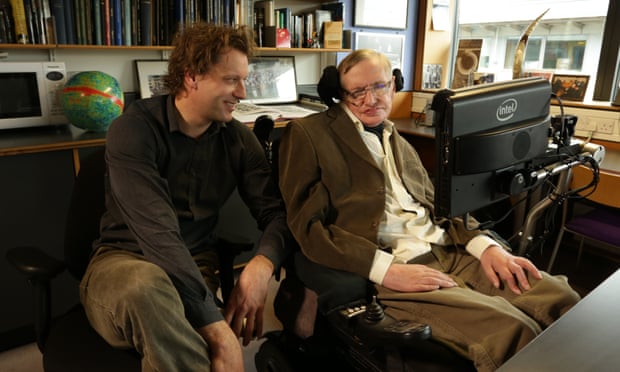
Thomas Hertog worked with cosmologist on a new book after he shared his doubts about A Brief History of Time
In 2002 Thomas Hertog received an email summoning him to the office of his mentor Stephen Hawking. The young researcher rushed to Hawking’s room at Cambridge. “His eyes were radiant with excitement,” Hertog recalls.
Typing on the computer-controlled voice system that allowed the cosmologist to communicate, Hawking announced: “I have changed my mind. My book, A Brief History of Time, is written from the wrong perspective.”
Thus one of the biggest-selling scientific books in publishing history, with worldwide sales credited at more than 10m, was consigned to the waste bin by its own author. Hawking and Hertog then began working on a new way to encapsulate their latest thinking about the universe.
Next month, five years after Hawking’s death, that book – On the Origin of Time: Stephen Hawking’s final theory – will be published in the UK. Hertog will outline its origins and themes at a Cambridge festival lecture on 31 March.
“The problem for Hawking was his struggle to understand how the universe could have created conditions so perfectly hospitable to life,” says Hertog, a cosmologist currently based at KU Leuven University in Belgium.
Examples of these life-supporting conditions include the delicate balance that exists between particle forces that allow chemistry and complex molecules to exist. In addition, the fact there are only three dimensions of space permits stable solar systems to evolve and provide homes for living creatures. Without these properties, the universe would probably not have produced life as we know it, it is argued by some cosmologists.
Hertog and Hawking were set on hammering out explanations for this state of stellar uncertainty after the latter had decided his previous attempts were inadequate. “Stephen told me he now thought he had been wrong and so he and I worked, shoulder to shoulder, for the next 20 years to develop a new theory of the cosmos, one that could better account for the emergence of life,” Hertog said.
It was a remarkable collaboration but not an easy one. When he was 21, Hawking had been diagnosed with an early onset slow-progressing form of motor neurone disease that gradually paralysed him.
By the time he began working with Hertog, he had been appointed Lucasian professor of mathematics at Cambridge University, one of the world’s most prestigious academic posts (Isaac Newton was a previous holder), and had produced a series of remarkable theories about general relativity, black holes and the origin of the universe as well as his bestseller A Brief History of Time. However, his condition had deteriorated. He was in a wheelchair and could only communicate using a small computer from which he selected words delivered by a speech synthesiser.
“Halfway through our collaboration, he lost the remaining strength in his hand to press the clicker which he used to converse,” says Hertog. So Hawking switched to a sensor mounted on his glasses that could be activated by twitching a cheek muscle, but eventually even that become too difficult.
He slowed from a few words per minute to several minutes per word, Hertog said. In the end, communication stopped. “I used to position myself in front of him and fire questions and would look into his eyes to see if he was agreeing or disagreeing. By the end, I could detect several levels of no and several levels of yes with a few in between.”
The Guardian for more