
by MEAGHAN MACSWEEN
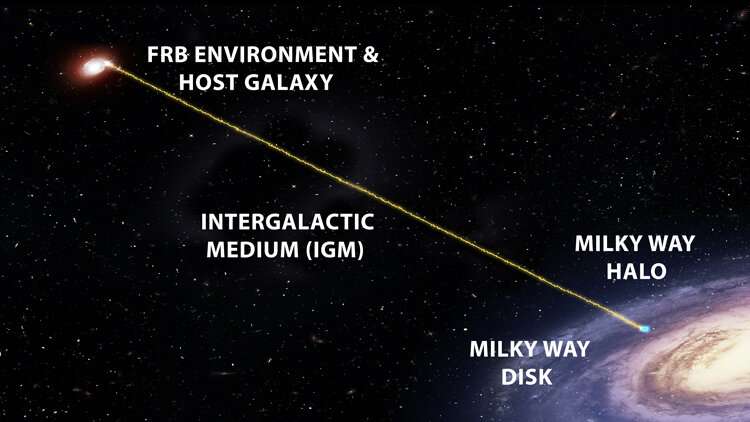
University of Toronto researcher Amanda Cook has found a way to use bright signals coming from across the universe to weigh the atmosphere of the Milky Way galaxy.
The radio signals she used come from the astronomical phenomenon known as fast radio bursts (FRBs)—enigmatic celestial objects that generate brief flashes of radio waves and are considered one of the biggest mysteries in astronomy.
Since an FRB simultaneously generates both high frequency radio waves (the equivalent of blue light) and low frequency radio waves (the equivalent of redlight), the different colors of radio waves might be expected to arrive at a telescope at the same time. But that’s not what happens. As an FRB passes through gas, it slows down—more so for the high frequencies than the low frequencies. The result is a delay between the different frequencies or colors reaching our telescope, effectively smearing the radio burst’s signal out in time.
Astronomers like Cook call this smearing “dispersion” and are able to use it as a tool to detect otherwise invisible gas throughout the cosmos.
“Using smearing to study the universe is like using your home heating bill to work out what the weather must have been like over the winter,” says Cook, who is a Ph.D. candidate in the David A. Dunlap department of astronomy and astrophysics, and the Dunlap Institute for Astronomy & Astrophysics, in the Faculty of Arts & Science.
“In the same way that your heating bill tells you whether it was a harsh winter or a mild winter—but not what the temperature was like on any individual date—the smearing that we see allows us to infer the total amount of material that the FRB signal has encountered on its journey from the FRB to Earth. It just can’t tell us how that material was distributed along the way.”
“The key thing is that regardless of how gas in front of the FRB is distributed, an FRB signal that is smeared more by the time it reaches our telescopes must be produced by an FRB that is farther away in the same way that an expensive heating bill must have meant a cold winter overall,” she continues.
PhysOrg for more