
by EWAN CAMERON
AI does not put people out of work. People put people out of work.
The Slander of History
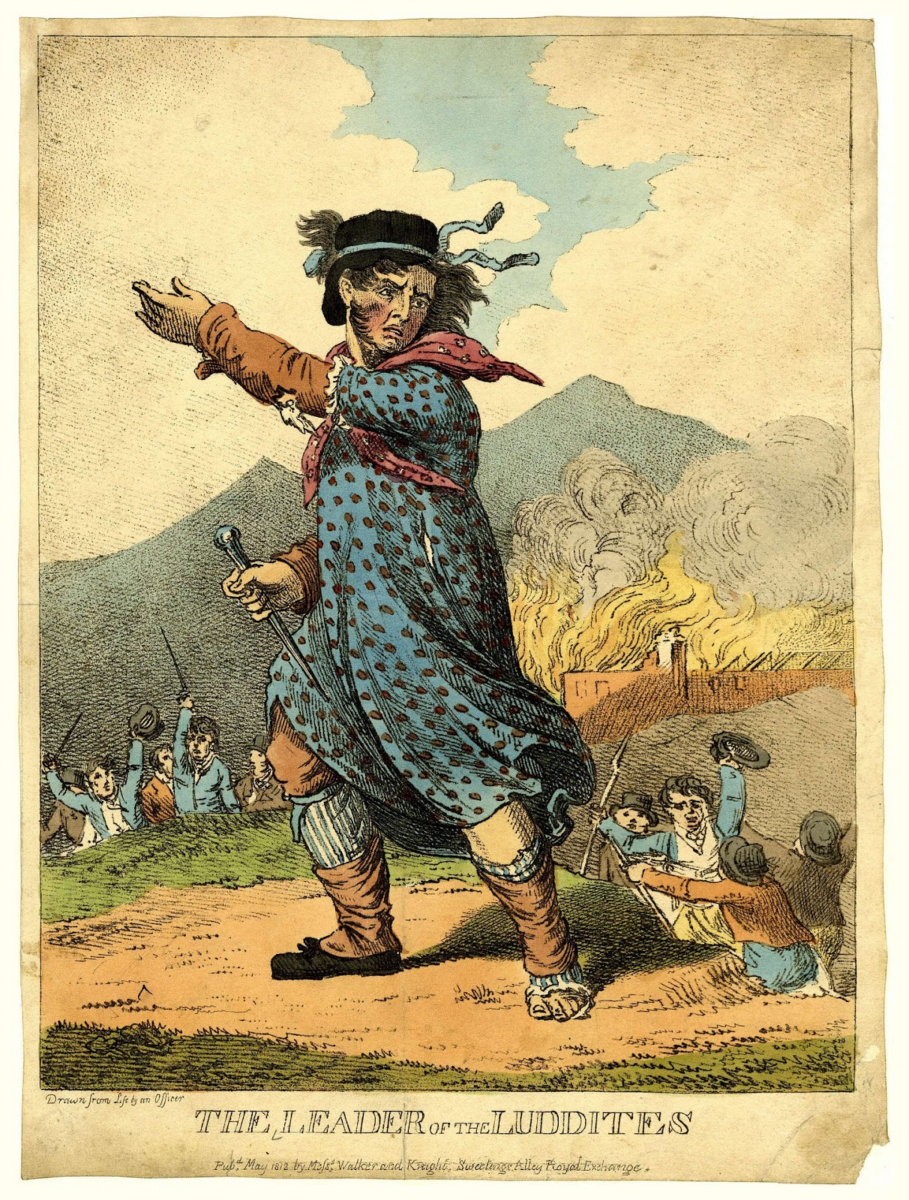
One consequence of ‘national education’ is how it crushes folk memories under the weight of so much standardization. I grew up in the English Midlands, in a place where 200 years previously, the movement that came to be known as Luddism sprung up. Luddism was a social movement of the 1810s in Lancashire, Yorkshire, Cheshire, Derbyshire, Nottinghamshire, and Leicester, one quickly snuffed out by state violence. Yet, we were never taught much about who the Luddites were, just a memory of visiting the Framework Knitters Museum and being entranced by the hypnotic motion of the circular sock knitter.
Like most people from my generation, the word ‘Luddite’ was simply a synonym for someone who hated new technology. I probably heard it used to describe people who refused to get a mobile phone, or who persisted with handwritten letters well into the age of email. If I thought about who the Luddites were, I imagined them as a quasi-religious sect that held primitive views against the inevitable march of technological progress and smashed up weaving equipment in a frenzy. Maybe you had, or have, the same view.
Actually, far from an irrational cult, the Luddites were a highly organised group of working weavers and their supporters. Did they smash up looms? Sure, but it wasn’t because they hated some abstract idea of technology. The fury of the Luddite movement, which spread over the East Midlands and Yorkshire areas, was centred around the social relationship of clothing workers to their work.
For frame-work knitters in particular, their livelihoods were not only being ground down by the introduction of machinery that would improve productivity (i.e. profits to the owners) but the practice of speculators investing in frames that could be rented out to the labourers. Thus, immiseration came from both a reduction in the cost of goods and increased rental costs for the frames. New technology made the manufacture of goods like stockings quicker, but this quicker process also led to poorer quality goods, an indignity that not only dragged down wages, but offended the worker’s pride in their craft.
Luddism manifested in the towns surrounding the city of Nottingham as a highly organised group of workers-cum-political activists, who carried out clandestine raids on workshops. Frame-breaking was not only illegal, but brought either transportation (i.e. exiled to Australia) or worse, execution, and 17 men were executed in 1813 for their participation in frame breaking. Thus, apart from their representatives in the media or local politics, the Luddite ‘Army of Redressers’ was an anonymous one, complete with a leader, “Ned Ludd”, a mythological figure who doubled-up as a pseudonym for various leaders of the movement.
Nottinghamshire’s other legendary figure of the redress, Robin Hood, is a celebrated figure whose name has been used to sell countless books and movies, as well as airports and energy companies. Hood’s tale is easy to grasp: rob from the rich and give to the poor. Ned Ludd’s cause: smash the machines that are used to justify our impoverishment, is less easy to script into a Disney film. In comparison to the somewhat paternalistic gentleman thief Hood, Ludd also perhaps represented the ‘sturdy self-reliance of a community’.
Go into Nottingham city today and between the cat café and a comic book shop, you’ll see The Ned Ludd pub. Beyond these small puddles of folk memory, Ludd is largely forgotten, and the Luddites are remembered only for what they did and not why.
History’s slander is a continual rebuttal to righteous protests. In 1998, a group called the Earth Liberation Front burned down a ski lift in the Colorado Rockies in protest against encroachment into the territory of the reintroduced wild Lynx. The actions were taken against property but the group were nevertheless dubbed ecoterrorists, a phrase that calls to mind violence against people. The waves of protest against free trade regimes and supply chains founded on sweatshops and impoverished farmers were, by a supine mainstream press, called “anti-globalisation”, a phrase that invokes once again the Luddite slander: a group of a primitives vainly standing against the tides of human progress. The actual lodestar phrase of those protests was “Another World is Possible”, an ideological riposte to the neoliberal “There is No Alternative”. The alter-globalisation protests at the turn of this century were not against new communications technology, but the ways in which multi-national corporations were using it to aid their ruthless exploitation of the world’s poor.
AntiCaptalist Resistance for more