
by RAMZY BAROUD
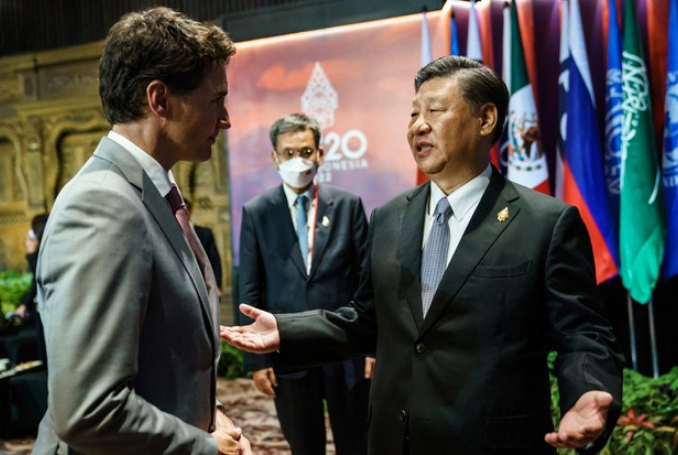
Though brief, the exchange between Chinese President Xi Jinping and Canadian Prime Minister Justin Trudeau on the sidelines of the G20 summit in Indonesia on November 16 has become a social media sensation. Xi, assertive if not domineering, lectured the visibly apprehensive Trudeau about the etiquette of diplomacy. This exchange can be considered another watershed moment in China’s relationship with the West.
“If there was sincerity on your part,” the Chinese President told Trudeau, “then we shall conduct our discussion with an attitude of mutual respect, otherwise there might be unpredictable consequences.”
At the end of the awkward conversation, Xi was the first to walk away, leaving Trudeau uncomfortably making his way out of the room.
For the significance of this moment to be truly appreciated, it has to be viewed through a historical prism.
When western colonial powers began the process of exploiting China in earnest – early to mid-19th century – the total size of the Chinese economy was estimated to be one-third of the world’s entire economic output. In 1949, when Chinese nationalists managed to win their independence following hundreds of years of colonialism, political meddling and economic exploitation, China’s total GDP merely accounted for 4 percent of the world’s total economy.
In the period between the first Opium War in 1839 and China’s independence, over a hundred years later, tens of millions of Chinese perished as a result of direct wars, subsequent rebellions and famines. The so-called Boxer Rebellion (1899-1901) was one of the many desperate attempts by the Chinese people to reclaim a degree of independence and assert nominal sovereignty over their land. The outcome, however, was devastating, as the rebels, along with the Chinese military, were crushed by the mostly Western alliance, which involved the United States, Austria-Hungary, Britain, France and others.
The death toll was catastrophic, with moderate estimations putting it at over 100,000. And subsequently, once more, China was forced to toe the line as it has done in the two Opium Wars and many other occasions in the past.
China’s independence in 1949 did not automatically signal the return of China to its past grandeur as a global, or even an Asian power. The process of rebuilding was long, costly and sometimes even devastating: Trials and errors, internal conflicts, cultural revolutions, periods of ‘great leaps forward’ but sometimes, also great stagnation.
Seven decades later, China is back at the center of global affairs. Good news for some. Terrible news for others.
Palestine Chronicle for more