How Israel controls the West

by MARGARET KIMBERLEY
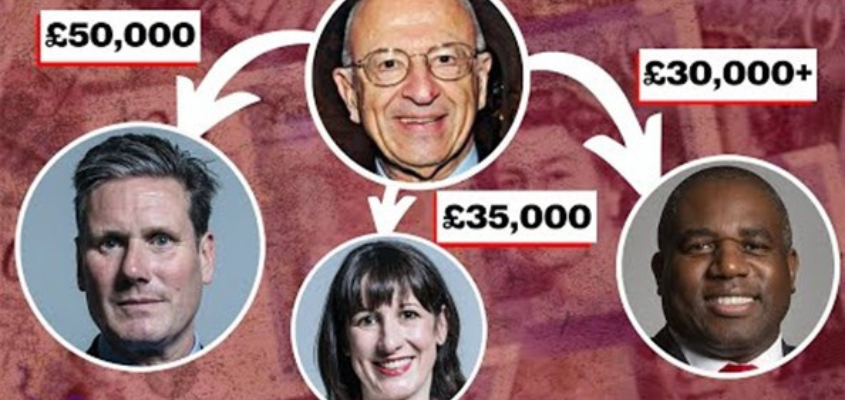
British zionist Trevor Chinn has funded the campaigns of politicians such as Prime Minister Keir Starmer, Chancellor of the Exchequer Rachel Reeves and Deputy Prime Minister David Lammy. IMAGE/Declassified UK

The state of Israel is reviled by most people in the world as a genocidal, war criminal nation. Money, influence peddling, and brute force ensure that international condemnation is not allowed to thwart zionist and imperialist objectives. 

“I have many jobs as [Senate] leader… and one is to fight for aid to Israel — all the aid that Israel needs,” – Charles Schumer, Democratic Party Leader in the U.S. Senate

Perhaps we should be grateful that Senator Schumer grudgingly acknowledged that he has some responsibilities other than giving public money to Israel. Although it must be said that he and his colleagues display no such level of seriousness about acting on behalf of the people of this country. They are far more interested in carrying water for oligarchs and collaborating with the people they claim to oppose

His recent remarks were actually rather tame when one considers the reach of zionist influence around the world, especially in the “collective west” of Europe, Canada, Australia, and the United States. These nations are sometimes willing imperialist partners in crime while also being victimized by zionist pressure campaigns. The determination to ensure that a pariah nation, that is committing genocide, maintains political and financial support, that millions of people don’t want to give, requires that both political manipulation and gangsterish force be applied at the most opportune moments.

Public approval of Israel in the U.S. has dropped significantly, with a majority of those polled, 59%, now holding negative views of that country. These opinions may be of some concern to the American Israel Political Action Committee (AIPAC) and other zionist political groups, but any worries they have are eased by following a simple and devastating playbook. 

Dissenters are punished openly. When members of congress step out of line from the accepted zionist discourse they are suddenly confronted with well funded opponents. That’s what happened to Congressional Black Caucus (CBC) members Cori Bush and Jamaal Bowman in 2024. And AIPAC was not shy about dancing on their political graves. “This year, AIPAC and our 5 million members across the country helped defeat 11 detractors of the U.S.-Israel relationship. Being pro-Israel is good policy and good politics!”

The newly elected progressive mayor of New York City, Zohran Mamdani, may express solidarity with Palestine but he felt compelled to keep the Mayor’s Office to Combat Anti-Semitism that Eric Adams established. He is not alone in feeling the pressure that is applied in New York, Washington, London, and the Land Down Under.

The Donald Trump administration recently bypassed the congressional approval process to provide Israel with $6.5 billion in military aid. Joe Biden’s administration did likewise, empowering the Gaza genocide also by going around congress. The purpose of these winks and nudges is to give cover to members who would vote “yes” if asked, but who do not want to be taken to task for their support of war crimes. None of them really object to U.S. presidents making an end run around them to keep the zionist project afloat and their careers secure. 

The release of the most recent Epstein files provides a glimpse into how this bad sausage gets made year after year. Very wealthy and well connected zionists, like the late Jeffrey Epstein, are Israeli state operatives using everything from sex trafficking to compromise powerful men, to bribing the diplomats who shaped the Oslo Accords. Israel’s concerns are always top of mind for presidents and prime ministers who in turn dutifully follow the directives of their benefactors and their enforcers.

Washington is not alone in facing this onslaught. The Epstein files have also created a political crisis in the United Kingdom. Prime Minister Keir Starmer is facing calls to resign from the leadership of the Labour party and from his office after his chief of staff Morgan McSweeney’s close relationship to Epstein came to light. McSweeney is an Irishman who was long known to be a zionist operative but who also engineered Starmer’s leadership of Labour by working with zionist individuals and groups in the UK to undermine Jeremy Corbyn. 

The Ireland-born McSweeney volunteered on an Israeli kibbutz as a teenager and went on to become a leader in Labour where he spearheaded the campaign to smear Corbyn as an anti-semite and to purge him and the rest of the left out of that party. 

McSweeney’s close connection with Peter Mandelson, a zionist and friend of Epstein, put him at the top of British politics and at the right arm of a prime minister. His connections were an open secret but he was finally done-in when it was revealed that he recommended Starmer’s appointment of Mandelson as ambassador to the U.S. 

Mandelson’s connection with the sex trafficker Epstein was the final straw but McSweeney has always made certain that Israel’s interests were represented at the highest levels of government.

McSweeney and seemingly everyone in British politics owes their position to Trevor Chinn, a wealthy man who once said, “I’ve spent my entire life working for Israel.” Indeed he has by funding both the Labour Friends of Israel and the Conservative Friends of Israel. Zionists are nothing if non-sectarian, making sure that Conservatives and Labour in the UK and Democrats and Republicans in the U.S. know where their fortunes lie. 

Black Agenda Report for more

Not a drop to search

by SHAHZAD SHARJEEL

Pipes that carry water in and out of Google’s data centre in The Dalles, Oregon IMAGE/Google/New Scientist

Life keeps getting more complex and guilt-ridden by the day. As if the carbon footprint calculation was not enough to turn one into an off-grid hermit, now we have the water footprint to feel guilty about. I hereby declare you ‘guilty’, dear reader, of all the charges I am framing against all of us in this piece.

Ask me how much water I consume in a day, and I will start with the few glasses I drink, then quickly move on to the litres used for washing and bathing. Push a bit more, and I will confess to being an obsessive car washer. Some of us would mention the ‘green patch’ in the house that must be watered year-round. Push harder still, and we will grudgingly divide the 3,000 to 7,000 litres of water needed to produce each pair of denim by the period we own them to arrive at a daily average. Since I am terrible at mental math, I will do all these calculations on my smartphone to determine how much water each listed activity costs. In doing so, data centres globally will consume 0.26 millilitres, about five drops of water, for each search. Mind you, this data on water consumption pertains to regular web searches; AI searches consume more water.

It took a media outlet to take the Oregon city government to court to obtain data on the water used to cool the Google data centre. In 2021, the search giant used about 12.4 billion litres of water in the US alone. In 2023, it used 23bn litres worldwide. WHO guidelines recommend 50 to 100 litres of water per person to meet drinking, cooking, and hygiene needs under normal circumstances. However, in a post-disaster or humanitarian crisis, 15 litres per person is the minimum required to meet basic needs.

To fully grasp how much we are all contributing to water stress, particularly owing to our web wanderlust, let us consider that Google is not the only search engine in the world. Microsoft’s internal projections estimate that, in 2030, the water required to cool its 100 data centres will be 28bn litres. To make things even more complex, the data centres use water both physically and virtually. While the usage in the physical sense, ie, water used to cool the data-processing centres at these facilities, is one measure, virtual usage pertains to the water used by their electricity providers to cool their production plants.

Imagine the water consumed in even a day of web searches.

Before we jump to condemn the tech billionaires for destroying the world’s ecology in their quest for private gain, let’s consider the fact that we are as much part of the problem as we are beneficiaries of these technological developments. It is amusing to watch developing countries lay all the blame for global warming at the doorstep of the developed North. The argument goes something like this: ‘It is the North that burned all the coal and oil in its pursuit of capitalist greed; we, the South, are not even industrialised yet.’ To buy into this simplistic logic, one would have to discount all the benefits of advancements we have derived since the Industrial Revolution. While developing countries may not have released greenhouse gases into the atmosphere, they have benefited from everything that resulted from the North’s ‘greed’, from jet engines to search engines to diagnosis and treatment of all manner of diseases.

The next time you are told to work smarter and put AI to use to complete one inane task or another, think hard if you can put your natural intelligence to use before resorting to AI.

Dawn for more

The ghost of Ali Shariati dances with the Epstein empire

by NICKY REID

Trump has seriously fucked up in the Middle East this time and even he knows it. In the first two weeks alone of Bibi and Donald’s latest savage bombardment of the Islamic Republic of Iran, neither regime has been able to keep their various stories straight for longer than fifteen seconds.

First, we were supposedly doing this because the Iranian people were just one airstrike away from returning the Shah to power in a popular uprising but after slaughtering half of the nation’s leadership from the Ayatollah down to the dog catcher, the Iranian people seemed more supportive of the fundamentalist hand that barely feeds them than ever before.

So, then the story changes to a strangely familiar narrative about weapons of mass destruction, weapons that Trump himself insisted repeatedly that he had heroically obliterated in the Ten-Day War last year. And that old gem was followed rather swiftly by yet another narrative about some inevitable plot by Iran to take over the Middle East in a week at any given second unless we helped Israel massacre their daughters in daring daylight raids on elementary schools. Now, they mostly just point at the mess they made and say, “Now, you see, with nukes that would be way worse.”

The only thing that seems to change more than Trump’s chickenshit excuses for setting the region on fire is the timeline for when V-day is supposed to come. Two weeks becomes four weeks becomes four months becomes four weeks again after oil prices spike. Believe it or not. all of these rambling narratives actually do tell the same story. The story of a vane and ignorant empire that opened Pandora’s Box by assassinating a nation of 90 million’s god-king and then completely lost control of the expanding global horror show that followed.

Attack the system for more

Afghanistan’s institutionalized silence and the cost of inaction

by NASRATULLAH TABAN

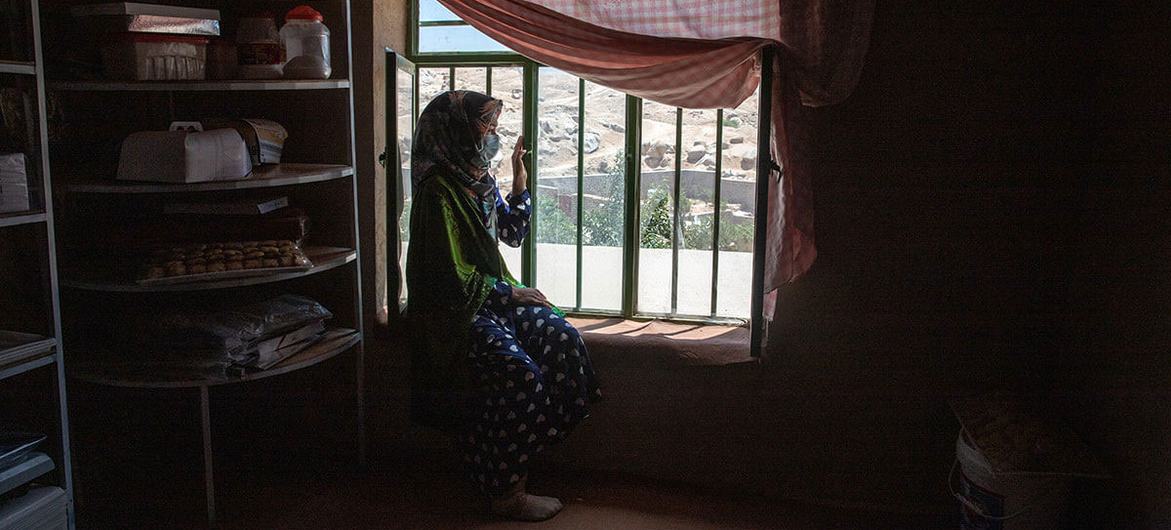
A 31-year-old woman sits by the window. She used to be an entrepreneur before the Taliban takeover. IMAGE/ © UN Women/Sayed Habib Bidell

Four years after the Taliban returned to power, Afghanistan is experiencing what many call a “great muting.” This is not just the result of war or economic problems, but a deliberate effort by the Taliban to erase voices. In communication theory, a group is considered “muted” when those in power control the main ways people can express themselves, such as language, law, and media. This leaves marginalized groups unable to share their experiences in a way others can understand.

For Afghan journalists, women, and ethnic minorities, this is not just a theory; it is a daily reality enforced by the Taliban. The streets are quiet, not because there is peace, but because the Taliban has created a culture of silence where speaking out can cost someone their life.

Afghanistan once had one of the most dynamic media landscapes in South and Central Asia. Hundreds of television channels, radio stations, newspapers, and online platforms reported on politics, corruption, and social issues. Journalists risked their lives to hold the powerful to account. Today, fewer than 50 independent media outlets operate nationwide, down from over 400 in 2021. Human Rights Watch reports that dozens of journalists have been threatened, arbitrarily detained, or beaten in the past year alone. Female reporters, once prominent voices in newsrooms and on air, have largely been forced out. Many journalists report living in constant fear, aware that every article could provoke retaliation. In this climate, truth itself has become dangerous.

Targeting Women and Hazara

Women and girls have suffered the most dramatic and visible losses under Taliban rule. UNESCO estimates that more than 22 million girls are barred from secondary school and university, reversing decades of educational progress. Many will never see the classroom again. Women are prevented from working in most sectors, must travel with male guardians, and are constantly monitored by morality police. Public spaces, workplaces, and recreational areas have effectively been closed to them.

Observers describe watching an entire generation of girls vanish before their eyes. The consequences extend far beyond classrooms. Hospitals operate without female staff, businesses lose vital contributors, and families struggle to survive. In Afghanistan today, half the population is effectively silenced, unable to participate in shaping the society around them.

EurAsia Review for more

Oil’s monopoly kaput, China to be top supplier of energy security

by HAN FEIZI

Noor Phase III CSP Project (150 MW) in Morocco, a central tower Concentrating Solar Power project, has the largest unit capacity in the world. The Project won the 2019 China International Sustainable Infrastructure Award, the 2020 China Power Quality Project (Overseas) Award, and the Social Responsibility Award Certificate issued by the Moroccan government. IMAGE/ PowerChina

With Hormuz closed, Gulf states under attack, every importing country will do what’s needed to remove oil from its energy stack

So, baby, can’t you see

I’ve got to break free

I’ve got to break free

I want to break free, yeah

Queen

The world cannot possibly absorb more exports from China, screamed the pundits.

After the US and Israel ignited the Middle East powder keg? Oh yes it can! And oh yes it will!

Now more than ever, the world – especially the Global South – will buy everything China has to sell.

China set off alarm bells after its 2025 trade surplus grew 20% year-on-year to $1.2 trillion, in defiance of Trump tariffs. China’s 2025 exports increased 5.4% while its already low imports fell marginally. The 20% collapse in exports to the US was more than offset by growth everywhere else – particularly Global South countries with exports to ASEAN and Africa surging 13% and 26%, respectively.

Concerns were compounded by January and February 2026 data showing that China’s exports increased 22% in dollar terms (19% in Rmb terms). Exports to the EU, ASEAN and Africa rocketed 25%, 27% and 47%, respectively.

Asia Times for more

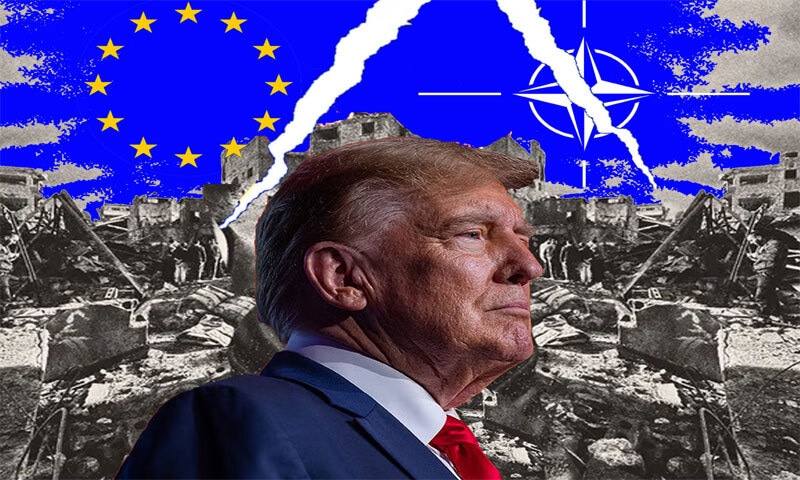
The rupture in the Western world order

by EJAZ HAIDER

“This bargain no longer works. Let me be direct. We are in the midst of a rupture, not a transition… You cannot live within the lie of mutual benefit through integration, when integration becomes the source of your subordination.”

— Mark Carney, Prime Minister of Canada, at Davos 2026

“After the war, we gave Greenland back to Denmark. How stupid were we to do that? But we did it, but we gave it back. But how ungrateful are they now? And then after the war, which we won, we won it big — without us, right now, you’d all be speaking German and a little Japanese, perhaps.”

— Donald Trump, US President, at Davos 2026

“If anyone thinks that the European Union, or Europe as a whole, can defend itself without the US, keep on dreaming. You can’t. We can’t.”

— Mark Rutte, Secretary-General Nato, speaking at EU Parliament

Canada’s Prime Minister Mark Carney went to the World Economic Forum at Davos and told the world that his country — by extrapolation, all US allies — had lived a “pleasant fiction” that is now over. That fiction was grounded in the assumption that the United States would continue to lead a global order and that such order would perpetually guarantee stability, provide limitless liquidity, and manage all systemic risks. Under this global order, American hegemony would continue to “provide public goods, open sea lanes, a stable financial system, collective security and support for frameworks for resolving disputes.” This does not obtain anymore.

For decades, America’s Western allies lived comfortably with a system in which the US was the accepted hegemon and which benefitted them as its satraps. That system is now unravelling because of the brazenness and boorishness of US President Donald Trump and because the allies are now being treated like others were always treated in the Global South. For the first time, Canada and Europe are being forced to confront the fact that power creates its own dynamics…

This is where the irony lies. For Carney, as also other US allies, US hegemony worked and made them prosper as long as its application of force targeted states and societies in what we loosely describe as the Global South: Latin America, Africa, the Middle East, to name just the most obvious regions. These are also the regions where a number of states or leaders within those states decided to remove the signboard, to not live the lie that Canada was so content to live with until recently and acquiesced in.

Those leaders were picked off — the list is long from Mohamed Mosaddegh to Patrice Lumumba to Ngo Din Diem to Salvador Allende to hundreds of failed attempts on Fidel Castro — those states suffered and most, like Iran, continue to suffer. The system’s power did not come from its truth, but from Canada’s willingness, as also of other US allies, to perform as if it were true. Now, “its fragility comes from the same source”, as identified by Carney.

I argue that the challenge faced by the US allies is not that the United States has suddenly become more of a hegemon. The entire post-WWII system was grounded in unequal power distribution and accepted hegemony of the US by its allies. The fiction Carney spoke about was (and remains) an elaborate mise en scène, put together not just by the US but also its allies. In fact, as we shall discuss later, the centrality of a dominant power is the core tenet of an integrated alliance system that must also have a unifying perception of threat and shared values.

Carney’s assertion that “when we only negotiate bilaterally with a hegemon, we negotiate from weakness”, and his invocation of Thucydides’ Melian Dialogue are, therefore, about the direction of the exercise of US hegemony, not hegemony itself. What is true, however, is the fact and Carney’s realisation of it, that a hegemon’s intent can change. That is what has happened.

To that end, I propose to briefly look at how the North Atlantic Treaty Organisation (Nato) came about and what exactly is the Greenland issue about. Finally, I argue that, while this moment may not be a Wagnerian frenzy, it could lead to that in the years to come, quite possibly unravelling Europe, which is not a single, seamless entity but a conglomeration of multiple states and ethnolinguistic groupings.

EUROPE, AMERICA AND NATO: FROM RELUCTANCE TO PRIMACY

What follows is based on a number of works, including those by US international affairs academic Lawrence Kaplan, Canadian diplomat Escott Reid and US historian Melvyn Leffler and several declassified documents from the Foreign Relations of the United States (FRUS) volumes.

Dawn for more

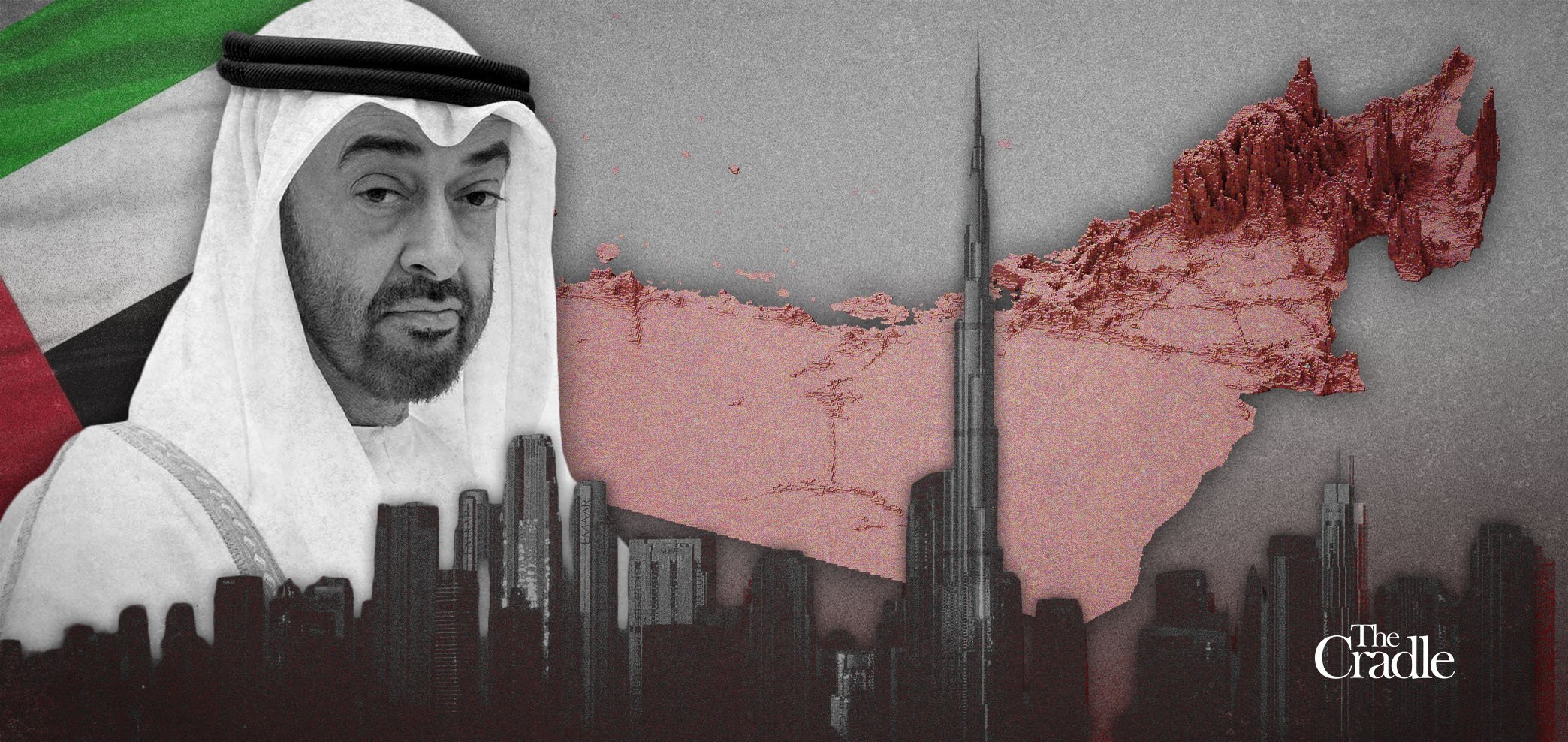
The UAE: One state or seven competing emirates under one flag?

by MOHAMAD HASAN SWEIDAN

Behind the skyscrapers lies a fragile federal bargain shifting toward Abu Dhabi and tested by the Emirates’ ties to Washington and Israel.

In December 1971, seven rulers sealed a pact that fused their territories into a federation. There was no uprising in the streets, no grand constitutional rupture shaped by popular will. 

What emerged was a calculated bargain among hereditary rulers who understood both their fragility and their ambition, as British power receded from the Persian Gulf and Washington’s shadow stretched steadily across the region.

That bargain still holds. But it has never been equal.

Seven Emirates, one destiny? 

The UAE is routinely portrayed as a unified, stable, forward-looking state – a Gulf success story that leveraged oil wealth, global trade, and strategic alignment with the US to project power well beyond its size

In recent years, it has added normalization with Israel and deepening security integration with Washington to that formula. Yet what is rarely acknowledged is that the UAE is not a monolithic state in the classical sense. It is a federation of seven hereditary emirates, each with distinct economic models, political cultures, and varying levels of wealth and influence.

The question, then, is not whether the UAE is stable today. It is whether the structural imbalances built into its formation can endure the mounting internal and external pressures of the coming years.

A federation built on asymmetry

The UAE was not created by a single ruling family consolidating power. It was born of negotiation. In December 1971, six emirates formed the federation. Ras al-Khaimah joined in February 1972, bringing the total to seven. From the outset, the union brought together territories that were unequal in resources, demography, and geopolitical weight.

Before British protection agreements carved out the Trucial Coast, large swaths of today’s UAE lay within Oman’s sphere of influence, where tribal confederations and maritime rulers operated under shifting Omani suzerainty. The federation is thus a recent political settlement, not the continuation of a historical state.

Abu Dhabi controls the commanding heights of the federation, overseeing roughly 96 percent of oil and gas production capacity – giving it not only the largest share of hydrocarbon reserves, but also decisive control over how and when that wealth enters global markets.

Dubai charted a different course. With limited oil, it built its identity on economic openness – ports, aviation, re-export, finance – turning geography into leverage. It compensated for resource scarcity through hyper-connectivity and risk-taking.

According to the Central Bank of the UAE, Dubai received 9.9 million international visitors who spent at least one night in the first half of 2025, and Dubai Airport handled about 46 million passengers during the same period.

The northern emirates followed other paths. Ras al-Khaimah relied more heavily on manufacturing, quarrying, and mid-scale trade. Sharjah positioned itself around education, culture, and a more socially conservative public identity, even as it sought to expand industrial capacity and job creation. 

The Cradle for more

Age of reaction

by AASIM SAJJAD AKHTAR

Narendra Modi is no stranger to genocides. He acquired the moniker ‘Butcher of Gujrat’ for presiding over anti-Muslim pogroms as chief minister in 2002. By undertaking a highly choreographed official visit to Tel Aviv, Modi is both rubber-stamping the Netanyahu regime’s genocidal assaults on Gaza and cementing the alliance between the fanatical creeds of Hindutva and Zionism.

The Christian Right has already upended ‘normal’ politics in the US by projecting a millenarian vision of the world that can only be achieved by totalitarian and violent means. Trumpism is now an entrenched, grassroots phenomenon that will very likely outlive Donald Trump. Meanwhile, various shades of both secular and religious right are running riot across Europe, with fearmongering about cultural invasions by the proverbial immigrant.

Despite their best pretensions, Muslim countries do not buck the trend. Reac­tio­n­a­­ry politics and repressive state nationalism are the order of the day across large swathes of the Arab world, Southwest Asia and the world’s largest Muslim state, Indonesia. The current hybrid regime in this country presents itself as a leader of this putatively coherent bloc of countries.

Some believe that this notional ‘Muslim’ bloc, along with other constituent parts of the ‘Global South’, can become a bulwark against US imperialism, Zionism and Hin­dutva. An ostensibly pro-people group of countries can now even rely on a superpower, China, to both resist the US-Israel-India axis and even usher the world towards a new tomorrow.

Reactionary politics and repressive state nationalism dominate.

The hypothesis is backed up by reference to some recent developments. Most notable was Pakistan’s successful deployment of Chinese-made aircraft to down India’s French-made fleet (and its armoury of Israeli drones). The subsequent defence agreement between Pakistan and Saudi Arabia, as well as the former’s growing export of arms more generally, is also present as evidence of a burgeoning security alliance to resist Zionist aggression. There is even an argument that Iran has, as yet, not suffered a major assault because the ‘Muslim’ bloc, China and other countries have stood firm in its defence.

The fundamental problem with this hy­­pothesis is that there are just as many, if not more, examples that disprove it. To begin with, the notional bloc is united in its desire to win the good graces of the Trump White House. The calamitous ‘Board of Peace’ is just the tip of the iceberg. Military contr­a­cts and cooperation between Muslim countries and the US are old news. Pakistan’s mi­­litarised ruling class, like many of its ‘Mus­­lim brethren’, is inking all sorts of minerals, crypto and other deals with the US. The Gulf states do big business with India, not to mention happily call it a strategic par­­tner. The UAE even boasts annual bilateral trade with Israel in excess of $3 billion.

On the other end of the planet, Venezuela and Cuba are amongst the few states in our world that clearly articulate an anti-imperialist policy. How many countries stood up for Venezuelan president Nicolás Maduro when he was kidnapped by US commandos in broad daylight? He still languishes in a New York jail.

Dawn for more

Hyderabad’s forgotten cinema: Inside film culture of Nizam’s era

by BUSHRA KHAN

Yakut Mahal remains the only single screen theatre of the Nizam’s era IMAGE/ Facebook

Yamini Krishna traced Hyderabad’s cinematic history, drawing attention to film cultures in Nizam’s era

If you walk into a multiplex in Hyderabad today, the dominance of the Telugu film industry feels ancient and natural. But according to the researcher and author, Dr C Yamini Krishna, this is a narrative that began only a few decades ago.

Speaking to Siasat.com on the final day of the History Literature Festival at Hyderabad Public School, Yamini Krishna traced Hyderabad’s cinematic history beyond the familiar Telugu timeline, drawing attention to Urdu film cultures that existed long before the industry arrived in the city.

The author of “Film City Urbanism in India,” Krishna was in Hyderabad as a speaker at the festival’s session “Cinema of Hyderabad: Pasts and Futures,” alongside SV Srinivas and Srinivas Kondra. Her work, grounded in extensive archival research, focuses on cinema in Hyderabad before 1948 and the cultural shifts that followed.

Siasat for more