
by EJAZ HAIDER
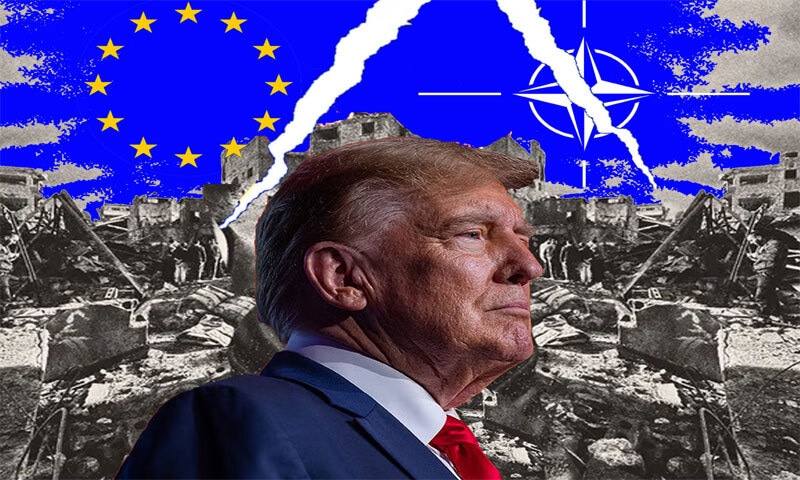
“This bargain no longer works. Let me be direct. We are in the midst of a rupture, not a transition… You cannot live within the lie of mutual benefit through integration, when integration becomes the source of your subordination.”
— Mark Carney, Prime Minister of Canada, at Davos 2026
“After the war, we gave Greenland back to Denmark. How stupid were we to do that? But we did it, but we gave it back. But how ungrateful are they now? And then after the war, which we won, we won it big — without us, right now, you’d all be speaking German and a little Japanese, perhaps.”
— Donald Trump, US President, at Davos 2026
“If anyone thinks that the European Union, or Europe as a whole, can defend itself without the US, keep on dreaming. You can’t. We can’t.”
— Mark Rutte, Secretary-General Nato, speaking at EU Parliament
Canada’s Prime Minister Mark Carney went to the World Economic Forum at Davos and told the world that his country — by extrapolation, all US allies — had lived a “pleasant fiction” that is now over. That fiction was grounded in the assumption that the United States would continue to lead a global order and that such order would perpetually guarantee stability, provide limitless liquidity, and manage all systemic risks. Under this global order, American hegemony would continue to “provide public goods, open sea lanes, a stable financial system, collective security and support for frameworks for resolving disputes.” This does not obtain anymore.
For decades, America’s Western allies lived comfortably with a system in which the US was the accepted hegemon and which benefitted them as its satraps. That system is now unravelling because of the brazenness and boorishness of US President Donald Trump and because the allies are now being treated like others were always treated in the Global South. For the first time, Canada and Europe are being forced to confront the fact that power creates its own dynamics…
This is where the irony lies. For Carney, as also other US allies, US hegemony worked and made them prosper as long as its application of force targeted states and societies in what we loosely describe as the Global South: Latin America, Africa, the Middle East, to name just the most obvious regions. These are also the regions where a number of states or leaders within those states decided to remove the signboard, to not live the lie that Canada was so content to live with until recently and acquiesced in.
Those leaders were picked off — the list is long from Mohamed Mosaddegh to Patrice Lumumba to Ngo Din Diem to Salvador Allende to hundreds of failed attempts on Fidel Castro — those states suffered and most, like Iran, continue to suffer. The system’s power did not come from its truth, but from Canada’s willingness, as also of other US allies, to perform as if it were true. Now, “its fragility comes from the same source”, as identified by Carney.
I argue that the challenge faced by the US allies is not that the United States has suddenly become more of a hegemon. The entire post-WWII system was grounded in unequal power distribution and accepted hegemony of the US by its allies. The fiction Carney spoke about was (and remains) an elaborate mise en scène, put together not just by the US but also its allies. In fact, as we shall discuss later, the centrality of a dominant power is the core tenet of an integrated alliance system that must also have a unifying perception of threat and shared values.
Carney’s assertion that “when we only negotiate bilaterally with a hegemon, we negotiate from weakness”, and his invocation of Thucydides’ Melian Dialogue are, therefore, about the direction of the exercise of US hegemony, not hegemony itself. What is true, however, is the fact and Carney’s realisation of it, that a hegemon’s intent can change. That is what has happened.
To that end, I propose to briefly look at how the North Atlantic Treaty Organisation (Nato) came about and what exactly is the Greenland issue about. Finally, I argue that, while this moment may not be a Wagnerian frenzy, it could lead to that in the years to come, quite possibly unravelling Europe, which is not a single, seamless entity but a conglomeration of multiple states and ethnolinguistic groupings.
EUROPE, AMERICA AND NATO: FROM RELUCTANCE TO PRIMACY
What follows is based on a number of works, including those by US international affairs academic Lawrence Kaplan, Canadian diplomat Escott Reid and US historian Melvyn Leffler and several declassified documents from the Foreign Relations of the United States (FRUS) volumes.
Dawn for more