US President Donald Trump has authorised the USS Gerald R. Ford to enter the Caribbean. It now floats north of Puerto Rico, joining the USS Iwo Jima and other US navy assets to threaten Venezuela with an attack. Tensions are high in the Caribbean, with various theories floating about regarding the possibility of what seems to be an inevitable assault by the US and regarding the social catastrophe that such an attack will occasion. CARICOM, the regional body of the Caribbean countries, released a statement affirming its view that the region must be a “zone of peace” and that disputes must be resolved peacefully. Ten former heads of government from Caribbean states published a letter demanding that “our region must never become a pawn in the rivalries of others”.
Former Trinidad and Tobago Prime Minister Stuart Young said on 21 August, “CARICOM and our region is a recognised zone of peace, and it is critical that this be maintained”. Trinidad and Tobago, he said, has “respected and upheld the principles of non-intervention and non-interference in the internal affairs of other countries and for good reason”. On the surface, it appears as if no one in the Caribbean wants the United States to attack Venezuela.
However, the current Prime Minister of Trinidad and Tobago, Kamla Persad-Bissessar (known by her initials as KPB), has openly said that she supports the US actions in the Caribbean. This includes the illegal murder of eighty-three people in twenty-one strikes since 2 September 2025. In fact, when CARICOM released its declaration on the region being a zone of peace, Trinidad and Tobago withdrew from the statement. Why has the Prime Minister of Trinidad and Tobago gone against the entire CARICOM leadership and supported the Trump administration’s military adventure in the Caribbean.
Backyard Since the Monroe Doctrine (1823), the United States has treated all Latin America and the Caribbean as its “backyard”. The United States has intervened in at least thirty of the thirty-three countries in Latin America and the Caribbean (90 percent of the countries, in other words) —from the US attack on Argentina’s Malvinas Islands (1831-32) to the current threats against Venezuela.
Every year, millions of people sing the beautiful carol Silent Night, with its line “all is calm, all is bright”.
We all know the Christmas story is one in which peace and joy are
proclaimed, and this permeates our festivities, family gatherings and
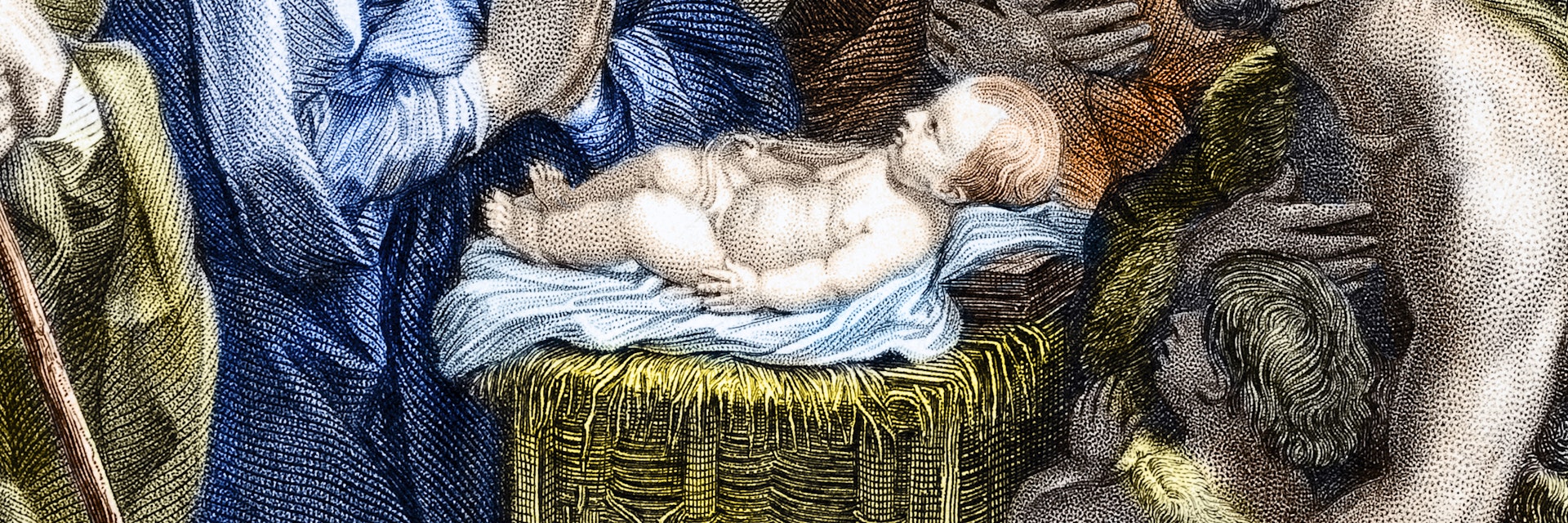
present-giving. Countless Christmas cards depict the Holy Family –
starlit, in a quaint stable, nestled comfortably in a sleepy little
village.
However, when I began to research my book on the childhood of Jesus, Boy Jesus: Growing up Judaean in Turbulent Times, that carol started to sound jarringly wrong in terms of his family’s actual circumstances at the time he was born.
The Gospel stories themselves tell of dislocation and danger. For
example, a “manger” was, in fact, a foul-smelling feeding trough for
donkeys. A newborn baby laid in one is a profound sign given to the
shepherds, who were guarding their flocks at night from dangerous wild
animals (Luke 2:12).
When these stories are unpacked for their core elements and placed in
a wider historical context, the dangers become even more glaring.
Take King Herod, for example. He enters the scene in the nativity stories without any introduction at all, and readers are supposed to know he was bad news. But Herod was appointed by the Romans as their trusted client ruler of the province of Judaea. He stayed long in his post because he was – in Roman terms – doing a reasonable job.
Jesus’ family claimed to be of the lineage of Judaean kings,
descended from David and expected to bring forth a future ruler. The
Gospel of Matthew begins with Jesus’ entire genealogy, it was that
important to his identity.
But a few years before Jesus’ birth, Herod had violated the tomb of
David and looted it. How did that affect the family and the stories they
would tell Jesus? How did they feel about the Romans?
A time of fear and revolt
As for Herod’s attitude to Bethlehem, remembered as David’s home, things get yet more dangerous and complex.
When Herod was first appointed, he was evicted by a rival ruler
supported by the Parthians (Rome’s enemy) who was loved by many local
people. Herod was attacked by those people just near Bethlehem.
He and his forces fought back and massacred the attackers. When Rome
vanquished the rival and brought Herod back, he built a memorial to his
victorious massacre on a nearby site he called Herodium, overlooking
Bethlehem. How did that make the local people feel?
And far from being a sleepy village, Bethlehem was so significant as a town that a major aqueduct construction
brought water to its centre. Fearing Herod, Jesus’ family fled from
their home there, but they were on the wrong side of Rome from the
start.
They were not alone in their fears or their attitude to the
colonisers. The events that unfolded, as told by the first-century
historian Josephus, show a nation in open revolt against Rome shortly
after Jesus was born.
When Herod died, thousands of people took over the Jerusalem temple
and demanded liberation. Herod’s son Archelaus massacred them. A number
of Judaean revolutionary would-be kings and rulers seized control of
parts of the country, including Galilee.
It was at this time, in the Gospel of Matthew, that Joseph brought
his family back from refuge in Egypt – to this independent Galilee and a
village there, Nazareth.
But independence in Galilee didn’t last long. Roman forces, under the
general Varus, marched down from Syria with allied forces, destroyed
the nearby city of Sepphoris, torched countless villages and crucified
huge numbers of Judaean rebels, eventually putting down the revolts.
Archelaus – once he was installed officially as ruler – followed this up with a continuing reign of terror.
A nativity story for today
As a historian, I’d like to see a film that shows Jesus and his
family embedded in this chaotic, unstable and traumatic social world, in
a nation under Roman rule.
Instead, viewers have now been offered The Carpenter’s Son, a film starring Nicholas Cage. It’s partly inspired by an apocryphal (not biblical) text named the Paidika Iesou – the Childhood of Jesus – later called The Infancy Gospel of Thomas.
Chinese chairman Xi Jinping met with Japanese prime minister Sanae Takaichi, at her request in Gyeongju, on 31 October, in the Republic of Korea.
The recently ensconced Japanese prime minister Sanae Takaichi began
her early leadership with a major diplomatic gaffe when she said a
Chinese attack on Taiwan could constitute “a survival-threatening
situation” for Japan requiring the use of force.
Beijing is apoplectic. Fu Cong, Beijing’s ambassador to the UN,
accused Takaichi of committing “a grave violation of international law.”
Chinese Foreign Minister Wang Yi said, “It is shocking that Japan’s
current leaders have publicly sent the wrong signal of attempting
military intervention in the Taiwan issue, said things they shouldn’t
have said, and crossed a red line that should not have been touched.”
Takaichi seems oblivious of Article 9 of Japan’s constitution which renounces war and forbids Japan from using force to settle international disputes.
2. The Government of Japan recognizes the Government of the People’s Republic of China as the sole legal Government of China.
3. The Government of the People’s Republic of China
reiterates that Taiwan is an inalienable part of the territory of the
People’s Republic of China. The Government of Japan fully understands
and respects this stand of the Government of the People’s Republic of
China, and it firmly maintains its stand under Article 8 of the Potsdam
Proclamation.
Not only is Takaichi oblivious of the country’s constitution and the
joint communiqué, she is also seemingly oblivious of Japanese history.
A modernized and expansionist Japan went to war and defeated the Qing dynasty. One requirement of the Treaty of Shimonoseki, 1895, was that China cede Taiwan to Japan.
Japan’s further expansionism and militarism led to its defeat after
WWII. Thus, Japan would have to relinquish ill-gotten territories. The Cairo Declaration of 1943 states:
[A]ll the territories Japan has stolen from the Chinese,
such as Manchuria, Formosa, and The Pescadores, shall be restored to the
Republic of China.
The terms of the Cairo Declaration shall be carried out
and Japanese sovereignty shall be limited to the islands of Honshu,
Hokkaido, Kyushu, Shikoku and such minor islands as we determine.
The major historical documents clearly point to Chinese sovereignty over Taiwan.
Despite China having asked for clarification and a retraction of
Takaichi’s erroneous remarks, no such clarification or retraction has
been forthcoming.
Why would Takaichi even make such ignorant remarks? What did she hope to gain? Assuredly not an economic rupture of the economically challenged Japan from China.
China’s travel sanctions following diplomatic tensions
with Japan have triggered mass flight cancellations, severe tourism
losses and a projected ¥2.2tn annual economic impact.
Japan has expressed remorse for its WWII atrocities, but no
official government apology has ever been issued. Meanwhile, Japanese
politicians, including Takaichi (although she skipped such a visit
during the 2025 autumn festival) have continued to visit the Yasukuni
Shrine, said to house the kami of Japanese dead including class-A war criminals eliciting anger among countries violated by Japan during WWII.
As
it heads out of the solar system never to return, the deep space probe
Voyager 1 is headed for yet another cosmic milestone. In late 2026, it
will become the first spacecraft to travel so far that a radio signal
from Earth takes 24 hours, or one light day, to reach it.
According
to Einstein, the speed of light is as fast as it’s possible for
anything to go. That may seem arbitrarily restrictive, but at 186,000
miles per second (299,388 km/s), that leaves a lot of leeway unless
you’re dealing with things at computer speeds where a delay can be
aggravating.
Another thing that can be aggravating is that though light is fast, the universe is, as The Hitchhiker’s Guide to the Galaxy
says, really big. This means that if you have to cover a long enough
distance, the speed of light starts to become noticeable in a way that
we don’t see on Earth.
Perhaps the first time we saw this publicly
was during the Apollo Moon landings over 50 years ago. If you watch old
video recordings of the astronauts on the lunar surface talking to
Mission Control back on Earth, you’ll notice that there’s a delay of
about 2.6 seconds between when someone makes a comment and the other
party replies. That’s because with the Moon being about 226,000 miles
(363,000 km) from the Earth, it takes a radio signal 1.3 seconds to
travel the distance.
Diagram of Voyager 1’s position in relation to the Sun
If you go to Mars, this gap becomes up to four minutes.
For Jupiter, it’s up to 52 minutes, and for Pluto (which I still
stubbornly say is a planet!) that comes to up to 6.8 hours. Small wonder
that deep space missions require robotic spacecraft that have a high
degree of autonomy. If they had to wait for direct instructions from
Earth before making a move, a few Mars rovers would have ended their
careers as a pile of scrap at the bottom of a ravine.
None of this
compares to Voyager 1, the veteran probe launched in 1977 to make a
flyby of Jupiter and Saturn before heading out on a one-way trajectory into interstellar space.
Despite being almost a half-century old and flying through the
incredibly cold, radiation-saturated depths of space at the edge of the
solar system, it still continues to function and NASA is determined that
it will continue to do so until its nuclear power source finally gives
out in the next year or so.
The brain’s structure changes in spurts, according to a new study. Malte Mueller via Getty Images
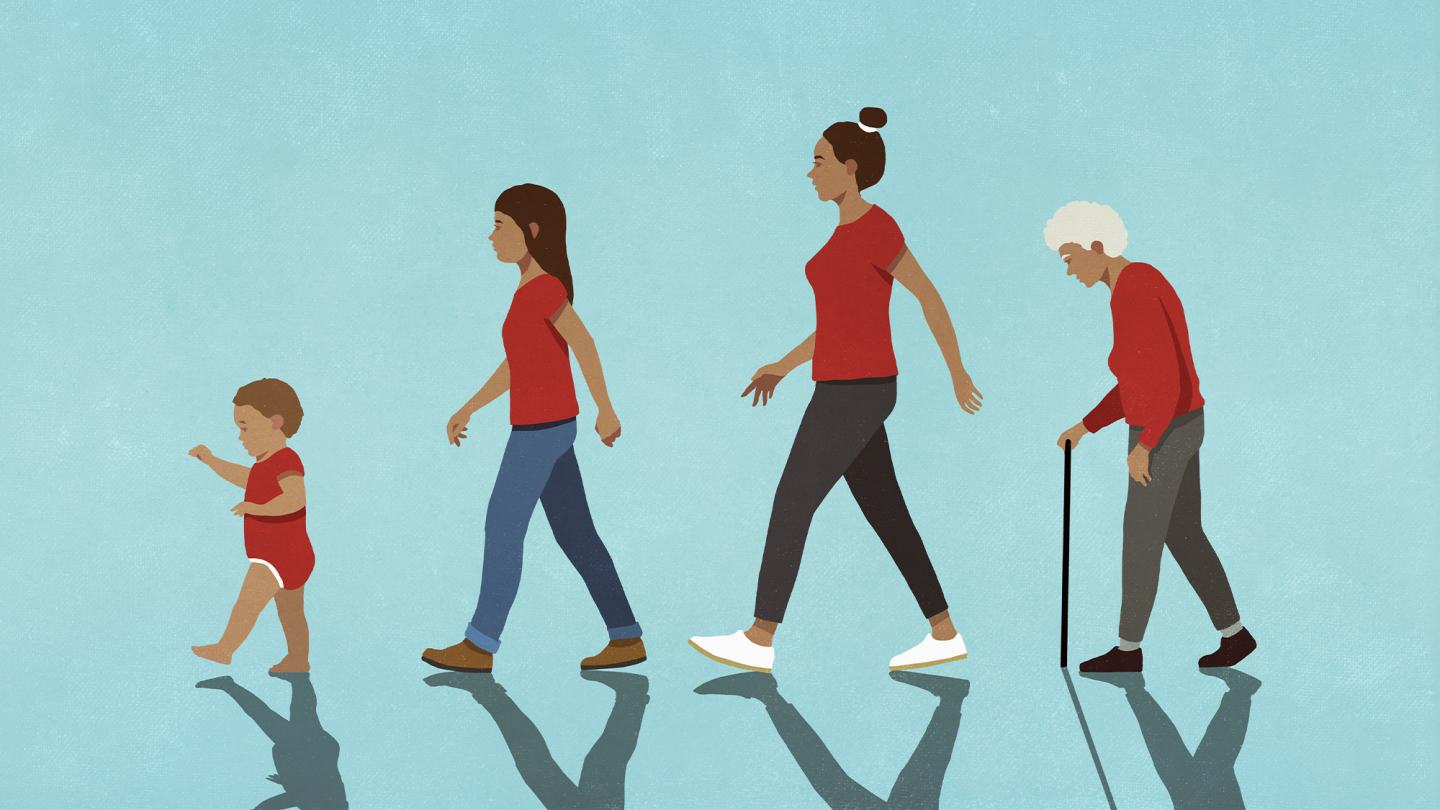
Brain scans of 3,802 people show how the brain’s structure changes at four major turning points.
A team of neuroscientists at the University of Cambridge in the United Kingdom identified five broad phases of brain structure
over the course of an average human life. These eras occur as the human
brain rewires to support the different ways of thinking while we grow,
mature, and eventually decline. The five major turning points are detailed in a study published today in the journal Nature Communications.
In the study, they compared the brains of 3,802 people between ages zero and 90, using datasets of MRI diffusion scans.
These types of MRIs map neural connections by following how water
molecules move through brain tissue. They detected five broad phases of
brain structure in the average human life that are split up by four
pivotal turning points between birth and death when our brains
reconfigure.
The major turning points occur at ages:
Nine (Childhood brain architecture)
32 (Adulthood brain architecture)
66 (Early aging)
83 (Late aging)
“We know the brain’s wiring is crucial
to our development, but we lack a big picture of how it changes across
our lives and why,” study co-author and neuroscientist Dr. Alexa Mousley said in a statement.
“This study is the first to identify major phases of brain wiring
across a human lifespan. These eras provide important context for what
our brains might be best at, or more vulnerable to, at different stages
of our lives. It could help us understand why some brains develop
differently at key points in life, whether it be learning difficulties
in childhood, or dementia in our later years.”
Age nine–From baby to kid
From infancy through early childhood, the brain is defined by network consolidation. All of the connectors between neurons called synapses
that were overproduced in a baby’s brain whittle down. The more active
synapses survive, shaping the brain’s early architecture.
Across the whole brain, these
connections rewire in the same pattern from birth until about nine years
old. Meanwhile, the brain’s grey and white matter grow rapidly in
volume.
The childhood brain runs from birth up
until a turning point at the age of nine. Here, the brain is
experiencing a change in cognitive capacity, but also an increased risk of mental health disorders.
Age 32–Adult brain takes shape
In the early 30s, the brain’s neural wiring shifts into adult mode. White matter
continues to grow in volume, so the brain’s communications networks are
increasingly refined based on MRI scans showing how water molecules
movies. These changes keep the brain at an enhanced level of cognitive
performance that peak in the early 30s and is the brain’s “strongest
topological turning point” of the entire lifespan, according to the
team.
“Around the age of 32, we see the most
directional changes in wiring and largest overall shift in trajectory,
compared to all the other turning points,” said Mousley. “While puberty
offers a clear start, the end of adolescence is much harder to pin down
scientifically. Based purely on neural architecture, we found that
adolescent-like changes in brain structure end around the early
thirties.”
Adulthood is the longest era and three
decades. The brain’s architecture also stabilizes compared to previous
phases, without any major turning points for the next 30 years. According to the team, this corresponds with a “plateau in intelligence and personality.”
All Eras: representative MRI tractography images of all eras of the human brain. Image: Dr. Alexa Mousley, University of Cambridge
Age 66–Early aging begins
This mid-60s turning point marks the
start of an “early aging” phase of brain architecture. It’s a more mild
period and is not defined by any major structural shifts. However, the
team still uncovered meaningful changes to the pattern of brain networks on average at around age 66.
“The data suggest that a gradual
reorganisation of brain networks culminates in the mid-sixties,” said
Mousley. “This is probably related to aging, with further reduced
connectivity as white matter starts to degenerate. This is an age when
people face increased risk for a variety of health conditions that can
affect the brain, such as hypertension.”
VIDEO/Studio Canal/Youtube Poster for Jacques Rivette’s Suzanne Simonin, La Religieuse de Diderot.
We think of France as being more liberated
culturally and sexually than the US. And perhaps it is, today. But in
the 1960s, post-war/pre-Mai ’68 France was still in the grip of the
Catholic Church and right-wing Gaullist politicians.
In 1965, France banned the showing of Jacques Rivette’s film of Denis Diderot’s 1792 novel, La Religieuse
(The Nun). Not only did they ban the film, they also banned the radio
and television press from reporting that they had banned the film.
Although Voltaire and Rousseau grabbed the headlines as philosophers
of the Revolution, it was Diderot the Encyclopedist whose “seditious”
words put him under constant surveillance, led to the confiscation of
his manuscripts and eventually landed him in the dungeons of the king’s
prison at Vincennes, where the Marquis de Sade was later locked in a
dark cell for seven years. (The last straw for the enforcers of imperial
obedience was his heretical “Letter on the Blind,” which not only
advocated reason over religious superstition but advanced a theory of
natural selection 100 years before Darwin.)
Diderot’s novel, which wasn’t published until a decade after his
death, was a scathing assault on the corrupt and incestuous ties between
the Church and the Ancient Regime. Rivette’s film, which is remarkably
faithful to the novel, targeted the modern reincarnation of that
repressive alliance.
Simone is the illegitimate daughter of an aristocratic family in
financial ruin. Her severe mother tells her she is a daily reminder of
her sin, a child who will never have the status to be married. Against
her will, she is placed in a convent. The convent is a prison, a
sanctified Bastille, where the nuns are kept in cells, the windows are
barred and all interactions with the secular world take place behind
curtains or grill-like barriers.
Every act of rebellion is punished with increasing severity: she was
placed in isolation, deprived of food and books, whipped and forced to
kneel or prostrate herself (stress positions) on stone floors for hours.
The basic techniques of torture haven’t changed all that much across
the centuries.
Planning and development expert Arif Hasan has spent more than five decades working with poor communities across Pakistan and development practitioners and institutes around the world.
Over the last 50-plus years, I have sat through numerous
presentations on government, NGO, masters and PhD students’ development
projects, in various countries, both in what is now known as the global
North and global South.
In addition, international financial institutions (IFIs), such as the
World Bank and the Asian Development Bank, have also sought my
assistance. I have also been a member of various United Nations
committees on physical and social development, and a consultant to them.
As the chief adviser and the chairperson of the Orangi Pilot Project
(OPP) and the Urban Resource Centre (URC), I have challenged the
structure of thinking of many such projects and documented my concerns
regularly.
The most important thing I have learned in the process is that most
of these projects have a very strong anti-poor bias and are primarily
concerned with brick and mortar aspects of problems.
ANTI-POOR BIAS
As far as academia is concerned, almost all teachers and supervisors
bring their class prejudices with them, and the literature search that
students have to undertake strengthens these prejudices.
The poor are portrayed as helpless and incapable of taking decisions
regarding their own lives. The students are asked to observe and pass
judgements on their observations. The poor are almost never asked their
own definition of poverty. Judgements are passed in surveys on the basis
of very small numbers. And once these numbers are cited, they become
the “truth” for other students and consultants to follow.
Planning and development expert Arif Hasan has spent more than five
decades working with poor communities across Pakistan and development
practitioners and institutes around the world. He reflects on the major
lessons he has learnt from that experience and his personal observations
on what is wrong with Pakistan’s development paradigm…
In addition, studies by IFIs have an interest in portraying
conditions to be much worse than they really are, so as to increase
their loan packages for the project or policy under consideration. In
addition, much of the loans Pakistan takes are for paying off previous
loans, something that is seldom taken into consideration by the authors
of the plans.
DOUBLE STANDARDS
The anti-poor bias expresses itself in other ways as well. Building
standards developed for poor and rich settlements vary considerably. The
poor settlements have much lower standards, the contractor is badly
supervised, and the element of corruption is much higher in percentage
terms. Much of the roads, sewage trunks and water pipes constructed for
them collapse in a short period of time and, in the absence of
well-planned drainage, low-income settlements are completely flooded.
It is not of much satisfaction that middle-income settlements today
suffer the same fate as well. Even the workmen employed for the
low-income settlement projects are not skilled, paid less per day, and
the savings that are generated are taken over for politicians,
bureaucrats and the contractor himself.
Many decisions that are taken for low-income settlements are a
violation of common sense. Much of the professionals employed on these
projects are barely trained, and many do not possess a qualification and
are seldom present on site.
HEALTH
Health is a major issue in low-income settlements. Disease deprives a
family of income and, to get well, one has to spend money, which the
family cannot afford. The location of hospitals or medical facilities
are not where they are needed, but in locations where amenity plots had
been located in formal and informal planning.
In addition, in academic training, a lot of emphasis is put on
curative rather than preventive medicine. That determines the location
and design of health-related infrastructure, and the relation between
disease and architecture simply does not exist in planning concepts.
The cost of curative medicine has become so high that many families
are now heavily in debt because of it. Surveys show that people have
shifted to hakeems [traditional healers] and homeopathic systems, so as
to make medicine affordable.
PARKS AND PLAYGROUNDS
If you look at the location of parks and playgrounds, the main
municipal parks are eight to 10 km away from most low-income
settlements. Amenity plots in low-income settlements have been
encroached upon, and those that have not been encroached upon have not
been developed. Many of them have become garbage dumps and sorting yards
for solid waste, promoting disease and environmental degradation of the
settlements around them.
New York City mayor-elect Zohran Mamdani reacts as visits a mosque in San Juan, Puerto Rico on 7 November, 2025 IMAGE/Reuters
The genocide exposed not only Israel’s violence, but also the system that had guarded it. Mamdani’s win is the first electoral articulation of that awakening
Something shifted in New York.
In a city where financial power and media consensus ordinarily define
the limits of political possibility, a young Muslim democratic
socialist defeated a former governor backed by US President Donald Trump and the donor networks accustomed to pre-deciding electoral outcomes.
He did so against a joint establishment effort. Trump publicly endorsed former governor Andrew Cuomo. Major Democratic Party figures withheld support from Mamdani until the final days – and even then, gave it reluctantly.
The race became a confrontation not only with the Republican right,
but with the centrist leadership of the Democratic Party that has
dominated its direction for decades.
Weakening the Trump project
Mamdani’s win marks the breakthrough of the true left inside a party long disciplined by donor politics and triangulation.
From hope and hunger strikes to City Hall: The rise of Zohran Mamdani
Read More »
These were local elections – centred on transit, housing, and public
services – not presidential contests. Yet in New York, local elections
signal national direction. They reveal where the current is moving
before it becomes visible.
And the current has shifted.
In Virginia, Abigail Spanberger captured the governorship after four years of Republican rule. In New Jersey, Mikie Sherrill defeated Jack Ciattarelli decisively.
In California, nearly two-thirds of voters supported Proposition 50, reversing Republican-style redistricting strategies imported from Texas.
Taken together, these results signal a weakening of the Trumpian project – a formation built on anti-immigrant fear, Islamophobia, managed grievance, and the political power of concentrated wealth.
Its forward momentum has stalled. It is now being confronted by a new
political subject: younger, migrant, multi-racial and working-class.
Mamdani’s campaign was not built through elite patronage. It was
organised horizontally: students, tenants, working-class youth,
undocumented organisers, Black and brown families, white youth
disillusioned with managerial liberalism.
And Mamdani won more than a third of Jewish votes – dissolving, in electoral fact rather than argument, the claim that solidarity with Palestine is antisemitic.
In the United Kingdom, the Green Party’s membership surged past 150,000 because it named the genocide in Gaza clearly – with its young Jewish leader, Zack Polanski, speaking with a clarity that the Labour Party refused.
Legitimacy test
In Wales, Plaid Cymru party condemned the genocide without hesitation, demanded an arms embargo, backed Palestinian statehood in the Senedd, and joined demonstrations publicly – and its support held.
Moral clarity on Gaza has become the new measure of political legitimacy and hesitation now reads as weakness
Ireland’s prominent nationalist party Sinn Féin’s unwavering language
on Gaza restored its position as the party of anti-colonial solidarity,
strengthening its support across working-class, youth, and older
Republican communities alike.
And in Ireland again, Catherine Connolly’s landslide
on 24 October 2025 – 63.4 percent of the vote and 914,143
first-preference ballots, the largest since the presidency was created –
confirmed that voters are rewarding moral clarity.
In France, La France Insoumise surged to become the principal opposition force, drawing especially strong support from young voters, Muslims, and working-class neighbourhoods.
Across these contexts, the pattern is clear: moral clarity on Gaza
has become the new measure of political legitimacy and hesitation now
reads as weakness. Euphemism now reads as complicity.
The reason is simple: Gaza shattered the machinery of silence.
The genocide exposed not only the violence of the Israeli state –
the bombardment, the siege, the forced displacement– but also the system
that had guarded it: media discipline, donor intimidation, and the
strategic use of antisemitism to suppress dissent.
The taboo collapsed
For nearly a decade, right-wing populism defined the horizon of
political possibility. The centre-right shifted right. The centre-left
followed.
There is a providential link between AI development and the falling global birthrate
AI may be somehow providential. In about 150 years, the world’s
population went from 800 million to 8 billion but the feat is unlikely
to be repeated in the next 150 years.
That is, the world won’t be home to 80 billion people in 2170. All
data show that birth rates are dropping and the global population will
stabilize sometime between late this century and early next century at
10 to 14 billion people. After that, it might actually decline.
This is happening because there was not simply a change in health
care and technology, cutting early deaths and extending life expectancy,
but also an unprecedented historical change in the quality of life.
For all of human history, children have been a capital and a force.
Families with many children had more manpower and thus more income,
influence and social clout. In the past 50 years, for the first time,
children have become a burden where more children meant more expenses.
The quality change is that, on average, parents are caring for
children as never before and that children no longer serve the needs of
parents and the family – rather, it’s the other way around.
Children are not expected to become herders at the age of six or toil
in a mine or on a boat. At that age, they need to go to school for
10-20 years. This was a rare privilege until mass education became the
norm after the end of the 19th century.
The world came to believe that investing in mass education had much
higher returns than sending most of its children to work at 5 or 6. Mass
education also meant better health care for children; they can’t study
if they are unwell.
With fewer children, parents’ affection and dedication are more
concentrated: if you have a couple of kids, it’s different from having
half a dozen or more. It has changed everything in the parent-child
relationship. Children are an expensive and risky investment for
families and society.
Therefore, a family or even a society can’t have too many children.
There are still many children in places where there’s a strong religious
drive or where they do not need investment.
For the rest of the people, children are a costly concentration of
affection, which (because of their nature) cannot be wasted, and thus
one cannot have too many of them. Even wars, a constant drain of blood
and lives throughout human history, now need, in general, fewer people –
with less carnage fewer children are sacrificed at the altar of death
and glory.
Short of a nuclear apocalypse, wars now aim at destroying a country’s
infrastructure and crippling its economy, with warfare flying on the
blades of AI-driven drones or cyberattacks.
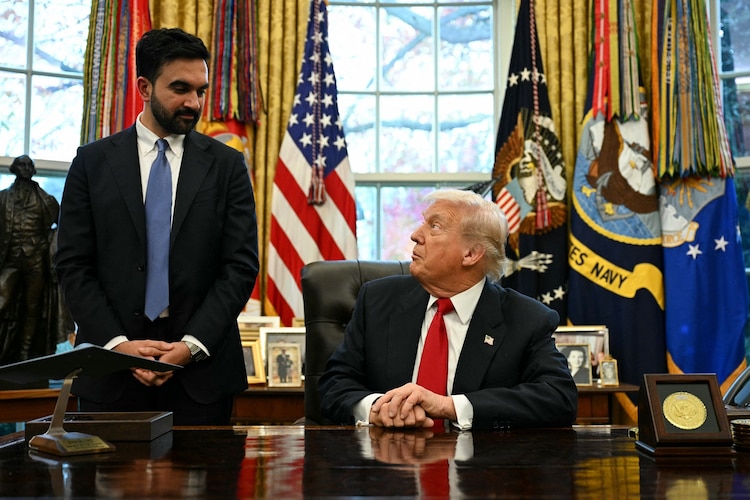
President Donald Trump meets with New York Mayor-elect Zohran Mamdani in the Oval Office at the White House in Washington, November 21, 2025. IMAGE/Jim Watson/AFP via Getty Images/ABC News
Mamdani, Trump, and socialist strategy
It was the most anticipated meeting at
the White House since Donald Trump’s confrontation with Ukrainian
President Volodymyr Zelensky. Would Trump dress down and insult New York
City Mayor Elect Zohran Mamdani? Would Mamdani give as good as got and
humiliate Trump as effectively as he did Andrew Cuomo in their Mayoral
debates?
But it was neither a battle royale nor a celebrity death match. It
was a surreal, chummy meeting where the two embraced over their
supposedly shared agenda of addressing the U.S. capitalism’s spiraling affordability crisis. The surprisingly affable nature of the meeting evoked a wide range of responses, from praise for Mamdani’s tactic of preemptively disarming Trump to condemnation of the Mayor Elect as a sellout.
In reality, Mamdani’s decision to avoid conflict and Trump’s embrace
of the affordability agenda are both born out of a shared political
weakness that drove them toward accommodating one another. Even worse,
in the aftermath of their meeting, Mamdani, despite reaffirming his
denunciation of Trump as a despot and fascist, persisted in saying
he would work with Trump to make New York more affordable. But this
friendly state of affairs will only be temporary; the knives will
inevitably come out. To prepare for the confrontation, we must double
down on building mass class and social struggle to win the demands and
secure the rhetorical promises of Mamdani’s campaign and defend
ourselves against the Trump regime.
Boxed in office
First, we must grasp the reasons behind Mamdani’s non-confrontational
approach to the meeting. Remember, he is in a weak position. He won
just over 50 percent of the vote, squeaking out a narrow victory against
two far-right candidates, Cuomo (supported by Trump!) and Sliwa, who
amassed together almost 49 percent of the vote.
Moreover, his office, while seemingly powerful, is dependent on the
City Council, the state government controlled by Kathy Hochul and the
Democratic Party establishment, and the federal government imperiously
wielded by Trump against any and all enemies real and perceived. And,
beyond these political obstacles, Mamdani’s ability to deliver anything
from his office in the capitalist state depends on the growth and
profitability of corporations, especially finance capital whose
international headquarters is in New York, for tax revenue to fund
reform.
Despite his nods to popular struggle, Mamdani is a reformist. He
believes that holding office is the route to delivering social change.
Given this, he has little room to maneuver and therefore every reason to
cut deals in the hopes of ingratiating himself to the real power
brokers in the state and capitalist economy so that they will let him
enact reforms. That explains why he has met with the Democratic Party
establishment, sought their endorsement, attempted to defang the
opposition of the real estate bosses by meeting with them, and even reappointed the dreaded billionaire police commissioner Jessica Tisch.
All of this also explains why Mamdani (like AOC) has chosen to oppose
the primary challenge by a fellow DSA member, Chi Ossé, to dethrone
neoliberal Zionist and House Minority Leader Hakeem Jeffries. Mamdani
went further, telling NBC
that he wants Jeffries to remain the Democratic Leader and become the
Speaker if Democrats retake the House. The logic of reformism,
especially without mass class struggle from below, is one of adaptation
to the capitalist class and its politicians, at best delivering
milquetoast liberal reform and at worst simply managing the existing
system (remember Francois Mitterrand, the “Red Margaret Thatcher?”).
Diplomacy not confrontation
Mamdani’s objective weaknesses and his reformist strategy shaped his
tactical approach to the meeting with Trump. He abandoned any pretense
of confrontation with the head of a regime that is carrying out a
bigoted class war at home. Trump has abolished the union rights of over a
million government workers and is carrying out state terror against
migrants and transactional, unilateral imperialism abroad—from murderous
gunboat diplomacy in Latin America to imposing imperialist “peace
deals” in Palestine and Ukraine that reward Israel and Russia as
colonial aggressors. Mamdani raised none of this. Out the window went
turning up the volume to denounce Trump as a despot, fascist, and
genocidal war criminal.
Instead, Mamdani stuck like a broken record on appealing to Trump to
join him in a partnership for affordability. He was intent on charming
and, in his own mind, disarming Trump in the hopes of seducing him to
sustain the flow of federal dollars into New York City’s coffers. Now,
many of Mamdani’s advisers will argue that he’s playing three- or
four-dimensional chess and can outfox Trump. Such arguments justify
reformism’s logic of accommodation, not resistance, to someone that they readily and openly call a fascist.
Only . . . mass struggle can win reform, not glad-handing a monster in the White House.
This strategy will not work to stop Trump. He’s already waging war on
New York. ICE is sweeping up people in the city, those dependent on
Obamacare are about to lose their subsidies, Medicaid cuts are ravaging
the working class, trans people are under federal siege, and on and on.
And if, under pressure from below, Mamdani does stand up on any of these
issues of class exploitation and social oppression, Trump will come
down on the city and its people like a ton of bricks. This may happen
anyway.
The high price of accommodation
Thus, the strategy of reformist accommodation comes at a high cost to
workers and the oppressed. We can already see it happening. In the
meeting, Mamdani underscored his commitment to keeping the police
commissioner and her gestapo of 35,000 officers that enforce the brutal
racist class inequalities of NYC. He didn’t blink an eye when Trump said
they shared a tough on crime agenda. This is just one of many
high-priced concessions to come, unless workers and the oppressed fight
for the campaign’s demands and the fulfillment of its rhetorical
promises.