
THE TRICONTINENTAL
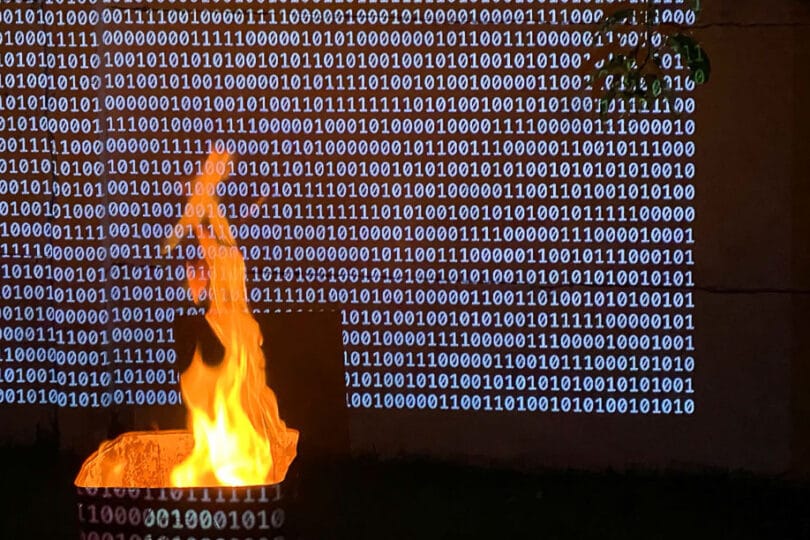
A data ‘cloud’ sounds like an ethereal, magical place. It is, in reality, anything but that. The images in this dossier aim to visualise the materiality of the digital world we live in. A cloud is projected onto a chipboard. A vegetable is represented by a genetically modified patent. A cryptocurrency is ‘mined’ not by digging into the earth’s crust, but through energy-consuming computing processes. A GPS coordinate is mapped alongside the footsteps of soldiers. A piece of code is shown as a smoke screen of ones and zeroes. Together they remind us that technology is not neutral but serves the interests of those who wield control over it. Technology is, therefore, a part of class struggle.
‘The challenge of modernity is to live without illusions and without becoming disillusioned’
– Antonio Gramsci
The question of ‘new digital technologies’ presents itself as a challenge, one whose importance is growing in debates within popular movements. Not only is there unequal access to technology; there is also a permanent concern over the use of data for the purposes of repression, control, consumerism, and surveillance. Coupled with this is the fact that the largest corporations today are information technology firms, which makes the question of new digital technologies essential to understanding the dynamics of contemporary capitalism. The effort to understand these concerns can be seen in the proliferation of related terms and concepts: digital economy, digital capitalism, platform capitalism, techno-feudalism, data capitalism, and surveillance capitalism, among others. Though there is still no agreed upon understanding about these phenomena, the challenge for those who dare to change the world is to construct a collective and objective analysis about the role of digital data and technology companies in contemporary capitalism.
With that in mind, our 46th dossier, Big Tech and the Current Challenges Facing the Class Struggle, is a product of the Seminar on Digital Technology and Class Struggle, a Landless Workers’ Movement (MST) project that sought to analyse these transformations in contemporary capitalism and their implications for how to organise our struggles, seeking to dig deeper than questions of digital security or competing narratives on social media.1 This process of building knowledge mainly sought to initiate a debate and to study questions related to digital technology and class g for our movements. We sought to gather different perspectives on this issue and reflect on them in order to build a common understanding, starting not only from the analyses of researcher and expert, but also from the knowledge base of other organisations dedicated to studying digital technologies.
The following reflection is the result of this collective process of building provisional knowledge. The aim here is to understand technological transformations and their social consequences with an eye towards class struggle. It is beyond the scope of this study to provide an exhaustive discussion or conclusion on these themes. Rather, it is a first attempt at understanding issues we believe to be fundamental to social organisation today, drawing upon a broad range of works analysing how these technologies work as part of the dynamic of capital accumulation.
Technology and Capitalism
Within capitalist society, technology appears as an exceptional tool to transform the way we produce, distribute, and consume goods. Technology is not neutral, nor is it divorced from social structures; rather, it acts upon a world built by human labour which–in a capitalist society–is centred on the accumulation of profit by the propertied. The dominant ideology would have us believe that the development of technology and science occurs in a cumulative and inexorable fashion, that the advent of capitalism remains the pinnacle of this process, and that humanity has arrived at a system that produces everything in the best and most efficient way, making everything that came before it–and everything that still resists integration into it–irrelevant. This narrative obscures the fact that technologies are the products of labour, of social relations and dynamics in specific historical and cultural contexts.
Monthly Review Online for more