
by KIM STERELNY
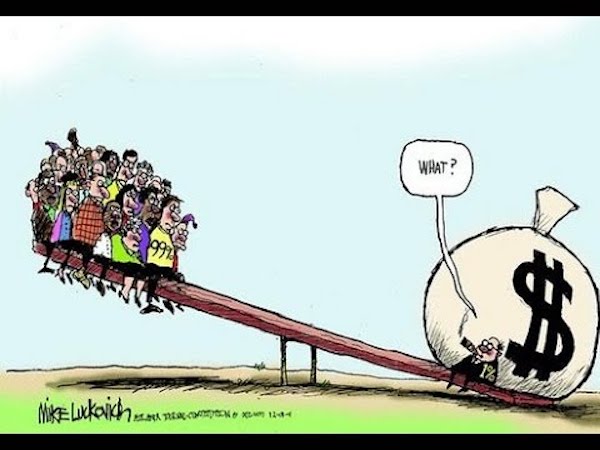
For 97 per cent of human history, all people had about the same power and access to goods. How did inequality ratchet up?
Most of us live in social worlds that are profoundly unequal, where small elites have vastly more power and wealth than everyone else. Very few of the have-nots find this congenial. As experimental economists have shown, we tend to enter social situations prepared to take a chance and cooperate in collective activities. But if others take more than their share, we resent being played for a sucker. We live in unequal worlds, and few of us are unaware of, or indifferent to, that fact.
Since the elites are massively outnumbered, the origins and stability of unequal divisions of the cake are puzzling, especially once we realise that this is a very recent aspect of our social existence. Our particular species of humans has been around for about 300,000 years and, best as we can tell, for about 290,000 of those years we lived materially poorer but much more equal lives. For most of our life as a species, most communities lived as mobile foragers, shifting camps when local resources became scarce, but probably sticking to a regular pattern over a defined territory.
Mobile foragers live in small bands (tens, not hundreds), but with connections of kith and kin to neighbouring bands, in social worlds of a few hundred to a few thousand. In many respects, these forager cultures are varied. They have differing cultural traditions and face different environments. The Australian Western Desert and the High Arctic could hardly be less alike, and both differ sharply from the rainforests of the Congo basin. Even so, in crucial ways, their social lives are remarkably similar. They sometimes have elders or initiates, but they have no chiefs. No-one has command authority over other adult males. Relations between the sexes vary but, in many forager cultures, women are indispensable, skilled, autonomous and essential props of the foraging economy. They gather plant foods and small game, and make much of the equipment of everyday life. They often have a good deal of social and sexual choice.
Aeon for more