
by PEPE ESCOBAR
Iran’s president-elect will ‘Look East’ while seeking to exit ‘strategic patience’ when dealing with the US
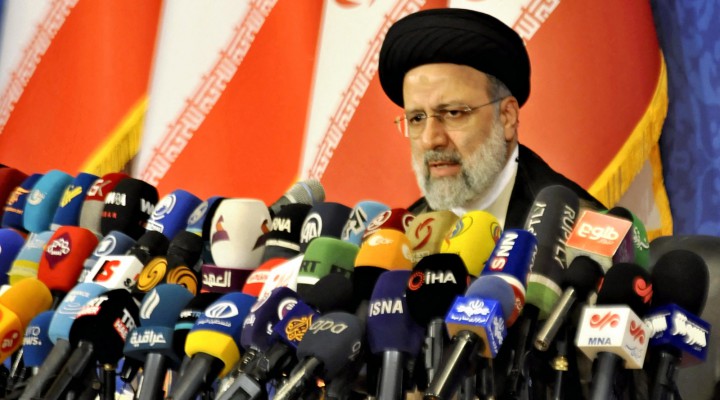
In his first press conference as President-Elect with 62% of the votes, Ebrahim Raeisi, facing a forest of microphones, came out swinging and leaving nothing to the imagination.
On the JCPOA, or Iran nuclear deal, the dossier that completely obsesses the West, Raeisi was clear:
– the US must immediately return to the JCPOA that Washington unilaterally violated, and lift all sanctions.
– The JCPOA negotiations in Vienna will proceed, but they do not condition anything in terms of Iran’s future.
– The Iranian ballistic missile program is absolutely non-negotiable in the framework of the JCPOA, and will not be curbed.
Asked by a Russian journalist whether he would meet President Biden if a deal was struck in Vienna and all sanctions lifted – a major “if” – Raeisi’s answer was a straight “No”.
It’s crucial to stress that Raeisi, in principle, favors the restoration of the JCPOA as its was signed in 2015 – following the guidelines of Leader Ayatollah Khamenei. But if the Vienna charade goes on forever and the Americans keep insisting on rewriting the deal towards other areas of Iranian national security, that’s a definitive red line.
Raeisi acknowledged the immense internal challenges he faces, in terms of putting the Iranian economy back on track, getting rid of the neoliberal drive of outgoing Team Rouhani, and fighting widespread corruption. The fact that election turnout was only 48.7%, compared to the average 70% in the prior three presidential contests will make it even more difficult.
Yet in foreign policy Iran’s path ahead is unmistakable, centered on the “Look East” strategy, which means closer cooperation with China and Russia, with Iran developing as a key node of Eurasian integration or, according to the Russian vision, the Greater Eurasia Partnership.
As Professor Mohammad Marandi of the University of Tehran told me “there’s going to be a tilt eastward and to the Global South. Iran will improve relations with China and Russia, also because of US pressure and sanctions. President-elect Raeisi will be better positioned to strengthen these ties than the outgoing administration.”
Marandi added, “Iran won’t intentionally hurt the nuclear deal if the Americans – and the Europeans – move towards full implementation. The Iranians will reciprocate. Neighbors and regional countries will also be a priority. So Iran will no longer be waiting for the West.”
Marandi also made a quite nuanced distinction that the current policy was “a major mistake” by Team Rouhani, yet “not the fault of Dr. Zarif or the Foreign Ministry, but the government as a whole.” That implies the Rouhani administration placed all its bets on the JCPOA and was completely unprepared for Trump’s “maximum pressure” offensive, which de facto decimated the reformist-minded Iranian middle class.
In a nutshell: in the Raeisi era, exit “strategic patience” when dealing with the US. Enter “active deterrence”.
A key node of BRI and EAEU
Raeisi was met by those who control the “international community” narrative with proverbially derisive and/or demonizing epithets: loyal to the “repressive machinery” of the Islamic Republic, “hardliner”, a violator of human rights, mass executioner, anti-Western fanatic, or simply “killer”. Amnesty International even called for him to be investigated as perpetrator of crimes against humanity.
Alt World for more