
by ARVIND DILAWAR
King explicitly linked the value of human dignity to the material conditions necessary to enable people to live a decent life.
“Racial domination and economic exploitation ought to be uprooted altogether.”
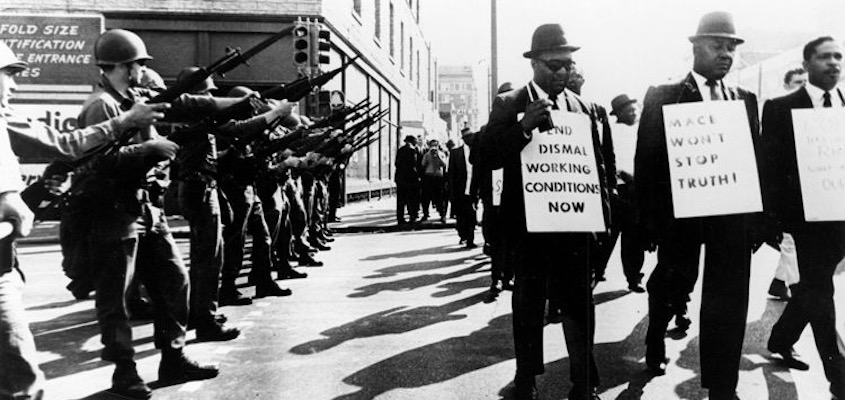
On April 4, 1968, Martin Luther King Jr was in Memphis, Tennessee, supporting a strike by municipal sanitation workers when he was shot and killed. While menial sanitation work was performed exclusively by African American men in Memphis, King’s support for the strike was about more than just race. A longtime student of progressive political scientists, sociologists, and economists, King saw Memphis as “a necessary stepping stone to Washington,” in the words of a colleague from the Southern Christian Leadership Conference, the organization he had founded to strengthen the civil rights movement.
In less than three weeks, multiracial caravans of poor people from all over the United States were set to converge on Washington, DC, to demand the federal government directly provide, or underwrite, universal access to the necessities of a dignified life, including work, housing, education, and health care. Following King’s assassination, the Poor People’s Campaign, as it was known, did occupy the National Mall and other strategic targets, such as federal agencies, for nearly two months. But in the end, the tenuous coalition of liberals and radicals that King had assembled could not hold up against state repression, including infiltration by the FBI.
The Poor People’s Campaign was ultimately cleared by tear gas and bulldozers, and its memory was relegated to an unfortunate afterword in the whitewashed history of the civil rights movement. Jacobin contributor Arvind Dilawar recently spoke with Sylvie Laurent, author of King and the Other America: The Poor People’s Campaign and the Quest for Economic Equality, about the so-called second phase of the civil rights movement, King’s radical views on issues like automation and universal basic income, and how the Poor People’s Campaign fit into King’s politics of collective liberation. Their conversation has been lightly edited for clarity and brevity.
Arvind Dilawar: Martin Luther King Jr’s Poor People’s Campaign is sometimes described as the “second phase” of the civil rights movement. Is that a fair characterization?
Sylvie Laurent: I am not completely on board with the “first versus second phase” framing of the civil rights movement. Not only does it obscure a long movement of black liberation, which has deep ties to unionism, Marxism, and socialism in the United States, but it feeds into a narrative whereby the first phase, aimed at formal equality and civil rights, was divorced from black American workers’ predicament.
King, the living metaphor of the movement, has been painted as having grown embittered and radicalized after 1966 (the so-called second phase), and his stronger commitment to critiquing capitalism has consequently been discounted. In fact, he was moving strategically. He had expressed deep concerns over economic exploitation, the ravages of capitalism, and the concentration of wealth since his early twenties. The civil-rights-centered agenda that dominated prior to 1964 had always been suffused with class-based and labor-related demands. But the legal protection of black lives and the reclaiming of black legal rights were a prerequisite to the broad restructuring of society necessary for the full emancipation of the worker and the poor.
Not only did King constantly point at the economic injustices that underpinned the racial inequality of America and support progressive labor unions, but he frequently drew analogies between the poverty-stricken white man who lost his job to the black exploited worker. Uniting the poor for the purpose of universal emancipation had been on his mind all along.
“The legal protection of black lives and the reclaiming of black legal rights were a prerequisite to the broad restructuring of society necessary for the full emancipation of the worker and the poor.”
Black Agenda Report for more