
by KAVITA SINGH
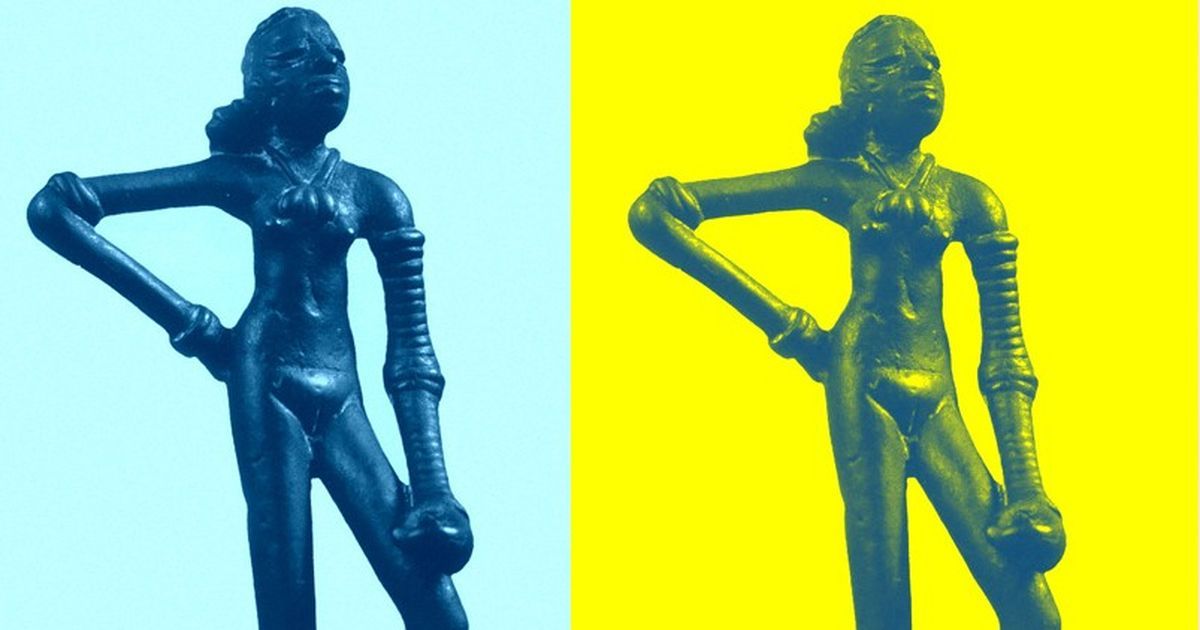
A reading of the essay shows that almost the entire piece is filled with wild conjectures to show that the Indus and Vedic civilisations were linked.
A paper published in the latest issue of Itihaas, the Hindi journal of the Indian Council for Historical Research, created a minor controversy last week. In the paper, according to media reports, retired Banaras Hindu University Professor Thakur Prasad Verma had claimed that the famous “Dancing Girl” bronze figurine found at Mohenjo-daro is actually an image of Hindu Goddess Parvati.
Verma offers this interpretation in a piece titled “Vaidik Sabhyata ka Puratattva, or Archaeology of the Vedic Civilisation. Upon reading the 36-page essay, I’m surprised that only his comments on the “Dancing Girl” were considered newsworthy – four pages devoted to this figurine are far from being the most outlandish ones in the paper.
Practically every page of the paper is filled with wild conjectures, feeble evidence, faulty argumentation, circular reasoning, disdain for chronology or scientific method, literal acceptance of mythical texts, scurrilous but unsubstantiated attacks on other historians and convictions based on prior beliefs. The essay is worth reading in its entirety because it demonstrates why most scholars hold Hindutva-style history in such poor regard.
Hasty derivations
The main arguments the author makes are as follows:
- The Harappan civilisation is old. The Puranas should be used to understand the Harappan civilisation and they speak of a history that is crores of years old. Thus, the Harrapan civilisation is crores of years old and is the civilisation spoken of in the Puranas.
- Western archaeologists and scientists who studied the Harappan civilisation hid the truth about its great antiquity as that would have shown western history as being shallow and brief, demonstrating the West’s inferiority to India.
- Scholars who say that deciphering the Harappan script is key to understanding the civilisation are part of a conspiracy to prevent anyone from conclusively saying it was a Vedic civilisation.
- Western scholars say the Harappan civilisation lasted only 700 years, from 2600 BCE to 1900 BCE. To imagine such a great civilisation rose, flourished and fell in such a short span shows their intellectual bankruptcy.
- The civilisation was confined to the western part of the subcontinent and did not spread eastward to the banks of the Ganga because the area that is now eastern India was at that time a sea. We know this because the Nadi Sukta hymn of the Rigveda describes the Ganga as a small river that leaves the mountains and immediately enters the sea. The sea must have been close to the mountain where the Ganga originated at the time. This proves that the areas that are now Bengal, Bihar and Uttar Pradesh (states through which the river today flows) were then under water.
- Since the Rigveda’s description of the Ganga explains why the Harappan civilisation did not spread very far eastward, it proves that the Harappan civilisation was the Vedic civilisation.
- The Rigveda also tells us that the Satluj and the Beas flowed into the sea. Today, they are tributaries of the Indus. They must have run a different course in the Vedic-Harappan times.
Scroll for more