
by ABHEET SINGH SETHI
 Indian Nuclear Forces, 2015 SOURCE/Bulletin of Atomic Scientists
 Indian Nuclear Forces, 2015 SOURCE/Bulletin of Atomic Scientists
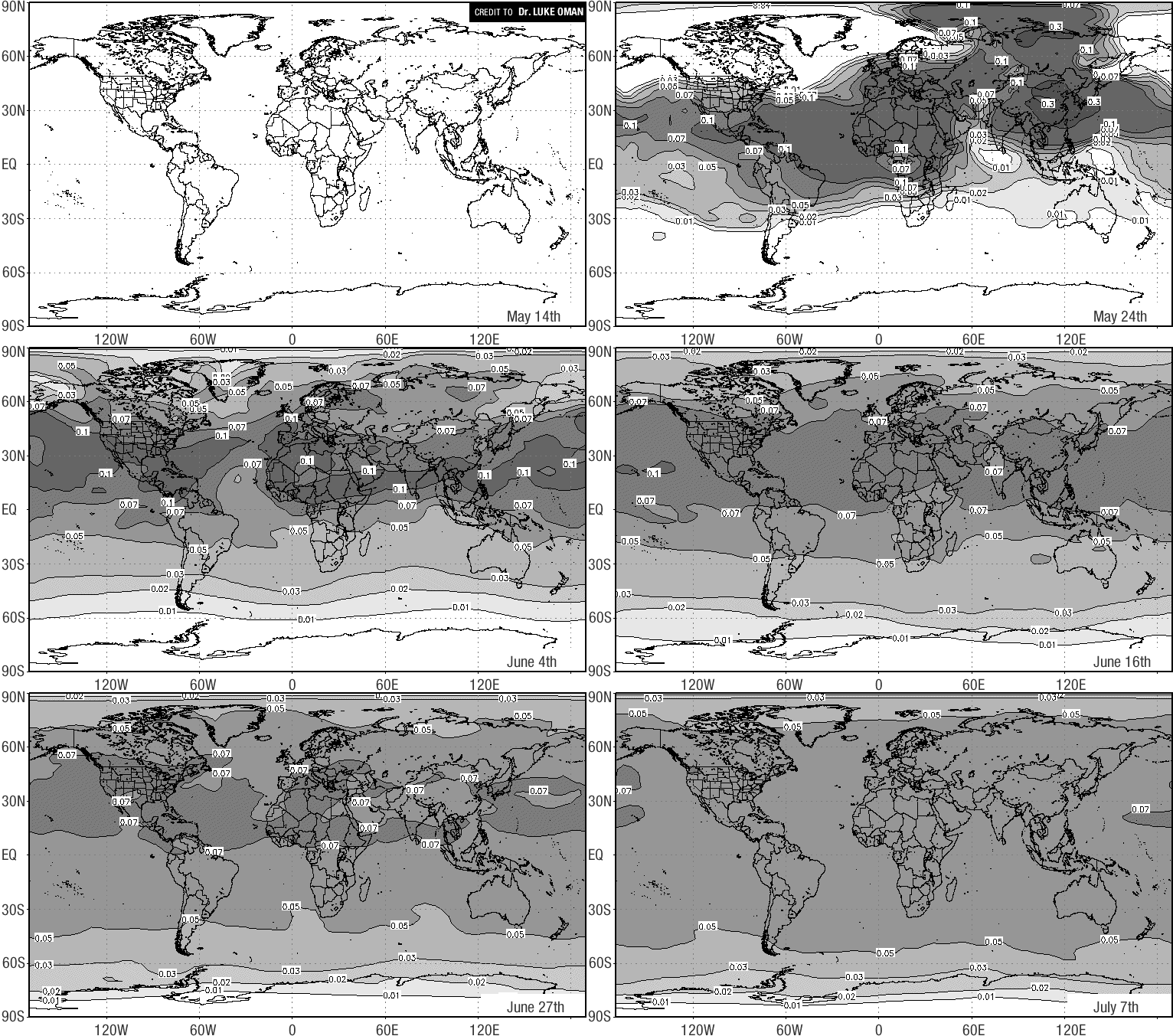
If India and Pakistan fought a war detonating 100 nuclear warheads (around half of their combined arsenal), each equivalent to a 15-kiloton Hiroshima bomb, more than 21 million people will be directly killed, about half the world’s protective ozone layer would be destroyed, and a “nuclear winter” would cripple the monsoons and agriculture worldwide.
As the Indian Army reports striking terrorist camps across the border, and a member of Parliament (MP) of the ruling Bharatiya Janata Party (BJP) urges a nuclear attack and the Pakistan defence minister threatens to “annihilate” India in return, these projections, made by researchers from three US universities in 2007, are a reminder of the costs of nuclear war.
Click here to see the projections
BJP Rajya Sabha MP Subramanian Swamy said, on 23 September, 2016, that if 100 million Indians died in a Pakistani nuclear attack, India’s retaliation would wipe out Pakistan.
But the real costs would be higher and not just in India and Pakistan, where the first 21 million people–half the death toll of World War II–would perish within the first week from blast effects, burns and acute radiation, according to the 2007 study by researchers from Rutgers University, University of Colorado-Boulder and University of California, Los Angeles, all in the USA.
This death toll would be 2,221 times the number of civilians and security forces killed by terrorists in India over nine years to 2015, according to an IndiaSpend analysis of South Asia Terrorism Portal data.
Another two billion people worldwide would face risks of severe starvation due to the climatic effects of the nuclear-weapon use in the subcontinent, according to this 2013 assessment by the International Physicians for the Prevention of Nuclear War, a global federation of physicians.
Pakistan has an estimated 110 to 130 nuclear warheads as of 2015–an increase from an estimated 90 to 110 warheads in 2011–according to this report from the Bulletin of the Atomic Scientists, a global disarmament advocacy. India is estimated to have 110 to 120 nuclear warheads.
Talk of war began after a terrorist attack on an army garrison in the Kashmir town of Uri claimed the lives of 18 Indian soldiers. The Indian Army said the attack was carried out by four terrorists from the Jaish-e-Mohammed (Army of Mohammed) group, based in Pakistan.
Pakistan’s defence minister Khawaja M Asif responded to threats from India by saying, “If Pakistan’s security is threatened, we will not hesitate in using tactical (nuclear) weapons.”
Pakistan’s nuclear weapons capability has previously deterred India from responding to previous attacks.
“At the end of the day, India has to ensure that the options it exercises–particularly the military ones–do not leave it worse off than before in terms of casualties and costs,” wrote analyst Manoj Joshi in The Wire.
It does not really matter if India has fewer nuclear weapons than Pakistan, IndiaSpend reported in April, 2015, primarily because of the doctrine of “mutually assured destruction”, or MAD, as it is commonly known (See this IndiaSpend report for more about India’s nuclear weapons program).
Hindustan Times for more