
by THOMAS NAGEL
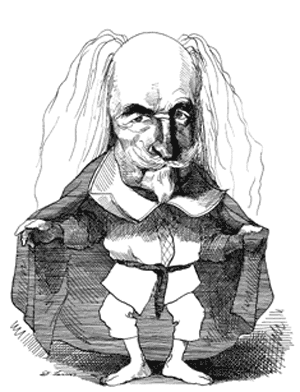 Thomas Hobbes DRAWING/David Levine
The Dream of Enlightenment: The Rise of Modern Philosophy by Anthony Gottlieb Liveright, 293 pp., $28.95
It is fascinating to learn about the concrete historical circumstances under which great philosophical works—works that have become timeless classics—were produced, and about the relation to their own times of the extraordinary individuals who produced them. For those with limited firsthand knowledge of the works this biographical approach can serve as an accessible introduction or reintroduction to the thought of some of the most important creators of our intellectual world. Anthony Gottlieb, a former executive editor of The Economist who is not a philosopher but a philosophical fellow traveler, is writing just such a history of the entire course of Western philosophy. The first volume, The Dream of Reason (2000),* took the story from ancient Greece to the Renaissance. The second volume, The Dream of Enlightenment, ends in the eighteenth century; a third volume will take us from Kant to the present day.
Gottlieb concentrates most of his discussion on six philosophers of the seventeenth and eighteenth centuries whose stature and influence are especially great—Descartes, Hobbes, Spinoza, Locke, Leibniz, and Hume—along with shorter treatments of Bayle, Voltaire, and Rousseau, and brief comments on many other figures. Here is what he says at the outset:
It is because they still have something to say to us that we can easily get these philosophers wrong. It is tempting to think that they speak our language and live in our world. But to understand them properly, we must step back into their shoes. That is what this book tries to do.
Gottlieb exaggerates the intellectual distance of these figures from us: it isn’t that they speak our language, but that we speak their language, because our world has been significantly formed by them. And he does not always succeed in stepping back into their shoes, which in the case of a great philosopher means understanding his thoughts from the inside, as well as in relation to his historical milieu. Nevertheless Gottlieb’s biographical narrative is vivid and often illuminating. Most important, he emphasizes throughout that these men lived in a historical period dominated by dramatic developments and conflicts in three areas—science, religion, and politics—and that their thoughts and writings were dominated by the need to respond to those developments, and to understand the relations among them.
First, there was the scientific revolution, which introduced a new way of understanding the physical world through universal laws, mathematically formulated, that govern everything that happens in space and time. Although knowledge of those laws is based on observation and experiment, the reality they describe is not directly available to human perception, but can be known only by theoretical inference. Two of Gottlieb’s thinkers, Descartes and Leibniz, were major contributors to the mathematical sciences—Descartes through the creation of analytic geometry (hence the term “Cartesian coordinates”) and Leibniz through the invention of the calculus (which was created independently by Newton). Descartes also produced theories of mechanics, optics, and physiology, Leibniz made significant contributions to dynamics, and Spinoza worked in optics and conducted experiments in hydrodynamics and metallurgy. But all six grappled with the question of how the austere physical reality revealed by the new science is related to the familiar world that we perceive—and to our minds, in which both perception and scientific reasoning take place.
Second, after the Reformation and the terrible wars of religion it had become clear that the plurality of religious beliefs in Christendom was not going to disappear. This posed questions both about the grounds for religious belief and about how governments should choose between imposing a single orthodoxy and tolerating diversity. In addition, each of these philosophers had to be concerned about the relation of his own work to the religious orthodoxy of his community, and about the dangers of ostracism, repression, or persecution. Descartes was deterred by the condemnation of Galileo from publishing his cosmological theories, and Spinoza was excommunicated by the Jewish community of Amsterdam.
Third, the basis of legitimate political authority was coming seriously into question, with skepticism about the divine right of kings and support for the right of subjects to overthrow a ruler who abused his power. This was not just theoretical: it took concrete form in the English civil war that culminated with the execution of Charles I in 1649 and the Glorious Revolution that replaced James II with William of Orange in 1688. Hobbes, Spinoza, Locke, Hume, and Rousseau all produced theories of political authority starting from the subject’s rather than the ruler’s point of view.
The New York Review of Books for more