
by RYU SPAETH
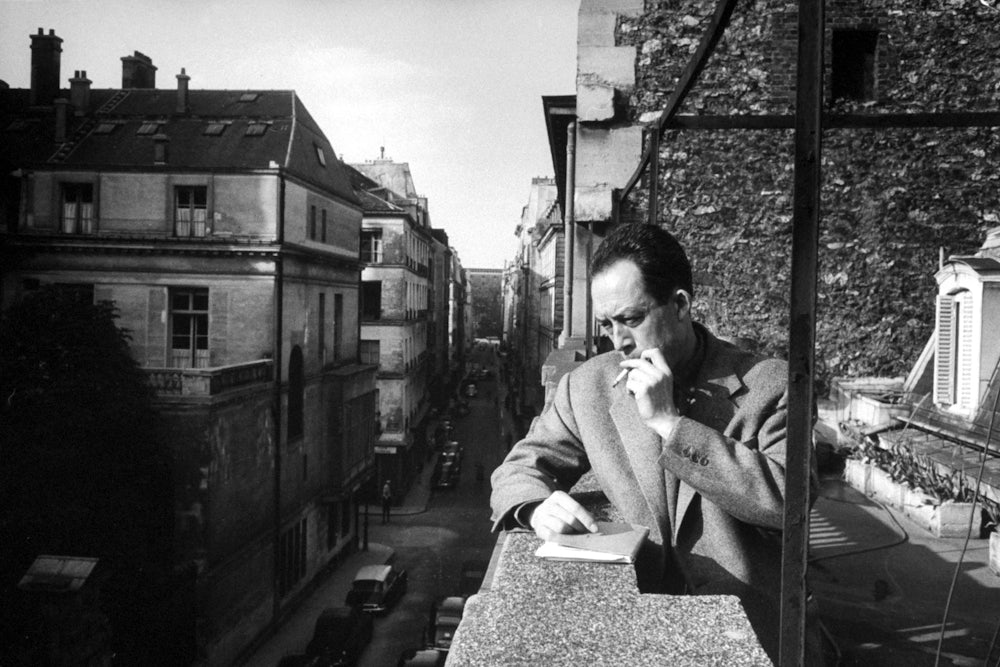 PHOTO/Loomis Dean/Getty Images
Since his death in a car accident on January 4, 1960, Albert Camus has led a kind of double-afterlife. In the West, he is not only remembered as one of the great writers of the post-war era, but as a hero of the resistance, a celebrity intellectual, and a style icon—“the Don Draper of existentialism,” as The New Yorker once put it. His best-known book, The Stranger, is a staple of high school curricula and virtual rite of passage for adolescents who may see something of themselves in Meursault, that avatar of sullen rebellion. But in Algeria, where he was born and raised—and in former European colonies in general—Camus cuts a different figure. At best, he is a compromised genius; at worst, an oppressor whose lionization has extended the colonial perspective well into the twenty-first century.
These two versions of Camus, like a superhero and his all-too-human alter ego, are rarely seen at the same time. Earlier this year, Camus was celebrated in a month-long retrospective in New York, commemorating his first visit to the United States. By the time of that trip, in 1946, all the components of Camus’s legend were in place. As the former editor of the underground newspaper Combat, he embodied the humanist response to Nazism. As an associate of Jean-Paul Sartre and the existentialists, he represented the new philosophical thinking emerging from the rubble of Europe. And, as a magnetic and sought-after public figure, he was seen as a man who, after years of war and unprecedented horror, could lead others to believe in life again.
But in the months before the retrospective, the Camus legend looked shakier than ever. The English-language publication of the Algerian writer Kamel Daoud’s The Meursault Investigation in the summer of 2015 occasioned a wholesale reassessment of Camus’s reputation in the mainstream press. Daoud’s novel, which is told from the perspective of the brother of the nameless Arab that Meursault kills in The Stranger, became an instant classic of post-colonial literature, rendering vividly Camus’s blind spots and latent biases. The Moroccan-American novelist Laila Lalami suggested that whereas The Stranger had erased Algerians, Daoud made the country “more than just a setting for existential questions posed by a French novelist.” The Guardian reported that Daoud’s novel had revived criticisms of Camus’s “inability to see violence through a non-white, non-colonial prism.”
Camus’s complex relationship with Algeria is one of the central themes of Alice Kaplan’s new book, Looking for “The Stranger,” which attempts to reconcile Camus’s dueling legacies. It is a historical account of how Camus’s novel came into being, starting with the famous opening sentence—“Today, Maman died”—scrawled in a notebook marked “22” in the fall of 1938 in Algiers. But, like the characters in Daoud’s book, Kaplan is also conducting an investigation. She searches for the creative origins of The Stranger in the strained relationship between Arabs and Europeans in Algiers’s lower-class neighborhoods of Belcourt, where Camus grew up, and Bab-el-Oued. And as her investigation deepens, she is drawn into the real-life story behind the unnamed Arab who, like Camus’s shadow, lives on as a silent rebuke to his creator.
The post-colonial critique of The Stranger has a long history. Lalami’s criticism echoes Edward Said’s assertion, in 1989, that the Arabs in The Stranger “are nameless beings used as background for the portentous metaphysics explored by Camus.” (Said, in turn, was echoing Chinua Achebe’s 1975 critique of Joseph Conrad’s Heart of Darkness: “Can nobody see the preposterous and perverse arrogance in thus reducing Africa to the role of props for the breakup of one petty European mind?”) Said’s essay was a cornerstone of post-colonial theory, whose influence in academia has changed the way we see scores of writers, from Conrad to Graham Greene to E.M. Forster. But doubts about Camus went back still further, and were rooted in his politics. Camus had opposed Algeria’s war for independence from French rule in the 1950s and ‘60s, and had instead proposed an Algerian federation in which Europeans, Arabs, and other groups lived in harmony. (Neither Arab freedom fighters nor French settlers liked this plan.) The French historian Pierre Nora wrote as early as 1961: “Meursault, in killing the Arab, represented the unconscious wish of the French in Algeria—keep the land and destroy the enemy.”
New Republic for more