
by NICHOLAS TAMPIO
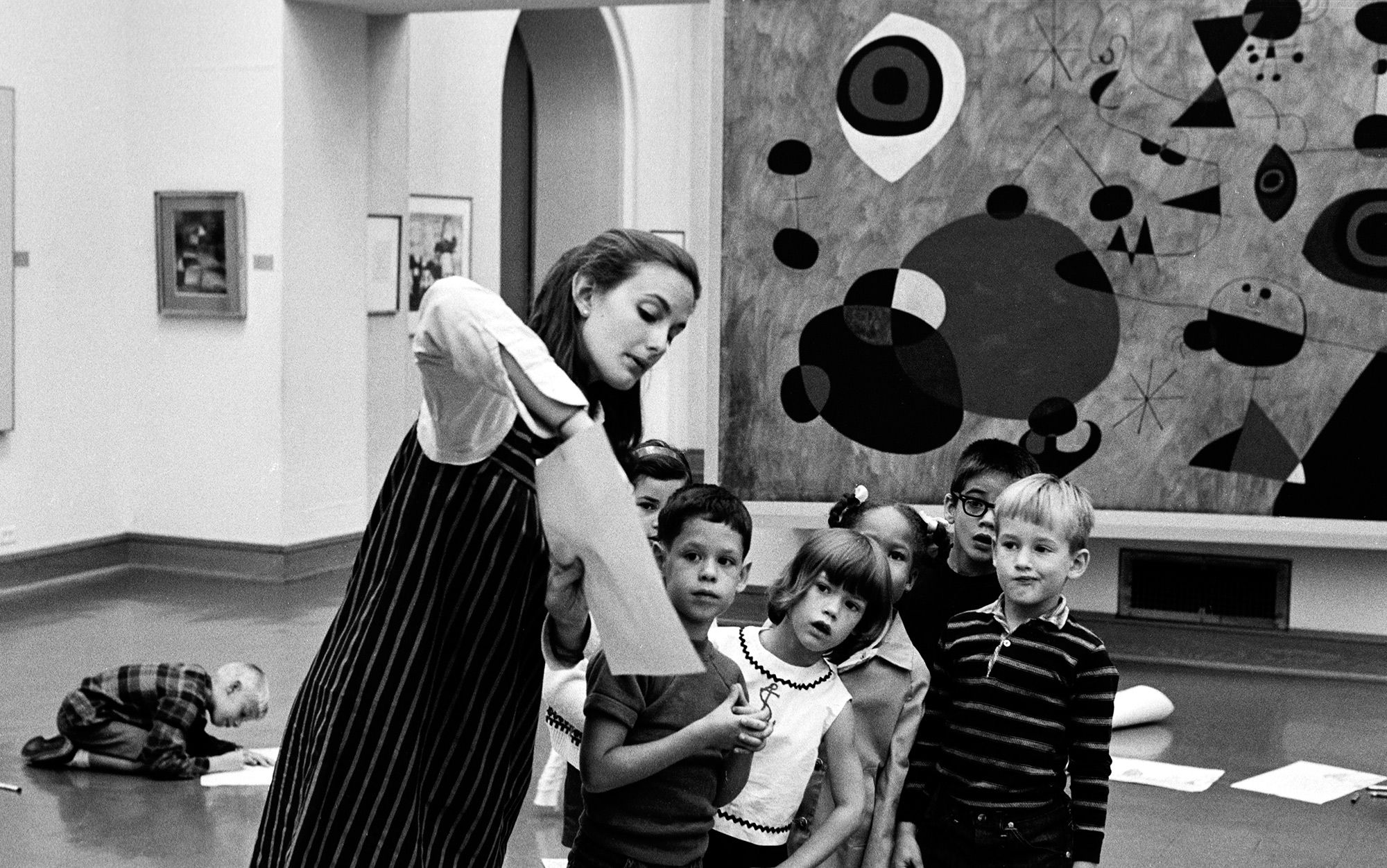 A class is held in fornt of a Miro painting at the Cincinnati Art Museum, Ohio, USA in 1968 PHOTO/David hurn/Magnum
Did you attend a public school in the United States and perform in a school play, take field trips, or compete on a sports team? Did you have a favourite teacher who designed their own curriculum, say, about the Civil War, or helped you find your particular passions and interests? Did you take classes that were not academic per se but that still opened your eyes to different aspects of human experience such as fixing cars? Did you do projects that required planning and creativity? If the answer to any of these questions is yes, then you are the beneficiary of John Dewey’s pedagogical revolution.
Dewey put forth the philosophy of education that would change the world in Democracy and Education, a book that turns 100 this year. Dewey’s influence is far-reaching, but his pedagogy has been under assault for at least a generation. The United States Department of Education report A Nation at Risk (1983) signalled the rise of the anti-Dewey front, under the somewhat misleading name of the ‘education reform’ movement. The report warns that other countries will soon surpass the US in wealth and power because ‘a rising tide of mediocrity’ engulfs schools in the US. The problem, according to the report, is that US education is ‘an often incoherent, outdated patchwork quilt’. The education reform movement aims to replace that ‘patchwork quilt’ – mostly made by local school boards, teachers and parents – with a more uniform system based on national standards.
The political right has often led the charge against Dewey’s legacy. In 1897, Dewey described his ‘pedagogic creed’ as ‘individualistic’ and ‘socialistic’ because it sees the need to nurture each child’s unique talents and interests in a supportive community. For both the business community and traditional-values conservatives, Dewey’s pedagogy fails to train workers, and inculcates liberal, even socialistic values. The US Chamber of Commerce and the Charles Koch-funded conservative think tank the Heartland Institute, to take just two examples, have tried to purge the US education system of its progressive elements. Similarly, in 2002, President George W Bush signed the No Child Left Behind act, an anti-Deweyan measure requiring states to implement test-based education reform.
The education reform movement has been successful, however, because many Democrats are also enthusiastic participants. In 1989, Bill Clinton, then governor of Arkansas, organised the education summit at the University of Virginia that began the process of formulating national education standards. The senator Ted Kennedy encouraged Democratic members of Congress to vote for No Child Left Behind. In 2009, the Barack Obama administration ran the Race to the Top competitive grant programme that incentivised states to adopt the Common Core standards in mathematics and English. The presidential candidate Hillary Clinton supports the Common Core and many other planks of education reform, as does her likely Secretary of Education Linda Darling-Hammond. Today, few Democrats with a national profile speak up for Dewey’s ideal of progressive education.
Aeon for more