
by KAMAL SIDDIQI & AZHAR JAMIL
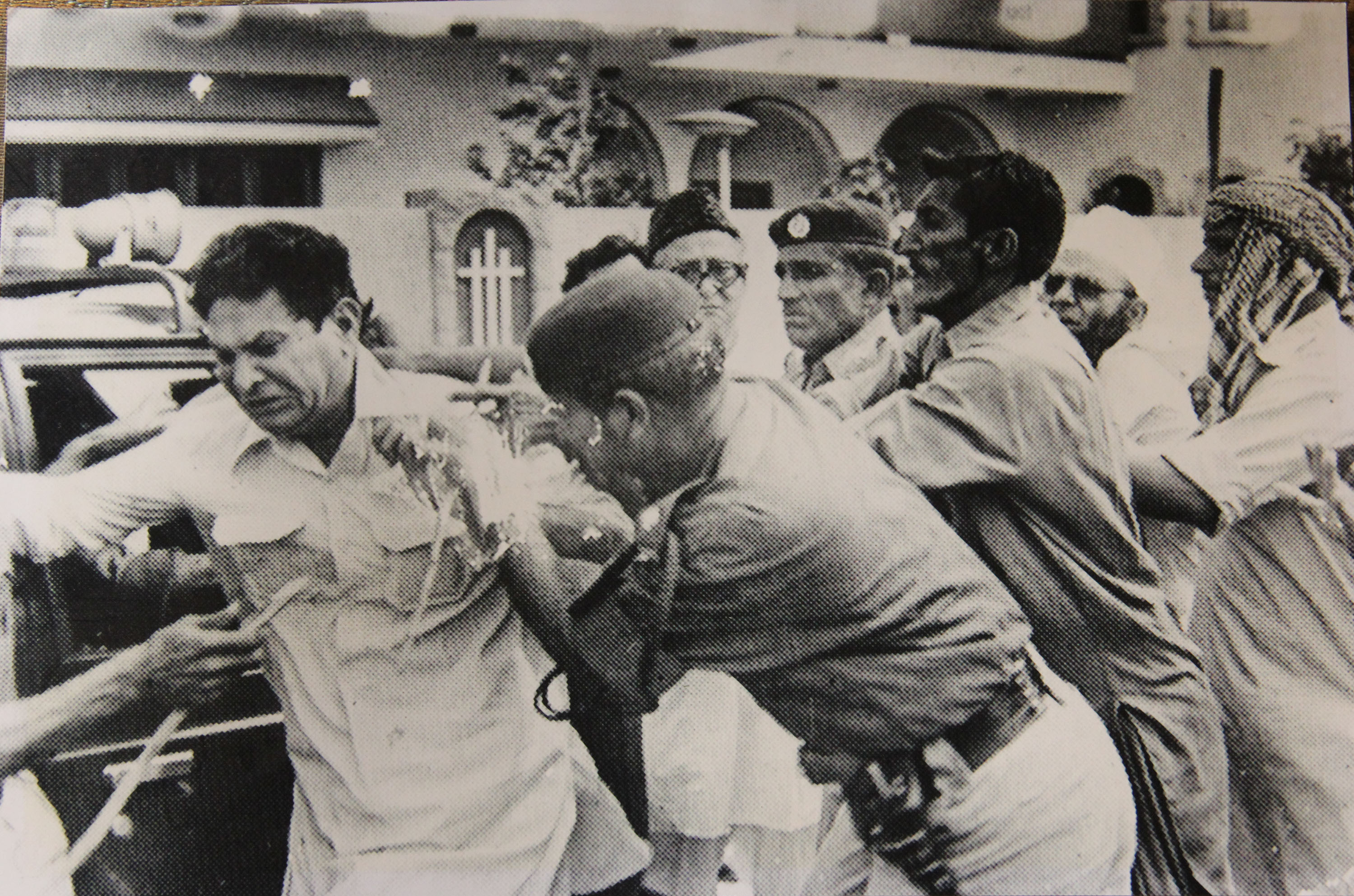 Police confronted Mairaj Muhammad Khan (1938-2016) while he was on his way to Sherbaz Khan Mazari’s house for a meeting of the MRD in 1983 PHOTO/M M Khan Collection
Mairaj Muhammad Khan has been an active participant in many of the important events that shaped our country in its formative years. He was a key player in the movement that led to the formation of the Pakistan Peoples Party (PPP), the movement against General Ayub Khan in 1968, which was sparked off by NSF-led students, as well as the movement for the restoration of democracy (MRD) against General Ziaul Haq from its formation in 1981 until it culminated in 1988.
He has been through it all; Ayub Khan, Yahya Khan, the dismemberment of Pakistan, the Bhutto years, General Zia and his dictatorship and the return to democracy in 2008. He was even associated with Imran Khan’s Pakistan Tehreek-e-Insaf for five years (1997 Dec to 2003 April) and left when his patience was completely exhausted. More than a politician, he now enjoys the position of an elder statesman.
Much of his wisdom comes from his experiences initially as a student leader and then as a mainstream politician. It also comes from his grassroots work amongst the labour classes of Pakistan as well as his socialist ideology.
This was a different Pakistan, then. Of East and West. And of student politics, where demonstrations on the streets of Karachi, then the capital city, could bring down the government.
There are lessons to be learnt, and incidents that have not been forgotten. Long gone have been the days when he left his house in PECHS, once the most happening locality for the middle and upper middle classes of Karachi. He now lives a sedate life in a comparatively dull and boring Defence Housing Authority with his son, who, ironically is a banker. This may not go down well with a socialist – “Not at all,” he replies “everyone to his own.”
…
Mairaj Muhammad Khan was jailed once again during the campaign and released in September 1965 when the Indo-Pak war broke out. The government that jailed him now requested Mairaj to address the people through Radio Pakistan as a show of national unity and to raise the country’s morale, which of course, he did. A few days later, when the students were speaking out against a ceasefire, Air Marshal Nur Khan (then commander-in-chief of the Air Force) met an NSF delegation led by Mairaj Muhammad Khan and said that though he highly valued the courageous spirit of the students, he requested them not to agitate against or oppose a possible ceasefire, as the country did not have the spares and necessary materials to continue the war much longer.
By 1966, there had been a falling out between Ayub and Bhutto, who was eased out of the cabinet but was given a tumultuous welcome by the NSF when his train arrived at the Karachi Cantonment station. Later in 1967, the NSF held a reception for Bhutto, who had earned much fame by his emotional and nationalistic speech at the UN during the 1965 war in which he said “…..we shall fight for a thousand years” (this had appealed to a large section of the country, especially the youth) and by subsequently distancing himself from the unpopular Tashkent Declaration with India in January 1966. At the reception, Bhutto spoke about socialism as the need of the hour, which was well received by the NSF students who were basically progressive, secular and anti-imperialist.
For Bhutto, the NSF became his initial group of supporters. This turn of events brought Mairaj Muhammad Khan close to him and it was then that the formation of the Pakistan Peoples Party came into being. The PPP, says Mairaj Muhammad Khan, owes its creation to the NSF.
It was at Mairaj’s one-bedroom PECHS house and 70 Clifton Karachi that dialogue started with Bhutto. This led to the inclusion of J.A. Rahim and talk of slogans and a party manifesto. The party’s founder members as announced by Bhutto at a public meeting in Lyari included J.A. Rahim, Mairaj Muhammad Khan, Rasool Bux Talpur, Dr Mubashir Hasan, Hayat Muhammad Khan Sherpao and Haq Nawaz Gandapur, although there were a host of other stalwarts as well who joined soon after.
Express Tribune for more