
by BARBARA NIMRI AZIZ
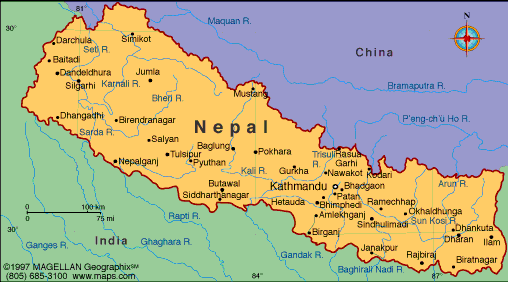 MAP/Info Please
I was crossing the airstrip to a small aircraft that would take me to Nepal’s interior. We had left the disarray of the departure hall in Kathmandu airport with its melee of early morning hopefuls anxious to escape the polluted city and fly to a trailhead in search of fresh mountain streams and clean air. Planes are in short supply here and cancellations of domestic flights are common. Although those waiting foreigners seemed remarkably patient with the delays, perhaps attributing the disorder to high altitude. Politics wouldn’t figure into any charming anecdote sent from their holidays in the Himalayas. Neither was I thinking about Nepal’s political troubles at that moment. Not until my colleague directed my attention to a medium sized plane parked on the edge of the tarmac.
“That Turbo Prop M16 is Chinese-made; it was bought by Nepal. Another of the same model, a gift, is expected: two-for-the-price-of-one, you can say.” Nepal could use more aircraft, with not infrequent crashes and regular over-bookings on domestic flights. As for the undelivered Chinese turbo prop, “It’s being held up”, my companion replied. He exhibited the lighthearted cynicism that Nepalese now apply to all public announcements, especially when officials are involved.
I recalled seeing a recent front page article where a minister announced that irregularities in the registration of a Chinese aircraft would delay its arrival. “Too much aid from China is not welcome.” Was this another case of India blocking Nepal’s economic exchanges with China?
“Maybe. Or maybe Boeing, American. Or Airbus. Europeans and Americans may be unhappy with China’s overtures in Nepal. India too; Delhi influences everything that happens here.”
India and Nepal are bound together in a myriad of ways with India being the overwhelmingly dominant partner. Nepalese were painfully reminded of this when India supported a severe and sustained economic blockade on its land-locked northern neighbor. With Nepal’s dependence on India for heating fuel and petrol for transport— two of many essential commodities ranging from paper and wood to rice and fruit, also manufactured items and packaged/processed food and beverages—life across much of Nepal came to a halt. It was the heating gas and transport fuel embargo that caused unprecedented hardships in population centers, especially the capital. It left people embittered and reassessing their relation with India.
The boycott was launched by the Mahdesi people, unhappy at what they considered marginalization, when last July after years of delays, Nepal’s new constitution was signed. Mahdesi-Nepalese, inhabiting a wide belt of land along their shared border, maintain close ties with India. They decided to utilize this strategic position to express their discontent with the constitution and press for better representation; thus the blockade of goods (from India) entering Nepal through their region.
That internal Nepal crisis took on greater significance when the Indian government was seen as reinforcing Mahdesi demands. Indeed India instructed Nepal to amend its constitution in line with Mahdesi requests. Nepal’s leaders were neither able to secure India’s co-operation nor to negotiate a solution with the steadfast Mahdesi.
As the blockade wore on (lasting for seven months, including winter, although it began to ease somewhat earlier) Nepalese began to seek an alternative. Not easy, since its northern border cuts through the almost impenetrable Himalayan mountain range. Tibet to the north is vast and undeveloped but is nevertheless Nepal’s best access to China. It would be years before a viable route through there could bring essentials like fuel on the scale needed. Although during the blockade China began sending limited supplies to its stricken neighbor.
Counterpunch for more