
INDIAN CULTURAL FORUM
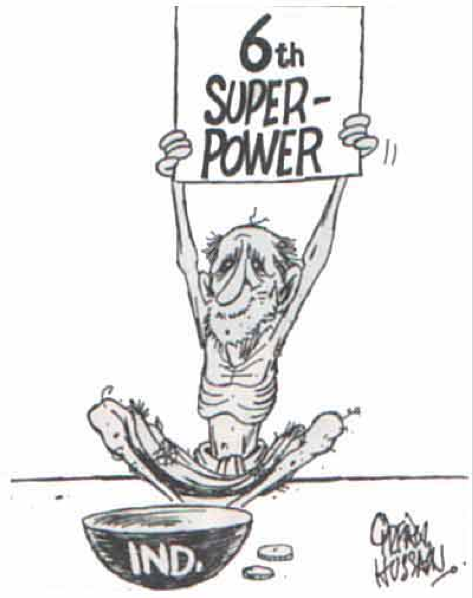 A cartoon after the 1998 Pokhran nuclear tests CARTOON/Irfan Hussain/ Outlook
Do our free speech laws not allow us to be critical of the country or the government? At what point can we say the line has been crossed from an exercise of free speech to sedition?
Article 19(1)(a) of the constitution of India which guarantees the right to free speech and expression absolutely allows for criticism of the government.
In the Kedarnath case [Kedarnath Singh vs State of Bihar, 1962 AIR 955], where the Supreme court examined the constitutional validity of Sec 124A, the court had an opportunity to consider the scope of subversive speech. Given that the word sedition by itself does not appear in Article 19(2) or in the reasonable restrictions provision, the court could uphold 124A only if it was brought within the ambit of ‘public order’.
The court, after examining the conflict in standards in colonial-era decisions (between ‘bad feelings’ and ‘bad tendency’) observed that since sedition was not included in Article 19(2), it implied that a more liberal understanding was needed in the context of a democracy. They made a clear distinction between strong criticism of the government and those words which excite with the inclination to cause public disorder and violence. They also distinguished between ‘the Government established by law’ and ‘persons for the time being engaged in carrying on the administration’.
The court then held that ‘strong words used to express disapprobation of the measures of Government with a view to their improvement or alteration by lawful means’ would not come within the section. Similarly, ‘comments, however strongly worded, expressing disapprobation of actions of the Government, without exciting those feelings which generate the inclination to cause public disorder by acts of violence, would not be penal’. They argued that what is forbidden are ‘words, written or spoken, etc. which have the pernicious tendency or intention of creating public disorder or disturbance of law and order’.
This has been further clarified in the Rangarajan case [S. Rangarajan vs. P. Jagjivan Ram, 1989 SCC (2) 574], which lays down the one of the most significant tests after Lohia [The Superintendent, Central Prison, Fatehgarh vs. Ram Manohar Lohia, 1960 AIR 633] and Kedarnath—namely the analogy of a ‘spark in a powder keg’. In a crucial paragraph in Rangarajan, the court explicitly held that while there has to be a balance between free speech and restrictions for special interest, the two cannot be balanced as though they were of equal weight.
One can infer that the courts are making it clear that exceptions have to be construed precisely as deviations from the norm; that free speech should prevail except in exceptional circumstances. And what is it that the court considers an exceptional circumstance?
Our commitment to freedom of expression demands that it cannot be suppressed unless the situations created by allowing the freedom are pressing and the community interest is endangered. The anticipated danger should not be remote, conjectural or far-fetched. It should have proximate and direct nexus with the expression. The expression of thought should be intrinsically dangerous to the public interest. In other words, the expression should be inseparably locked up with the action contemplated like the equivalent of a “spark in a powder keg”.
The court in this paragraph lays down in no uncertain terms the standard that has to be met in alleging a relation between speech and effect. The analogy of a spark in a powder keg brings in a temporal dimension of immediacy: the speech should be immediately dangerous to public interest. In other words, it must have the force of a perlocutionary speech act, in which there is no temporal disjuncture between word and effect. A cumulative reading of the cases on public order and sedition suggests that as far as subversive speech targeted at the state is concerned, one can infer that even if there is no absolute consistency on the doctrinal tests, there is a consistency in the outer frame, namely that democracy demands the satisfaction of high standards of speech and effect if speech is to be curtailed.
Indian Cultural Forum for more
via News Click