
by GEORGE YGARZA
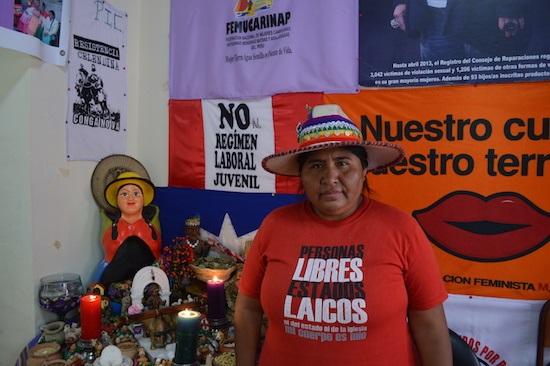 Lourdes Huanca Atencio, president of FENMUCARINAP PHOTO/George Ygarza
An interview with Lourdes Huanca of the National Federation of Female Peasants, Artisans, Indigenous, Native and Salaried Workers of Peru (FENMUCARINAP)
During the Fujimori regime, the progressive left was decimated. Dissidents were quickly branded as terrorists and silenced through defamation, marginalization or disappearances. But far from being frozen in the past, the Peruvian left remained alive in the periphery as clandestine student groups, indigenous people and women continued to organize. Following the downfall of Fujimori, these groups took to the streets never to lose them again. One of the first post-Fujimori organizations to emerge was FENMUCARINAP, the National Federation of Female Peasants, Artisans, Indigenous, Native and Salaried Workers of Peru.
The rise of FENMUCARINAP along with that of Keiko Fujimori, the daughter of former dictator Alberto Fujimori who is leading the polls exemplifies the paradoxes of Peruvian society. While Keiko Fujimori is prominently portrayed throughout mainstream media, an appropriate counterbalance would be to hear from the daughters and sisters who escaped that forced sterilization program her father forced on thousands of Peruvian women. Behind the prospect of Peru’s first female president lies a dark legacy of Fujimorismo defined by its authoritarianism, neoliberalism and reactionary policies. I reached out to FENMUCARINAP to understand what feminism looks from the perspective of a grassroots movement on the periphery of a centralized postcolonial state.
Lourdes Huanca Atencio is president of the FENMUCARINAP. The organization was founded in 2006 with the purpose of defending and fighting for the rights of women in Peru. These include struggles for the control and defense of the female body and political, economic and social empowerment. Rooted in an ancestral cosmovisión of their indigenous communities, a central struggle has been the fight for their subsistence, in maintaining land, water and seed sovereignty. FENMUCARINAP currently finds itself in 19 regions throughout Peru and counts on over 126,000 members.
The following interview was conducted in Spanish on April 7th, 2016, shortly before the country’s presidential and congressional first round elections. It was translated by the author.
George Ygarza (GY): Can you give a general background into FENMUCARINAP and the work it does?
Lourdes Huanca (LH): FENMUCARINAP was born on August 18, 2006. Our main goals, which as an organization comprised of women is not an easy thing, is control and defense of the territory of the female body which is often violated. Also for the political, economic, social and cultural empowerment as we [women] are the ones that sustain society and yet our work and contributions are not recognized. Finally, we also defend the sovereignty of our subsistence which is land, water and seeds, because a campesina without those things has no choice but to move to city where she then becomes extremely impoverished. It’s been a hard fought struggle for recognition because in this country, as in other countries in Latin America, it comes up against patriarchy, machismo and sexism.
NACLA for more