
by JESSA GAMBLE
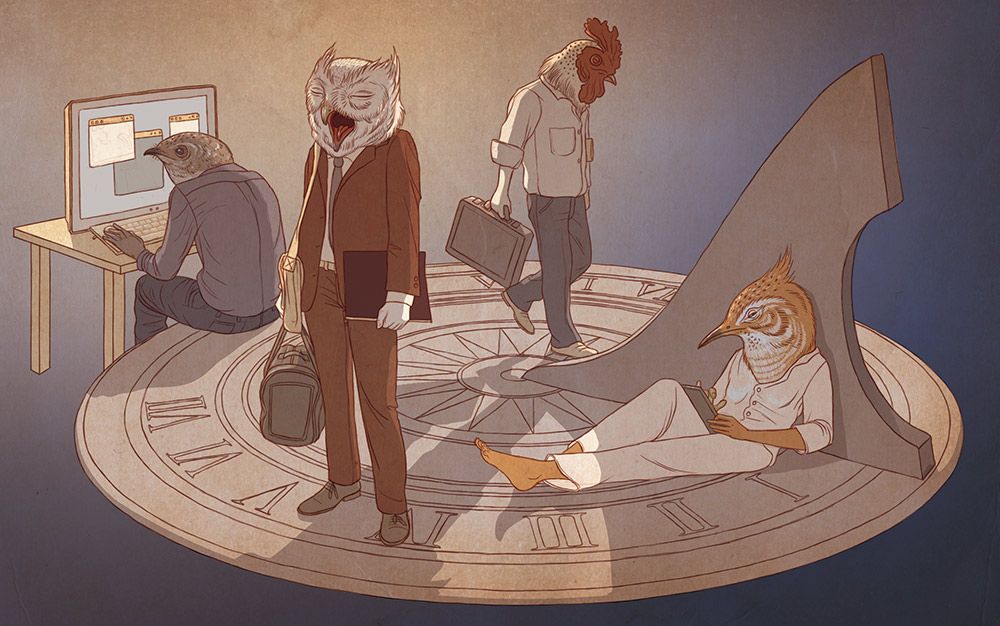
The ticking of the bodyclock can help us fight cancer, safeguard our hearts, time our meals, and enhance our intelligence
It was just a regular shipment of golden hamsters from the breeding colonies, except for one male animal. While all the other hamsters aligned on the shelf in the lab of Michael Menaker, then professor of biology at the University of Oregon, showed a regular 24-hour activity rhythm, the mutant and his descendants lived by a quicker daily pulse. The 20-hour hamsters didn’t live long under 24-hour cycles of light and dark – they died of a kind of perpetual jetlag. But put them in a 20-hour light cycle, and they were fine. In some meaningful sense, the animals’ home was not Earth. They were aliens whose home planet was somewhere out among the stars, rotating every 20 hours.
All life on a rotating planet is ruled by circadian rhythms. Chronobiology research has brought the importance of healthy sleep to the fore, and we have made great strides in understanding jetlag. But if we stop there, we’re missing the larger point, which is that our bodies in all their complexity live and die by the clock. For decades now, scientists have understood that every bodily function is under the control of the bodyclock. In other words, physiology is four-dimensional – we might as well be different animals during the day than we are at night.
Plenty of good science has been done, but the applications of this research, especially in medicine, are just beginning. A particularly promising approach seeks to bring the bodyclock into the clinic through ‘chronotherapy’. While chronotherapy sounds like it might be a kind of technique for righting a circadian system that’s out of kilter, in fact it relies on a functioning rhythm for precision-guided medical interventions. Using chronotherapy, the ticking of the bodyclock can help us fight cancer, safeguard our hearts, time our meals, and even make better use of our brain’s intelligence.
The first circadian clocks originated more than 2 billion years ago, during the Great Oxidation Event. They are found in all plants and animals, and in fact are almost universal in the tree of life. The circadian system works to provide two crucial whole-organism functions, one of which has lost some of its survival value for humans; the other is maladapted to modern lifestyles and causes us untold problems.
Internal clocks help living beings ready themselves for the daily events that are important to their survival: they act as a conduit between the organism and the environment. A bat’s inner alarm clock wakes her at dusk in a cave with no other time cues, and she flies out in time to catch the crepuscular insects that sustain her. Many bacteria shut off their cell division mid-day, regardless of cloud cover, to protect themselves from harmful UV radiation.
Aeon for more